
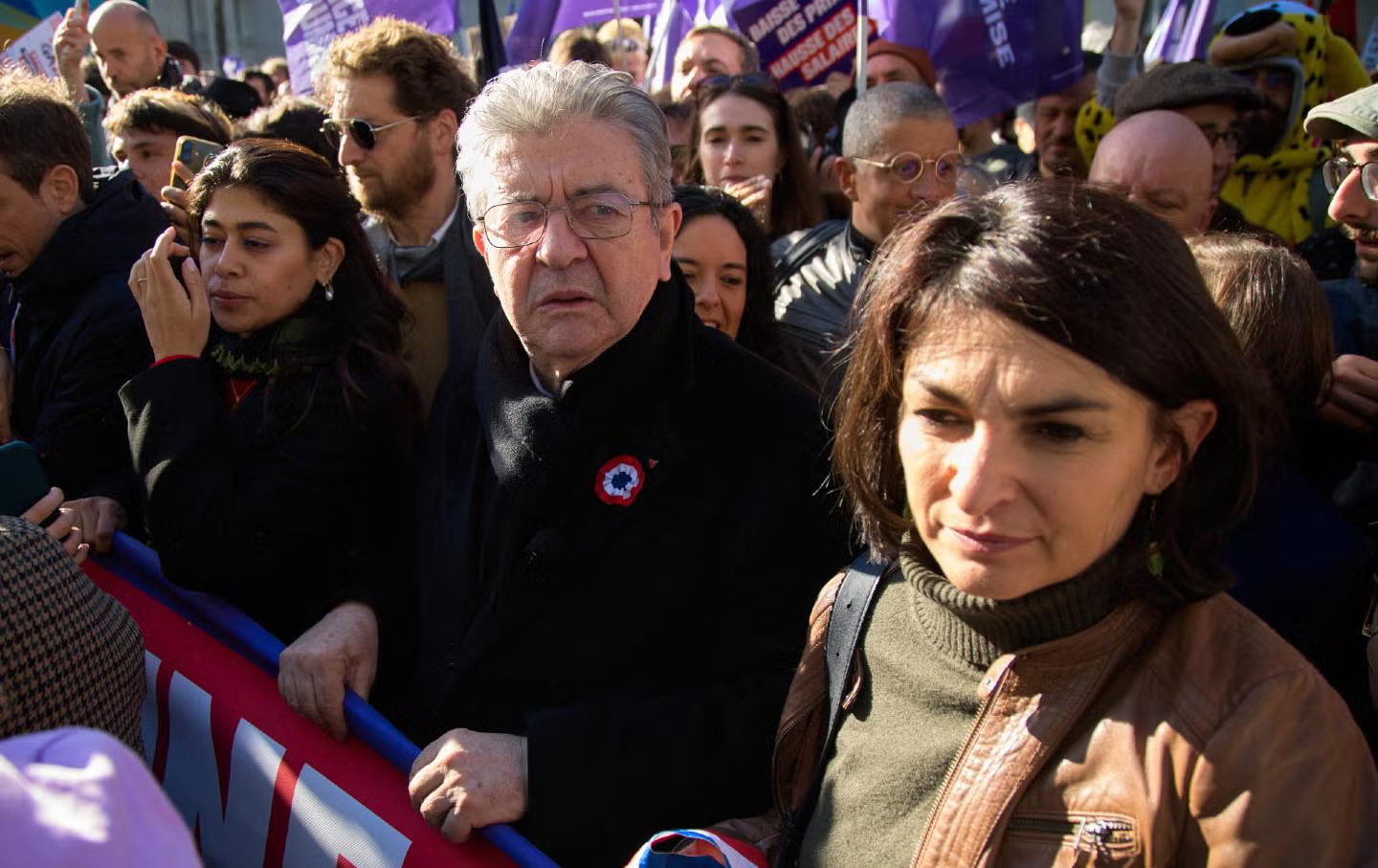
Years of progressive infighting weigh on Jean-Luc Mélenchon’s presidential ambitions.
A lot should be playing in the French left’s favor this autumn. With the country engulfed by one of the most intense cycles of social protest in years, public attention has turned to the needs of high school students and financially stressed households—and away from the culture-war issues that have made the fortunes of far-right firebrand Marine Le Pen. But it most of all adds up to a rebuke for outgoing centrist President Emmanuel Macron, whose erstwhile allies are being forced to run against a legacy that counts fewer and fewer defenders by the day.
“Everyone hates the Macronist regime,” left-wing candidate Jean-Luc Mélenchon told supporters at a campaign rally this Saturday, six months from presidential elections that could well sign the death certificate for the country’s traditional political class. On November 9, Macronist Prime Minister Sébastien Lecornu conceded to an accelerated rise in the minimum wage, the latest bid to calm the anger.
So where does it all leave the left? In many respects, this fall’s crisis is the dreamed-of preelection scenario for Mélenchon’s party La France Insoumise (LFI). Having long billed itself as the party-political companion to French social movements, LFI hopes to emerge as the natural electoral outlet for the pent-up frustration that has spilled onto the streets since September.
“The France of rebellions and revolutions—our dear country, we’re all well at home here,” Mélenchon boasted to the packed audience gathered in Le Bourget, a suburb just north of Paris. “France has reached a boiling point. In demonstrations and then elections, our people are looking for and will find a solution to its problems.”
Current Issue
For LFI, which currently leads the pack of progressive contenders for next spring’s vote, this Saturday’s rally was a showcase for its sprawling policy platform. The party is calling for a radical social-democratic program, including a jump in the minimum wage to €1,700 per month, or just over $1,900. Among the over 1,000 measures in the platform are a massive injection of funds for public services, a lowering of the pension age, price freezes on gasoline and food, and a program of reindustrialization through “ecological planning.”
With France’s budget deficit hitting well over 5 percent of GDP, a platform like this is predicated on confronting the European Union over the bloc’s stringent fiscal rules—something the left-wing force does not shy away from. The party also wants broad wealth redistribution, namely a cap on inheritances at €12 million, or nearly $13.5 million, and the creation of a so-called “Zucman tax,” a 2 percent annual charge on the country’s largest fortunes. Named for the French-born Berkeley economist Gabriel Zucman, it’s France’s version of the wealth tax that California voters defeated in a referendum last Tuesday.
“I only have one thing to propose, something that is ultimately quite reasonable: We must change everything,” Mélenchon summed up on Saturday, arguing that the country needed a politics adapted to what he called a “global crisis of human civilization.”
For the more than 10,000 people in attendance, the November 7 rally was also a reminder that the party knows how to put on a show. Beyond the candidate’s undeniable rhetorical talents, the convention featured a genre-bending display of political communication. Preceding Mélenchon’s headline speech was a video montage of scripted vignettes highlighting the party’s main proposals, scenes that drifted into onstage dramatizations featuring leading party MPs. As far as pedagogical political theater goes, Bertolt Brecht could hardly have done better.
And yet, the palpable enthusiasm among the left-wing base for Mélenchon’s candidacy, his fourth since 2012, is difficult to square with the many roadblocks on the way to power next spring. French progressives are marginalized and divided in a country tilting dramatically to the hard right, as Le Pen’s grip over a wide swath of the electorate shows few signs of giving way.
For the April 18 first-round vote, well over 30 percent are estimated to back the far-right front-runner. That’s a double-digit lead over Mélenchon, who currently finds himself in a distant second place, benefiting from the dispersal of candidates to his right—something that’s likely to change before Election Day. For now, however, the veteran left-winger is ahead of both the weak field of other progressive contenders and even Macron’s centrist and conservative allies, who are caught in their own factional fights and reeling from the outgoing president’s stark unpopularity. The runoff looks similarly dire. Polling has been proven wrong before, but the most drastic predictions have Le Pen leading Mélenchon in a hypothetical second-round vote by over 30 points, a wider gap than Le Pen’s lead over other potential runoff opponents.
The story of how France got here is a long one, and there’s plenty of blame to go around. Most goes to Macron, who has devoted much of his presidency to catering to hard-right priorities on subjects like immigration and public order. Propelled by drastic shifts in France’s media landscape, in particular the sudden rise of a television and news pole owned by hard-right billionaire Vincent Bolloré, the culture of French politics has undergone nothing short of a counterrevolution in the last 10 years.
Popular
“swipe left below to view more authors”Swipe →
But the left has also inflicted far too many wounds on itself. Its current weakness is downstream of the various failed attempts at cross-party coalition building in recent years, starting with the Nouvelle Union populaire écologique et sociale (NUPES) formed after Macron’s 2022 reelection as president. Long gone, too, are the days of the Nouveau Front populaire (NFP), the revamped left-wing alliance that delivered a surprise first-place finish in the snap parliamentary elections called by Macron in June 2024.
Stemming the tectonic shifts dragging France rightward was the best argument for progressive unity. But powerful forces opposed just that very strategy. Mélenchon’s sworn enemy since he bolted from the party in the late 2000s, the centrist Parti socialiste (PS) has lent its institutional stamp to the reckless pillorying of the radical left. This October, the party selected the anti-LFI media personality turned politician Raphaël Glucksmann as its candidate, confirming the center left’s definitive break with the Mélenchonists. Glucksmann and the various center-right figures now battling over the remnants of Macron’s coalition disagree on many things, but they seem to see eye to eye on the spurious idea that “Mélenchonism” represents as grave a danger to the country as Le Pen.
LFI has also painstakingly worked to undermine left-wing unity. Since the crack-up of the NFP and the NUPES before it, the open secret on the left is that the other main adversary of coalition politics was Mélenchon himself, who feared that a durable alliance would evolve into the institutional framework for a multiparty primary that might jeopardize his presidential candidacy. “My aim is not to unify the left,” the candidate told journalists shortly before taking to the podium this past Saturday.
Instead, LFI’s defining strategy has been to maintain hegemony over a left-wing electorate, itself reduced to a shrunken third of the political space amid the tripartite division of the French party system since 2017. There’s plenty of racist dog-whistling in the attempt to discredit Mélenchon’s appeal to what he calls the “new France” represented by the country’s diverse urban areas. But beyond these electoral strongholds, LFI has struggled to build out support in rural parts of the country and in smaller towns, a share of the electorate potentially requiring other types of candidates, messaging, and campaigning than those perfected by Mélenchon and his allies.
On international politics, possible allies have also long accused Mélenchon of foot-dragging when it comes to condemning Russia’s invasion of Ukraine since 2014. After Saturday’s rally, progressive and moderate critics were again up in arms at Mélenchon’s call for a referendum in the Donbas to decide control over the territory, currently largely occupied by the Russian military. Add on top of that the party’s often loose standards for fiery communication, which have landed it in a now-lengthy series of antisemitism scandals. They have had the combined effect of distracting from LFI’s otherwise principled—and often courageously solitary—defense of the Palestinian cause.
“Clarity” is the response from many France Insoumise supporters when they’re pressed on the infighting that has derailed the various attempts at left-wing coalition building. With their standard-bearer now positioned as the left’s lead contender for 2027, they also argue that it’s not too late to make up for lost time. Nonaligned factions in a progressive camp divided between Mélenchon and Glucksmann will have little choice, they claim, but to take sides as Election Day approaches. Then there are the abstentionists. And given Mélenchon’s undeniable knack for debating, many confidently assume that their candidate can trounce Le Pen in a head-to-head debate before the May 2 runoff.
For that matter, Mélenchon has long argued that the breakdown of France’s party system would lead to a decisive battle royale between what LFI calls the “left of rupture” and Le Pen. But if the cards fall hard next spring, one wonders just how much virtue there’ll really be in clarity.
More from The Nation
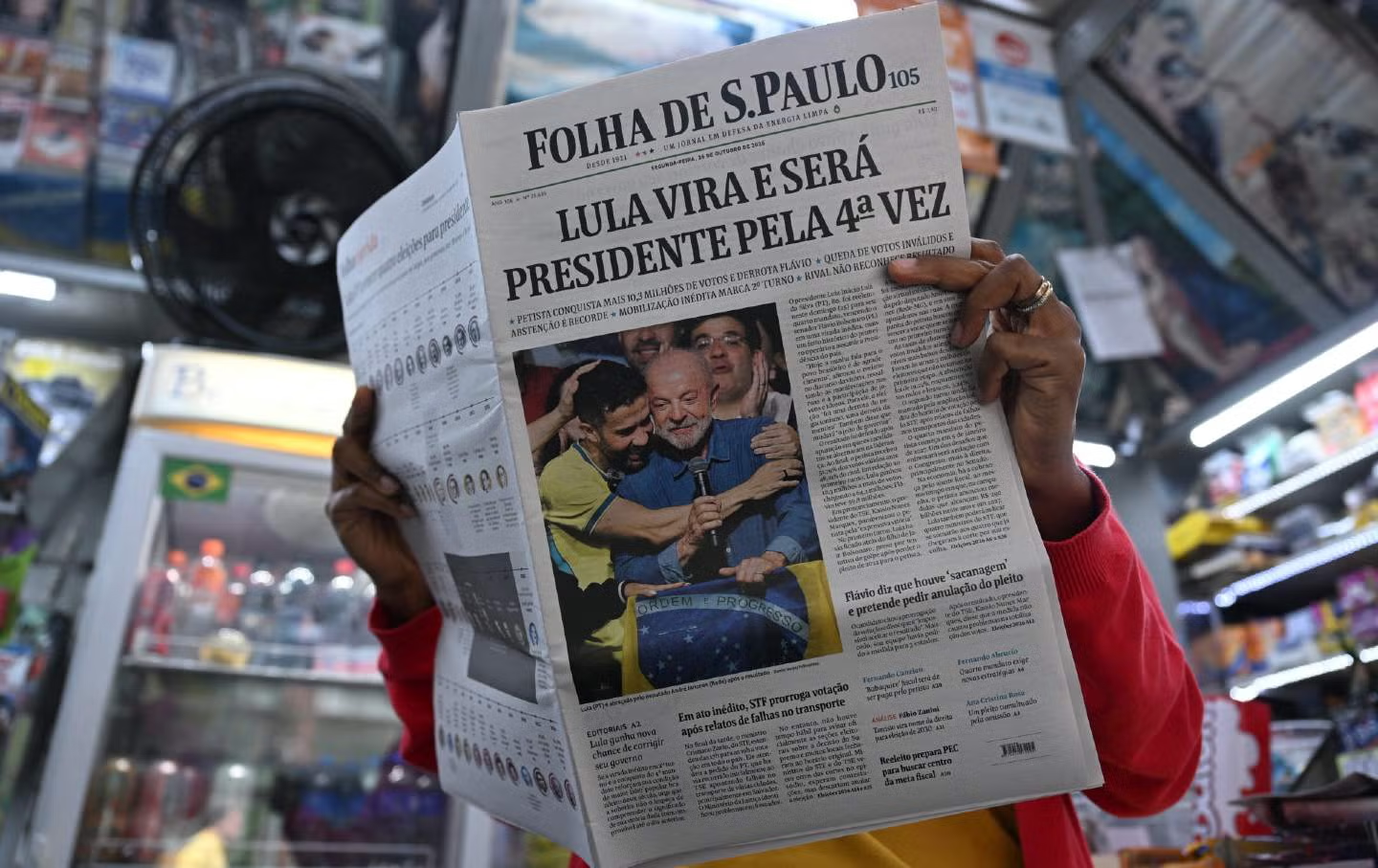
The Brazilian president looked headed for defeat. The Brazilian people had other ideas.

The implications of Trump’s red-carpet rollout for Flávio Bolsonaro.
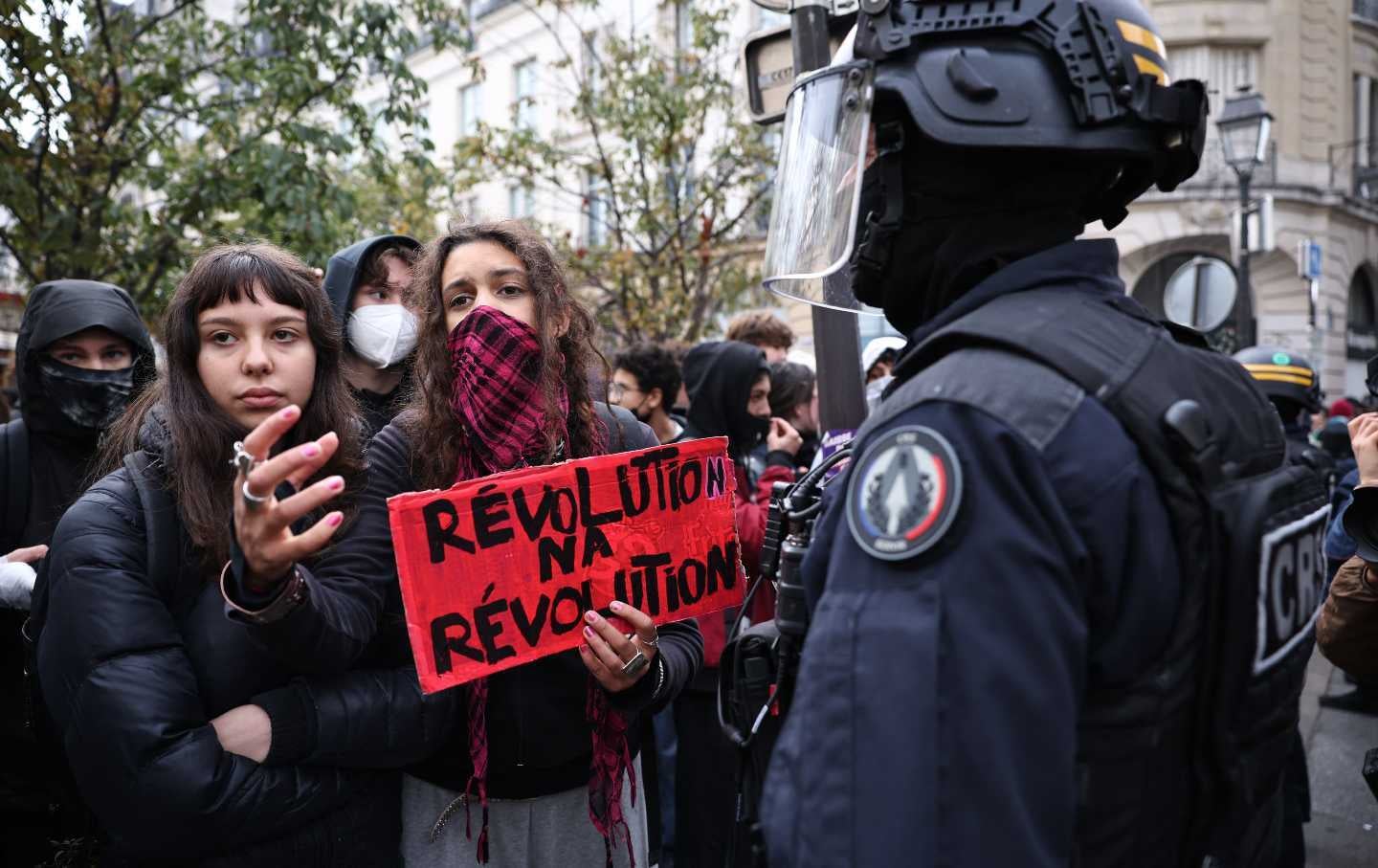
Despite harsh reprisal from the government, students show no sign of stopping.
A leading Brazil scholar predicts that Trump will continue to meddle in Brazilian politics.
In Serbia, the students may have discovered a formula for rescuing democracy through nonviolence and commitment to collectivism. Students everywhere should take note.