
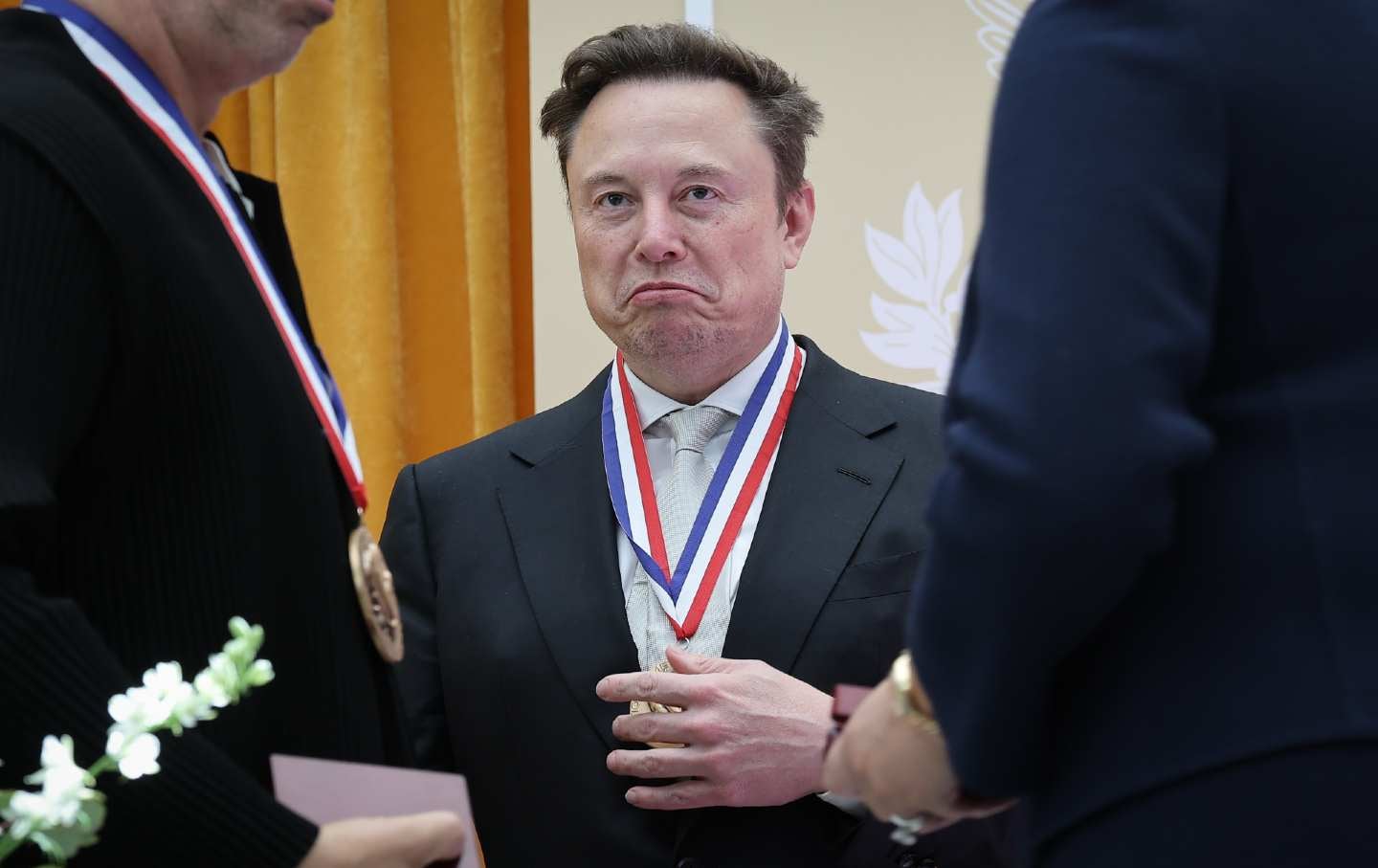
The midterms were more than just a victory for Democrats—they were also a critical blow for democracy, as well as a powerful repudiation of President Donald Trump’s crass authoritarianism and of the Republicans who have enabled his worst impulses. But if we want to enable our still-fragile democracy to thrive again, we need not only to purge it of the baleful influence of MAGA but also to confront directly another dire, and continuing, threat to self-rule: that of the billionaires who are increasingly using their wealth and power to try to override the will of the people. In some cases, our moneyed oligarchy quietly (or not so quietly) bankrolls the worst among the Republicans; in others, it puts considerable rightward pressure on the Democrats it supports.
Do we the people have a chance against billionaire money? We just might, as two case studies from the midterms make clear: James Talarico’s successful Senate candidacy in Texas, and the seemingly failed campaign for a billionaire wealth tax in California.
On the surface, the two campaigns seem to offer radically different lessons. In Texas, Talarico was able to overcome some $200 million in spending from Elon Musk and deliver a decisive victory, one that Talarico touted as proof “that all the money in the world is no match for the people of Texas.”
But it was more than simply people power that enabled Talarico to win; he also responded to Musk’s intervention in the race with a certain shrewdness, ultimately recognizing that in many ways Musk and his money were more formidable opponents than the corrupt and uncharismatic Ken Paxton. (Even Trump, Paxton’s key political supporter, jokingly referred to him as a “pain in the ass” who didn’t know how to dress, or talk, properly.) Given that Talarico was essentially running against a tag team of Paxton and Musk, he made the world’s richest man one of his primary foils in the campaign—thereby turning the millions that Musk directed into the coffers of the Paxton campaign into a political liability. “In all likelihood, if you’ve seen an attack ad on your TV, that was Elon,” Talarico said on the campaign trail. “If you’ve gotten lies in your mailbox, that was Elon. If you’ve received a text message saying scary things about me, that was Elon, too.” Musk, Talarico said, clearly “wants his very own personal United States senator,” one who would do Musk’s bidding in the state where he lives in exchange for purchasing his office.
All in all, Musk spent close to half a billion dollars in the midterms and got close to zero return. Six of his seven Senate picks went down in defeat (with one race still too close to call), and only a small handful of the 43 House candidates he supported prevailed. But it was the Texas race that marked his most significant defeat. Talarico, not surprisingly, sees his victory as a major blow in the battle against billionaires in politics. “We’ve just sent a message to every millionaire mega donor, to every trillionaire mega donor, every corrupt defender of this broken political system,” he declared in his victory speech.
In California, the lesson seemed to be of a rather different sort. The backers of Proposition 40—the voter initiative to ratify a billionaire wealth tax—were unable to fend off a “no” campaign backed by billionaire money. One top staffer of the SEIU–United Healthcare Workers West, the union behind the ballot initiative, blamed the campaign’s likely defeat on “billionaire-funded propaganda” that misled voters.
Current Issue

There was indeed a torrent of such propaganda coursing through California’s airwaves. After the billionaire tax was first put forward by Dave Regan of the SEIU-UHW, a number of the state’s wealthiest residents began strategizing how to defeat it in a secret Signal group chat. Google cofounder Sergey Brin, worth a cool $219 billion even after the dip in Big Tech stock values last week, led the charge, cofounding an innocuously named group called Building a Better California. Brin’s outfit quickly amassed a $333 million war chest, plumped up considerably by a $102 million donation from Brin himself. The group quickly realized that its biggest backers could ill afford becoming the face of the campaign; its own polling showed that “billionaires are seen as having a net negative impact across issues,” as internal documents seen by The New York Times put it. (Ya think?) And so their “billionaire-funded propaganda” starred not Brin himself but an assortment of non-billionaire opponents of the measure, Anti-Prop 40 ads thus featured doctors, carpenters, firefighters, and teachers, and even the Democratic governor of California, Gavin Newsom.
As the casting decisions for these ads suggest, the story of the likely defeat of Prop 40 was far more complicated than a simple blame-the-billionaires narrative would suggest. Regan is a divisive figure, to put it mildly—a publicity-hungry activist who’s considered something of an asshole not only by tech billionaires but also by some Democratic politicians; he has also, more significantly, been credibly accused of bullying and worse by union officials. He pushed the referendum largely on his own, without first making much of an attempt to build a coalition. He also sidestepped (some would say stepped on) an already existing campaign by the California Teachers Association (CTA) for another ballot proposition calling to make permanent an increased income tax on the wealthy (happily, despite all the confusion, this measure has passed). Prop 40 would have directed almost all of the proceeds of the wealth tax toward healthcare—a provision that alienated some union leaders who felt that at least some of the money should have gone to support their members as well. As a result, several leading unions, including CTA and the State Building and Construction Trades Council of California, came out against the tax.
In the end, the SEIU-UHW spent most of the $34 million it raised on gathering signatures, according to The New York Times, leaving only a small fraction of money on hand to counter the massive ad spending from Brin’s group. That enabled the “no” voices to define the terms of the debate. Weirdly, the union spent some of its paltry ad money on perplexing campaigns directed at Planned Parenthood, which had come out against the bill, and Newsom himself. (The anti-Newsom message was featured in ads that didn’t even run in California.) Why they went this way instead of pulling a Talarico and going directly after Brin I don’t know. When you’re fighting billionaires, you need to fight billionaires—not just in general but with great specificity, by name.
It didn’t help that Regan was not himself the best face for the Prop 40 campaign. The controversial and often volatile activist has long had a reputation as a bully. The issue came to a head in September when the press got hold of two investigative reports on his behavior sponsored by SEIU’s national union and its California council that substantiated accusations of threats and bullying of union officials by Regan—and a 2009 physical assault on a woman who was then SEIU California’s executive director. One of the reports concluded that Regan has a “propensity for bullying women and women of color.” (Regan dismisses the allegations as “politically motivated,” ginned up by opponents of Prop 40. A union hearing is set for December.)
And then in the final week of the campaign, as a sort of dysfunctional cherry on top, some 230 of SEIU-UHW’s own staffers went on strike, saying that the union wasn’t negotiating with them in good faith over a raise, derailing the union’s attempts to seal the deal with voters.
In the end, Prop 40 was defeated by more than all this internal dysfunction and a well-funded pro-billionaire agitprop offensive. Voters also appear likely to have passed a poison-pill measure bankrolled by the billionaire’s coalition, Prop 42, that bars future wealth taxes in California. Prop 42’s passage would leave proponents of a California wealth tax in worse shape than if the initiative had never been put forward in the first place. “What a waste of resources and what a squandering of an opportunity,” one prominent supporter of Prop 40 told Politico. “There was no coalition, they pissed off everyone, and so many of those natural allies that would’ve supported it refused.” Billionaires, in California and elsewhere, emerged from the fight not only with their wealth intact but feeling empowered. The apparent lesson for them was that they can win any future battles over wealth taxes by simply sacrificing a small sliver of that wealth to political donations.
Popular
“swipe left below to view more authors”Swipe →
But the ongoing struggle to contain the damage wrought by the superrich is hardly as hopeless as Prop 40’s likely defeat might make it seem. Talarico’s win shows that even the world’s richest man can lose to a charismatic politician who knows how to mobilize the disgust most Americans feel toward the excessive power of money in politics. In Talarico’s case, it certainly didn’t hurt that Musk himself is an odious, cringey edgelord who has almost completely squandered whatever goodwill he once had as a supposed tech wunderkind; his favorability rating, as measured by recent polls, is in the 30s, right alongside Donald Trump’s. But the thing is, most Americans seem to have grown profoundly tired of our billionaire class as a whole; they’re not just sick of Musk. If you start looking at our other billionaires, particularly of the tech variety, you’ll find that some are as widely despised as Musk, if not more so. According to a Reuters/Ipsos poll from last year, Amazon’s bald, newly buff Jeff Bezos had a 29 percent favorability rating; Meta’s Mark Zuckerberg garnered a pathetic 26 percent.
In other words, the people, if not the billionaires, are on our side here. According to the most recent Harris Poll Americans and Billionaires survey, more than half of all Americans think billionaires are a threat to democracy. And they want something done about it: 69 percent say the ultra-wealthy should have less influence in politics, 71 percent think wealth taxes should be imposed on the rich and 53 percent that there should be actual caps on wealth. They’re right on all counts, of course. We just need to do a better job of convincing them to vote as if these opinions matter.
More from The Nation

To win in 2028, Democrats must commit to breaking the power of the Supreme Court.
In places like Wisconsin, campaigns can’t win without seniors. They are the second-largest, fastest-growing, and most reliable group of voters.
Texas is predominantly and pragmatically populist. If the national Democratic Party wishes to conquer the Electoral College for a generation, it will follow the lead of the voters…

Trump just promoted his worst, most dangerous adviser. Get ready for a constitutional crisis.
The Democrats’ congressional leaders have been handed an enormous mandate they have no interest in carrying out.