
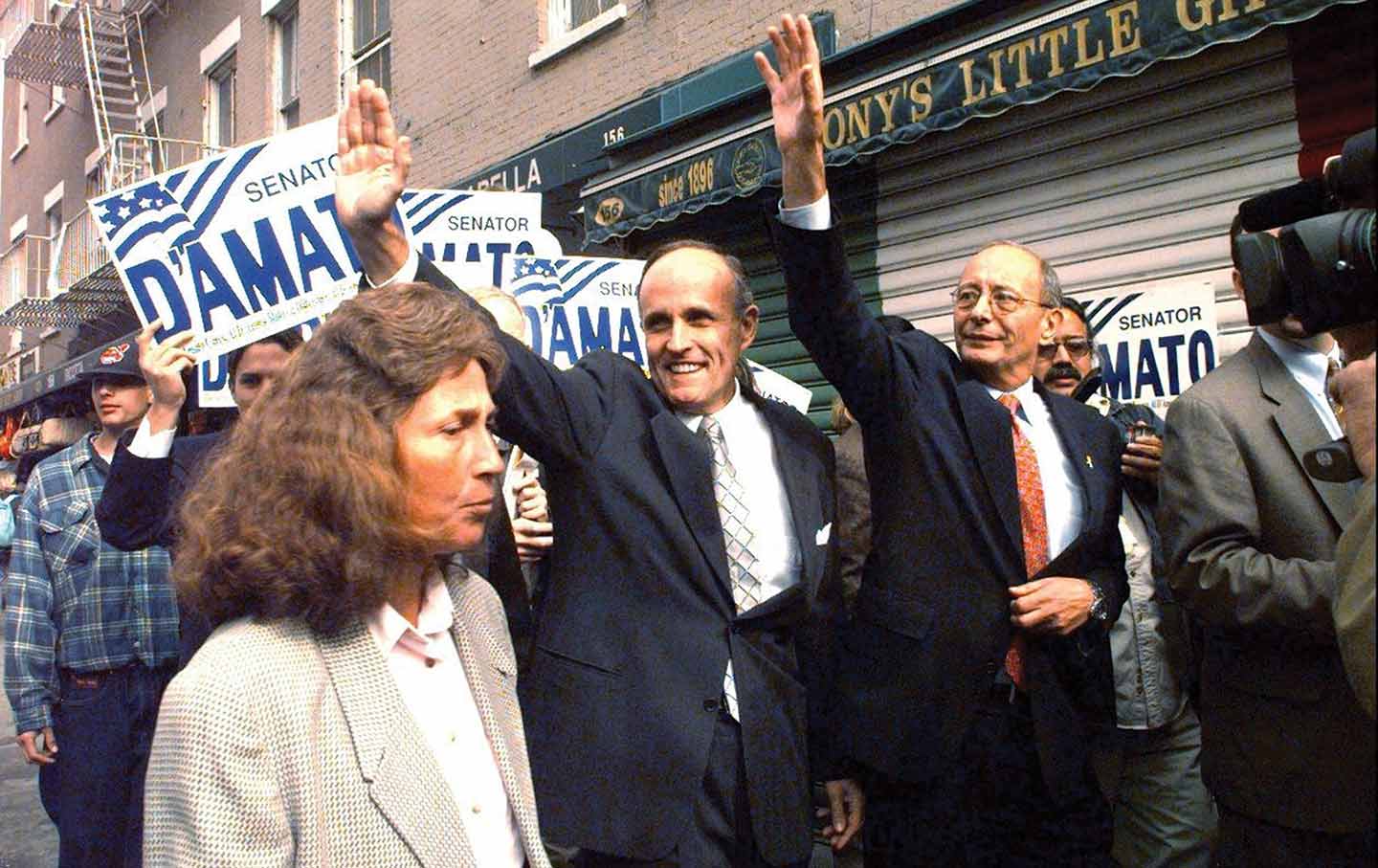
How did New York go from a center of social-democratic experiment to one of neoliberal devastation?
A new history of New York examines how it went from a center of social-democratic experiment to one of neoliberal devastation.
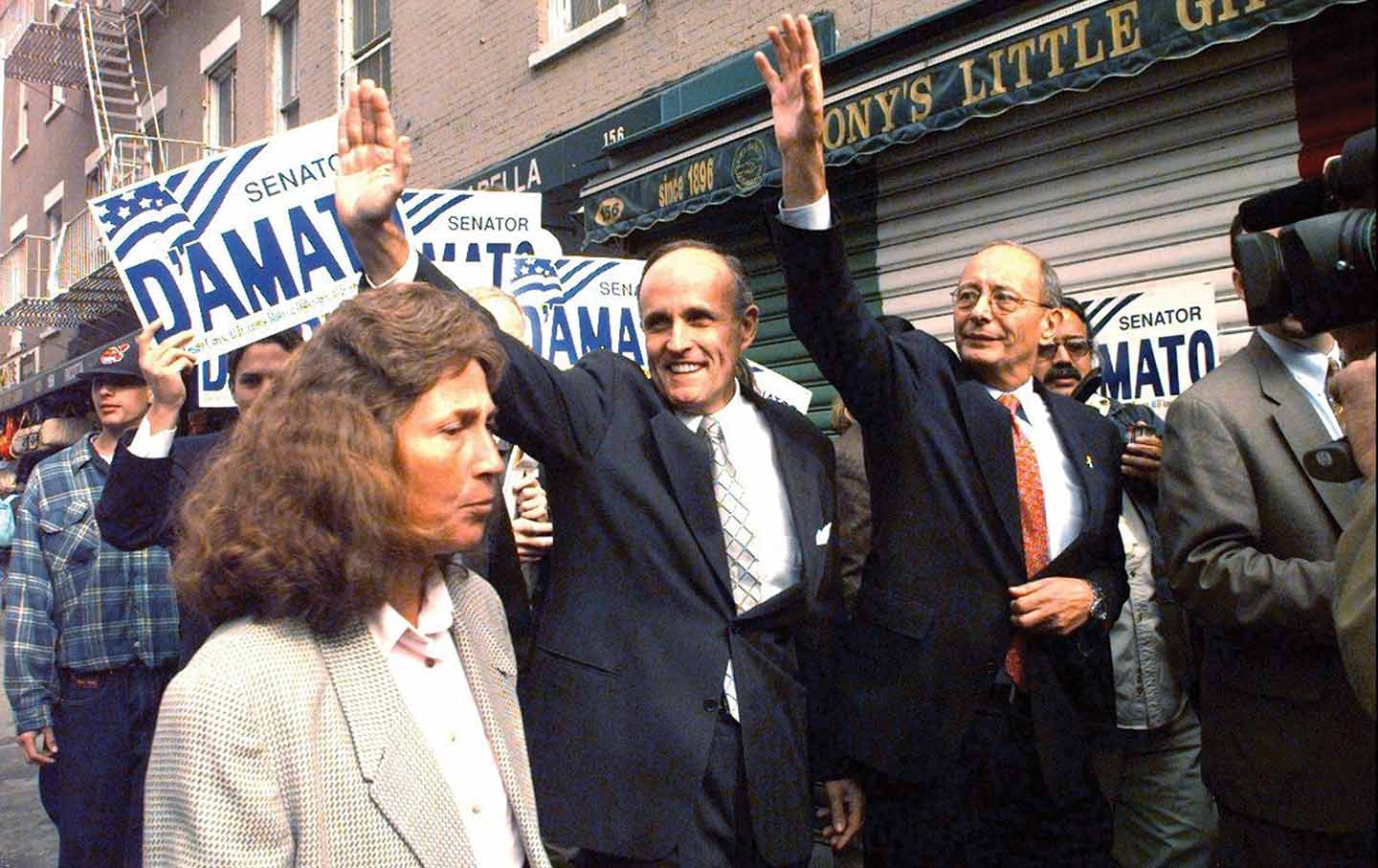
Rudy Giuliani during his bid for reelection in 1998.
(Misha Erwitt / Getty)
In 2013, Mason B. Williams published City of Ambition, in which he told the story of New York’s transformation during the New Deal era, when federal dollars from Washington powered Fiorello La Guardia’s expansive vision for the role of municipal government in everyday life. La Guardia’s alliance with Franklin D. Roosevelt, supported by an expanding labor movement and a network of left and liberal organizations, laid the basis for the New York I grew up in. Federal funds allowed the city to build the high school I attended, the subway lines I spent a lifetime riding, the highways, bridges, and tunnels that whisked me around the city and sometimes congealed me in traffic jams, the innumerable parks, playgrounds, beaches, swimming pools, and health clinics, and the public-housing system that currently has more than a half-million residents.
Books in review
City of Fortune: Inequality and the Making of Contemporary New York
Williams’s new book, City of Fortune, chronicles a transformation just as profound: the post-1970s-fiscal-crisis replacement of the local New Deal order with a New York version of neoliberalism. Williams shows in devastating detail how, over the past half-century, the city’s economy and municipal capacity for governance have grown at the same time that it has developed levels of poverty and inequality unprecedented in its modern history. It is the relationship between these trends—how “the systems that made [the city] work for some imposed costs and violence on others”—that is the central focus of his book.
Williams has digested the vast literature on modern New York, of which these trends are only a part. To it, he has added a massive research effort of his own, in scores of archival collections and publications, giving his volume an authoritative quality. His wide-ranging knowledge might bring to mind comparisons to the late historian Mike Wallace—and they would not be entirely unjust. But unlike Wallace’s encyclopedic accounts of life and change in New York, City of Fortune focuses on three particular issues to tell its story: policing, education, and housing. All three profoundly affected the lives of New Yorkers; all three were political flash points; and all three were intertwined with changes in both material conditions and ideological assumptions.
Like many other American cities in the 1960s and ’70s, New York suffered a massive increase in crime and the sense of danger and disorder that came with it. By the mid-1970s, the New York Police Department had been diminished by cuts in funding and personnel and seemed utterly ineffective in countering the trend. (Those of us who had cars stolen or apartments broken into during those years can remember how the police considered the idea of investigating such crimes laughable.)
But starting under Mayor Ed Koch, a new generation of police leaders and new crime-fighting strategies, many coming out of the academic world, reshaped police activity and remade life for millions of New Yorkers, especially men of color. Pursuing various iterations of “community policing” and “broken windows” theory, the NYPD aggressively combated even minor acts of disorder in neighborhoods targeted as centers of drug activity and crime, arguing that doing so would allow the natural mechanisms of community self-regulation to reemerge.
In the early 1990s, the crime rate in New York began to fall, and it would continue to do so until Covid-19 hit in 2020. How much police strategy had to do with this is unclear, since crime would soon decrease in other cities as well. Still, the NYPD doubled down on its intense policing in high-crime areas, which tended to be neighborhoods with large African American or Latino populations. “Stop-and-frisk” became the favored mode of policing, a practice both deeply racist in disproportionately targeting non-white men for searches without legitimate cause and a clear violation of the Fourth Amendment. Even as crime continued to drop, the city refused to reduce the pressure: In 2011, it recorded an astounding 685,724 stops.
Current Issue

In some precincts, there were more stops than residents. If you were young and Black, the relentless harassment could lead to jail time for petty offenses, job loss, or far worse. The swagger and sense of omnipotence that came with the official veneration of aggressive policing resulted in a series of tragic murders of innocent people by police officers that tore the city apart. Yet, Williams notes, the NYPD would only become more “impervious to reform.”
****In education, the city faced two massive challenges: the extreme racial segregation in its schools (among the worst in the nation) and their failure to provide huge swaths of students with a decent education. Rather than confronting segregation head-on—a politically difficult approach—the city began experimenting with “magnet schools” to draw students from both white and non-white communities to superior schools with superior resources. At roughly the same time, progressive educators like Deborah Meier began creating public schools that broke from the older, more rigid and hierarchical approaches to pedagogy and drew interested students from across relatively broad areas to alternative learning communities.
The idea of school choice, which encompassed both developments, proved ideologically promiscuous: It soon became a favored approach of leftists, liberals, and free-market conservatives. By the early 1990s, it was also the official policy of the New York City Board of Education. New schools (some dubbed “academies”) popped up like mushrooms, both within the regular public-school system and as charter schools, supported by foundation as well as taxpayer money.
Some of these new schools proved to be excellent, although they often created conflicts as they took over the buildings of older schools the way hermit crabs take over the shells of other creatures. They also helped keep middle-class white students in the public-school system—an explicit goal of city leaders. But in doing so, critics argued, they siphoned away resources as well as many of the best teachers and students from the rest of the system and left behind those who could not (or didn’t know how to) get into selective schools. Regardless of the reasons it was initiated, Williams notes, school choice often ended up reinforcing and deepening segregation and inequality.
New York’s housing market was plagued by segregation and inequality as well. “Nothing animated the city’s business community quite like rent regulation,” Williams observes, framing his discussion of housing around the never-ending contest over whether to expand, diminish, or eliminate rent control.
These limits on rent increases—a legacy of federal price controls during World War II—helped preserve a city made up largely of working- and middle-class renters during the postwar years, when America’s other major cities mostly shrank in size and vitality. In 1970, 1.3 million apartments in New York City built before 1947 were covered by the state’s strict rent-control law, while another 375,000 units built later were regulated by a looser rent-stabilization system the city set up in 1968. Rent regulations, by design, limited landlords’ profits and challenged the idea that owners of property had the right to do whatever they wanted with it. Landlords knew there was little point in arguing that they should be allowed to make more money—but the claim that rent control made it impossible to properly maintain their existing buildings and discouraged new construction carried more weight.
In 1971, with the support of Governor Nelson Rockefeller, the New York State Legislature instituted “vacancy decontrol,” which removed the limits on what a landlord could charge for a previously rent-controlled apartment after the former tenant had vacated it. The backlash against this victory for building owners was so intense that, three years later, the Legislature required that apartments leaving the rent-control system be placed, after a onetime opportunity to hike the rent, under rent stabilization, gradually shifting housing from the older regulatory system to the newer one. But rather than ending the battle, the decision simply changed the terrain on which it has continued.
For one thing, the mayor-appointed Rent Guidelines Board, which determines each year how much stabilized rents can be raised, became the object of intense lobbying by tenants and landlords, with hearings that are famously epic, unruly affairs. For another, real estate interests continued to chip away at the system, eventually winning laws that removed apartments whose rent was above a certain cap or whose tenants made more than a certain income (“luxury decontrol”). In 1997, Governor George Pataki and Republicans in the Legislature were set to gut the system beyond recognition, until a massive mobilization of tenants, backed by organized labor, largely forced them to retreat.
Despite how heroically tenants and their organizations have dug their heels in to maintain these restrictions on rent, the housing-affordability crisis in the city has only worsened. The removal of hundreds of thousands of apartments from the rent-regulation system, the failure to build enough new housing, and a growing population have combined to accelerate gentrification and make finding a place to live a nightmare for all but the well-off. “By 2011,” Williams writes, “for the first time in the city’s modern history, the median New York rental household was officially rent-burdened, paying more than 30 percent of its income in rent—and a third of households paid more than half.”
The three stories that form the spine of City of Fortune will be familiar to longtime New York residents, if not to outsiders, but Williams tells them with an impressive combination of lucidity and granular detail. He also makes two very important points about their dynamics that are not often brought out.
The first is the centrality of state politics to what happens in New York City. The system of rent regulation, for example, comes primarily from state law, though city ordinances are involved too. Its fate has remained in the hands of a Legislature made up mostly of people elected outside of the city and governors who looked to the suburbs for swing votes to keep them in office. The mayor may press the Rent Guidelines Board to limit increases on regulated units, but the state, if it chooses, could get rid of the entire system. Tax-abatement programs to encourage housing construction likewise come from Albany, not City Hall. So do charter-school authorizations and many of the regulations (including the testing regime) that shape the city’s school system. More broadly, the ability of the city government to create and maintain programs of all kinds, from policing to transit to healthcare access, depends on legal and financial relationships with the state and federal governments. The city cannot even change its income-tax rates, which are controlled by the state, to the frustration of the current mayor, Zohran Mamdani. Even with a DSA-led campaign to “Tax the Rich,” he failed to win state approval for a higher income tax on wealthy residents or a boost in corporate tax rates, ultimately settling for a modest surcharge on real estate taxes on expensive second homes.
Popular
“swipe left below to view more authors”Swipe →
The second point that Williams stresses is the continuity of public policy across parties and mayors. Though packaged and sold differently from administration to administration, practices like aggressive community policing (including stop-and-frisk) and school choice have proved remarkably durable, even with the mayor’s office occupied by such seemingly dissimilar characters as Ed Koch, David Dinkins, Rudy Giuliani, Michael Bloomberg, and Bill de Blasio. Williams never steps back enough to ask why this is so, though he does mention some factors in passing, including the power of institutional interests like the NYPD and the continuing influence of various lobbies and advocacy organizations.
Williams’s concentration on particular policy areas allows us to see the expanding impact of neoliberalism on everyday life, but it also limits his portrayal of the larger structures of economic and political power that shaped the evolution of the city. For example, the post-fiscal-crisis New York economy is quite different from its earlier incarnation, with the virtual disappearance of manufacturing—once a mainstay—and the increased importance of services, finance, and real estate. The new robber barons in the city, though they may be extracting wealth from across the globe and bringing it into New York, are also more attentive to municipal matters than their predecessors. And they are much more ideologically engaged: Issues like charter schools and school choice have become vehicles for delegitimizing the state and promoting free-market ideas (though when it comes to policing, the same folks are all for strong government).
The 1975 fiscal crisis, widely interpreted by politicians, business leaders, and the press as a verdict on the flaws of expansive egalitarian government, led to years of austerity. It also laid the basis for a consensus on the importance of attracting and catering to wealthy companies and individuals and maintaining an orderly city that would not offend them. This became the new common sense, the hegemonic idea sustaining the power of New York’s financial and real-estate elite. In myriad ways, it shaped public policy no matter who headed City Hall.
What did not happen in the years after the post-crisis recovery is as revealing as what did. While billions of public dollars were devoted to subsidizing high-end office construction, not a single new unit of public housing has been built in the past 35 years. During the same period, cities all over the world have built mass-transit lines or whole new systems; New York added only four subway stops, all serving wealthy Manhattan neighborhoods. As economic inequality and homelessness soared, with nearly one in seven public-school pupils homeless, the government failed to build the housing and provide the services needed for the displaced and resourceless.
City of Fortune is shocking not only for the details it recounts but also for its disturbing picture of the moral and political failures of New York’s leaders. How can a city like New York, with a landscape now punctuated by palaces for the ultra-wealthy—such as the $238 million penthouse that billionaire Ken Griffin counts as a second home—have 420,000 children living below the poverty line? How can a society go so wrong so quickly?
Williams sees some hope in the future and gives us a hint of what that future might look like. Ending his book on an upbeat note, he recounts an October 2019 rally in the Long Island City neighborhood of Queens, where Bernie Sanders, after suffering a heart attack, relaunched his presidential campaign with Alexandria Ocasio-Cortez at his side. In the crowd listening to Sanders’s moving appeal for solidarity across racial, religious, and national lines, Williams writes, was Zohran Mamdani, who had just launched his own campaign for the State Assembly.
Mamdani’s astounding election as mayor and his first months in office suggest that a new era might be beginning in New York. Unlike his opponents, Mamdani has a gut feel for the changes that took place in the city during the years Williams examines: the massive growth of inequality; the daily struggle of so many New Yorkers just to get by; the precarity of even young professionals in fields like higher education, culture, and the arts; and the extraordinary diversity of a city in which over 37 percent of the population was born outside the country (compared with 18 percent in 1970).
For progressives and ordinary New Yorkers, Mamdani is a breath of fresh air. Like Fiorello La Guardia, he is everywhere, filling potholes, shoveling snow, rallying with striking nurses, sharing iftar with city workers, riding his bike with Brooklyn parents taking their kids to school, and sitting in the nosebleed section of Madison Square Garden watching the Knicks. So far, he has been largely successful in avoiding pitfalls and inching toward fulfilling his campaign promises, which included freezing regulated rents, universal childcare, and free buses. But Williams’s account is a cautionary tale about the obstacles he faces: the limited power of the city in such crucial areas as tax policy and education; the fiscal challenges in an era when, unlike La Guardia’s, the federal government is determined to undermine blue-state cities rather than partner with them to better the lives of their residents; and the enormous power of the self-serving financial and real estate interests. It is too early to say if Mamdani and the movement that helped him win office will be able to break the link between the city’s growth and the grotesque inequality that Williams so ably chronicles. At stake is what it means to be a civilized society.
More from The Nation
Peter Mancall’s new book reframes the history of the American continent as a zone of encounters between Native peoples, European empires, and African societies.
To renew the promise of self-government, we must create a politics beyond opposing Trump.
In a rebuke of the Trump administration and its cataclysmic decisions and policies, voters elected record numbers of women into office.

A conversation with the former vice president about the fight for Democrats in the too-long-neglected South.