
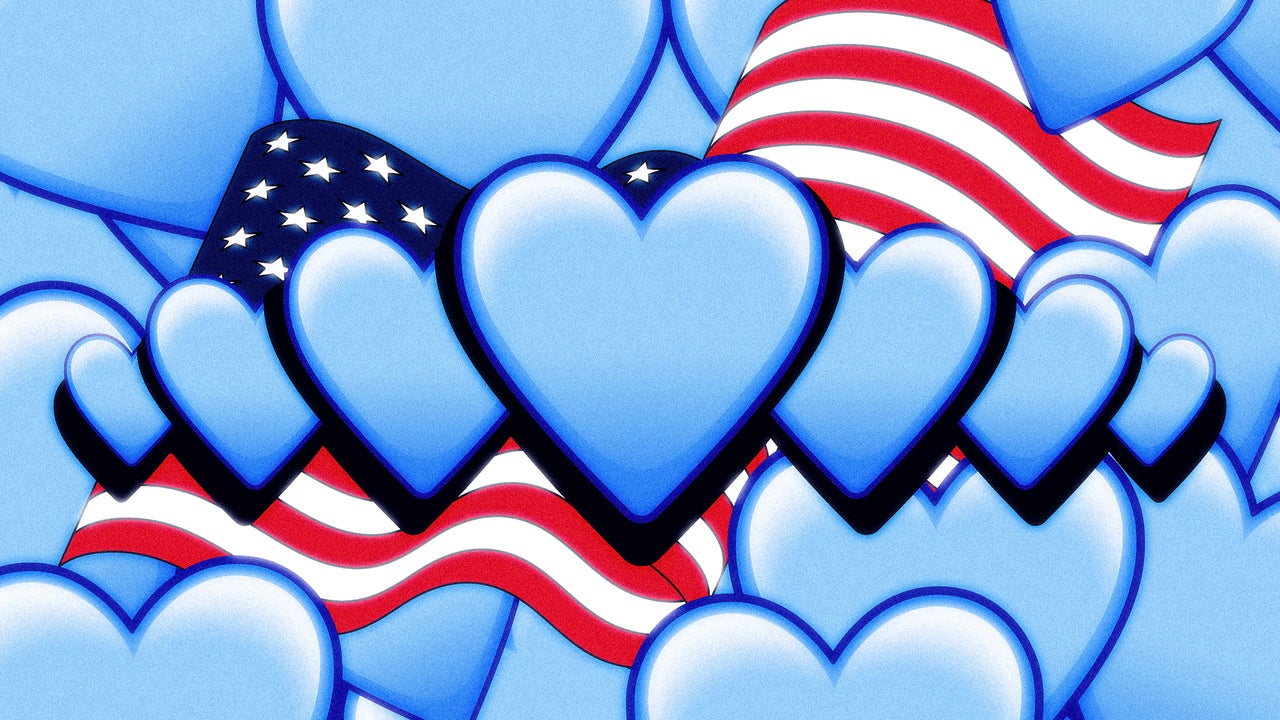
The blue heart emoji is having a moment among those celebrating Democrats’ midterm election results, and while you can clock this in many a comments section, it’s also backed up by stats.
Tinashe, the pop star, used the emoji 12 times in a post on X on Election Day encouraging her fans to vote, writing, “VOTE OR DIE ! LETS GO AMERICA 💙💙💙💙💙💙💙💙💙💙💙💙,” and others have spammed the emoji too in posts “libbing out” in excitement over the midterm results.
Scroll through the comments section on the Democratic Party’s official Instagram account (which posted on the grid nearly 100 times in 24 hours with good news of flipped states and seats) and you’ll see a tsunami of blue hearts. It’s occasionally paired with other emoji expressing joy, like for clapping hands, the U.S. flag, or a wave.
Google searches for the emoji are up 80% from last month, and up 1,050% from the comparable period last year, and they’re highest in Texas and North Carolina, two states where Democrats flipped U.S. House and Senate seats. On Emojitracker, which tracks real-time emoji copies on Emojipedia and GetEmoji, the blue heart emoji outpaced the pink and white hearts by more than two to one on Wednesday. (The red heart emoji, which is used more generally as the standard heart color for love, is the top emoji on the platform.)
Emojis have been adopted to signify political movements or support before, like the emoji for the rose, a longtime socialist symbol that Democratic Socialists of America uses in tweets. During Kamala Harris’s 2024 presidential campaign, her supporters used coconut and palm tree emoji to refer to her widely memed comments about context, and last year, Canada’s Green Party adopted the green dot emoji as its new logo.
Using the color blue for the left-of-center party is a uniquely American quirk of visual political communications. In other western democracies, the colors are flipped, and red is associated with movements ranging from labor to socialism and communism. Mainstream center-left parties like the U.K.’s Labour Party and Canada’s Liberal Party use red as their primary color, while the Conservative parties in both countries are associated with blue.
Before 2000, the colors used to represent a party depended on the TV network, news outlet, and year. But after the weeks-long recount in Florida of the 2000 presidential race between George W. Bush and Al Gore, which played out over cable news and nightly newscasts, the networks standardized the current color schemes, which stuck.
In 2004, the Republican Party formalized red as its color when it rebranded to an all-red “GOP” logo, and during his speech at that year’s Democratic National Convention, Barack Obama, then a senator from Illinois, bemoaned pundits who “like to slice and dice our country into red states and blue states.”
Though the colors had caught on as shorthand for the contemporary partisan divide of conservative rural areas and liberal urban areas, Obama still explained which party stood for which color during his 2004 speech, for listeners who might not be familiar with the terminology. Today, it’s so widely understood that the Democratic Party’s social media posts simply referred to their candidates either keeping or flipping a seat to “blue,” and a string of blue emojis can communicate excitement over Democrats’ big night without saying a word.