
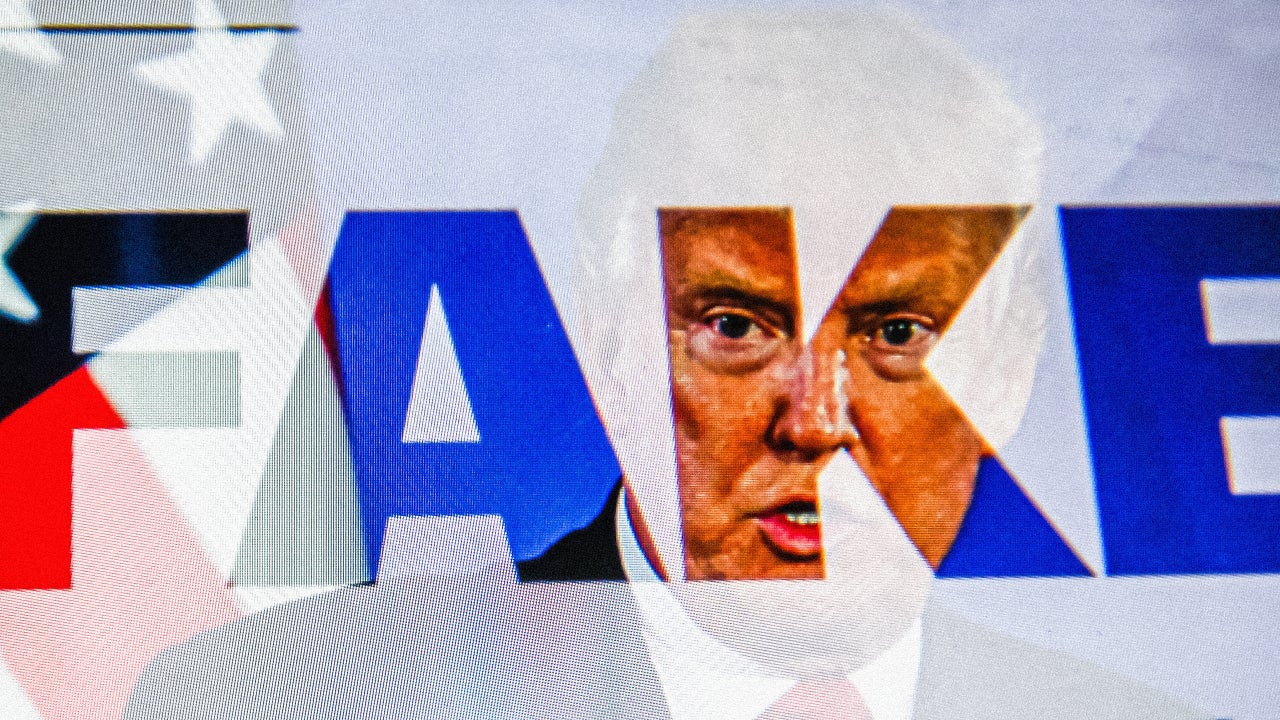
Imagine watching a political campaign video in which a candidate admits to taking a bribe. You recognize the face and voice. But the confession is entirely fabricated, thanks to artificial intelligence.
Now imagine that your state has passed a law against these AI-generated election deepfakes. Would that mean the video has to be removed from the airwaves?
In its June 2026 report, the National Conference of State Legislatures counted 31 states with election deepfake laws. California and Texas enacted their first election-deepfake laws in 2019, but most states adopted theirs in 2024 or later. Among the 31 states, 28 required disclosures. The other three—Maryland, Minnesota, and Texas—prohibited certain election deepfakes, even if the content carried an AI warning.
In many states, a warning telling viewers the content was generated or manipulated using AI can satisfy a government’s disclosure requirement. The fabricated ad can remain in circulation with that warning.
Louisiana, for example, requires AI warnings on certain campaign ads that falsely depict candidates and campaign calls that use artificial versions of public figures’ voices. Maryland, meanwhile, prohibits certain deceptive election deepfakes even when they carry a warning.
I am an AI policy scholar at the University of Denver, where we use an AI policy tracker to monitor bills and laws across the U.S. With 2026 midterm elections approaching, the important question for voters is what protection a deepfake law actually provides, and I examine two state laws—in Louisiana and Maryland—to illustrate the limits of what can be done.
When a warning is enough
Consider a political campaign ad that uses AI to put a candidate’s face onto someone else’s body, making it look as though the candidate said or did something that never happened.
A June 2026 Louisiana law requires a clear warning about AI use in ads that meet these conditions. The rule applies to certain messages urging people to vote for or against a candidate, including printed materials, online advertisements, and broadcasts.
As for videos, adding the required warning can satisfy the disclosure requirement in the Louisiana law. The warning tells voters how the content was made, not whether its accusations are true. It also does not excuse violations of other laws.
A 2023 Republican National Committee ad attacking former President Joe Biden illustrates this distinction. It depicted an imagined future after Biden’s reelection, with a warning: “Built entirely with AI imagery.” Although it predates Louisiana’s law, it shows how a disclosure can accompany an ad without stopping its circulation.
But this protection does not cover every candidate on the ballot. The Louisiana law excludes candidates for federal office. A fabricated video about a congressional candidate, therefore, does not need an AI warning.
For ads involving state and local candidates, leaving out a required warning can have serious consequences. Violators who are found to damage a candidate’s reputation or deceive voters can face a fine of up to $2,000, up to two years in prison, or both. Local district attorneys generally decide whether to prosecute, subject to the state attorney general’s supervision.
Louisiana also requires AI disclosures in certain campaign calls, including robocalls. Under a May 2026 law, calls that use AI to reproduce a public figure’s voice must disclose that use at the beginning of the call. The state’s board of ethics enforces the requirement. Violators can face civil fines of up to $2,500 for a first violation and $5,000 for subsequent violations.
When a warning will not do
Maryland takes a different approach to deceptive election content, prohibiting certain deepfakes even when they carry an AI warning.
Maryland’s May 2026 law covers images, audio, and video created or altered with AI or other digital tools to falsely depict a person in a way that looks or sounds genuine. Adding a label to that fabricated confession would not, by itself, make it lawful.
Whether someone violates the law also depends on their actions and purpose. They must knowingly or recklessly create, use, or spread a deepfake to produce materially false information, with an intent such as influencing a voting decision.
The law separately requires actual or intended harm to a voter, potential voter, or ballot petition, but does not define that harm. Misleading voters about a candidate alone does not automatically establish a violation. A conviction can bring a fine of up to $5,000, up to five years in prison or both.
Maryland also gives election officials ways to respond when false voting information is spread.
The state’s top election administrator must publicly correct credible reports of misinformation about voting procedures, results, or rights. For example, Maryland’s State Board of Elections has a rumor control page to monitor disinformation. The administrator can seek court-ordered removal of misinformation, though not against online services hosting others’ posts.
These powers do not let election officials remove every false claim about a candidate. The public can report election misinformation, and officials can pass those reports to the state attorney general.
Maryland’s reporting system dates to a 2024 law, but its deepfake prohibition and new removal authority took effect June 1, 2026. Neither guarantees that a correction will reach voters before they cast their ballots.
By early September 2026, the Wesleyan Media Project had identified at least 164 political ads nationwide created or enhanced with AI during the 2026 election cycle, accounting for nearly $80 million in ad spending. About 7 in 10 ads carried no AI disclosure, although the count includes uses beyond deceptive impersonations and does not establish how many ads violated a law or misled voters.
Does a warning change anyone’s mind?
Warnings can make people more skeptical of misleading content. However, whether that affects what they share or how they vote is a separate question.
A 2025 study tested warning labels on misleading AI-generated images in two experiments involving 7,579 Americans. People who saw the labels were less likely to believe the posts’ claims. However, warnings that simply identified content as AI-generated did little to change how willing people said they were to engage with it, including sharing it.
Warning labels can also raise doubts about accurate information. Another recent study found that people rated headlines as less accurate when they were labeled as AI-generated, regardless of whether the headlines were true or false. Knowing that AI helped produce something does not tell a reader whether its claims are correct.
Neither study tested whether a state’s disclosure law changes how people vote. The studies also cannot tell us whether the threat of punishment under Maryland’s law discourages people from creating or spreading deepfakes.
Deepfake enforcement
Passing a law also does not settle whether officials can enforce it.
In September 2026, a federal judge temporarily barred Montana from enforcing its deepfake law, finding that it likely posed a threat to a conservative PAC’s free speech rights under the First Amendment.
For voters, gaps in what disclosure laws cover mean that a video without an AI warning has not necessarily passed an authenticity test. The disclosure rule might not cover it, as with congressional candidates under Louisiana’s provision.
Moreover, someone may have ignored the law. A warning’s absence cannot tell viewers of the AI content which explanation applies.
So, back to that video of a candidate apparently admitting to taking a bribe.
It could still reach voters under both Louisiana’s and Maryland’s laws. In Louisiana, a video covered by the disclosure rule can circulate with the required warning. In Maryland, creating or spreading it could lead to punishment if the law’s conditions are not met. Neither approach guarantees that voters will avoid seeing the fabricated confession before casting their ballots.
These laws give states ways to respond to deception, but their passage alone cannot guarantee voters that what they are watching is real.
Stefani Langehennig is an assistant professor of practice at the University of Denver.
This article is republished from The Conversation under a Creative Commons license. Read the original article.
Source link