
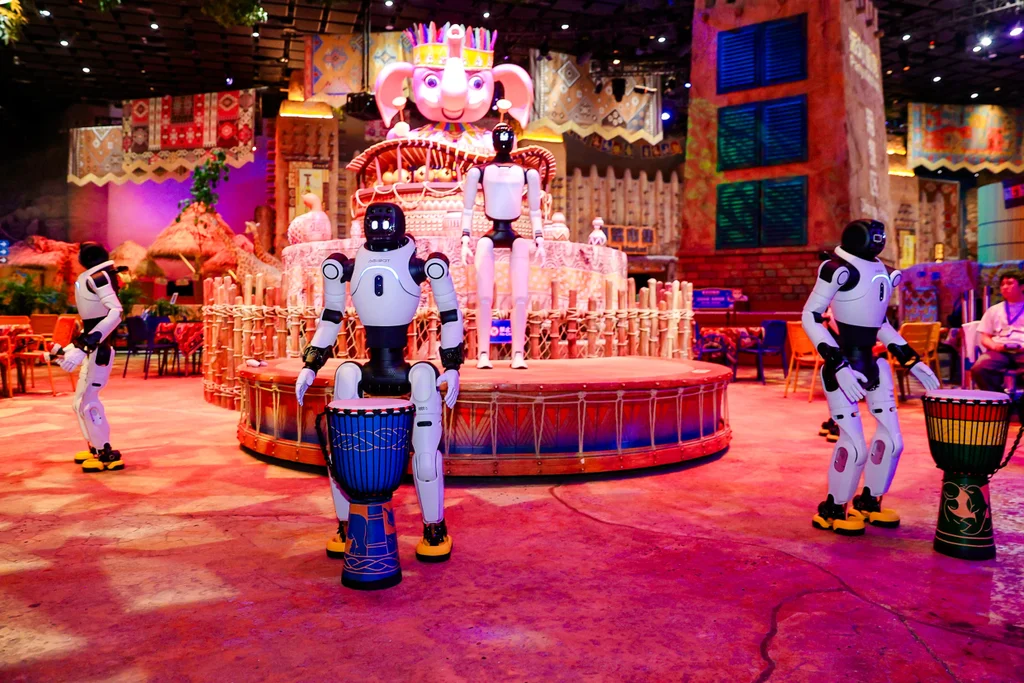
The Chinese robot manufacturer AgiBot just released more than 300 autonomous robots into a theme park to let them mingle freely with the public. It’s the largest deployment of this kind ever. In fact, this embodied AI invasion dwarfs any other public deployment of robots in China. Nothing in the West gets close to it.
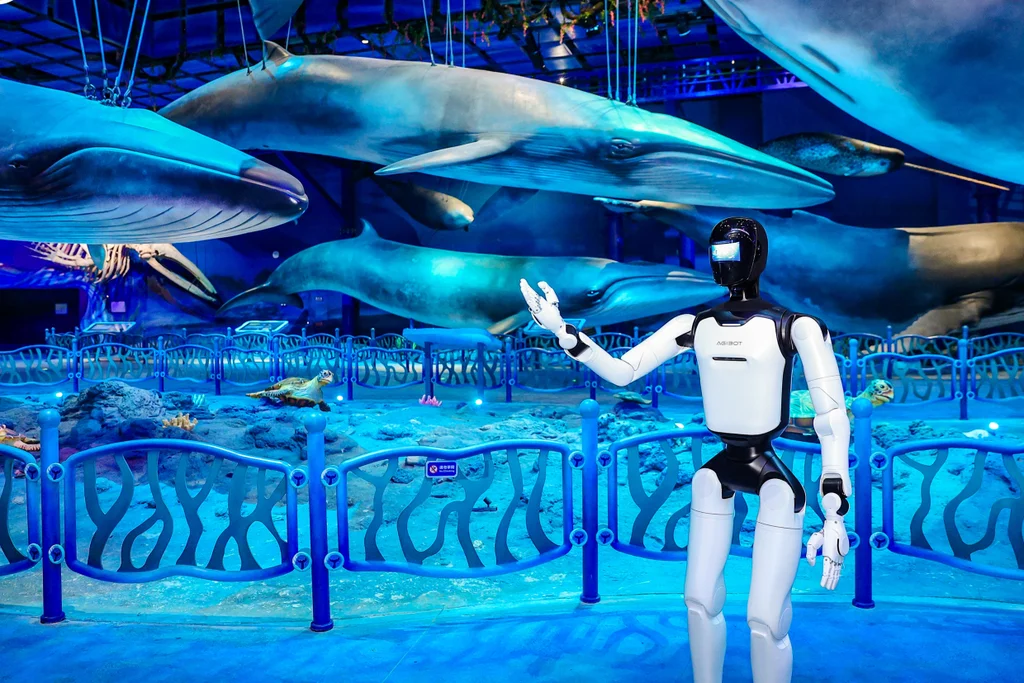
These 300 robo-spartans are now roaming the public walkways and hotels of Chimelong Spaceship Park in Zhuhai, on the Pearl River Delta bordering Macau. It’s a fleet made mostly of autonomous humanoid robots, which interact with families with kids in the park’s walkways, not inside fenced attractions. They can play table tennis, perform martial arts demonstrations, guide lost tourists, and check in guests to hotel rooms.
AgiBot built the fleet with Chimelong Group—a Chinese conglomerate that operates theme parks and luxury hotels—and the telecom company China Mobile. According to AgiBot, these humanoids are now an integral, fundamental part of visitors’ park experience. It’s a preview of a near-future world in which embodied AI becomes part of the human experience, full-time and everywhere, from supermarkets to hospitals.
The implications of this humanoid rollout go far beyond one theme park in southern China. It’s effectively a big experiment to provide humanoids with priceless data on how the world really works. This is vital information for the future of the industry, as embodied AI means putting intelligence into physical bodies that can sense, move, and manipulate the real world. Today, robots’ autonomy is constrained by AI’s limited understanding of reality.
The problem is that you can’t fully validate robots in a lab. You need chaotic, unscripted human environments. And there’s no environment more chaotic than a resort packed with tens of millions of visitors a year, like the one at the Chimelong park. This kind of large deployment puts Beijing way ahead—once again—in the race to control the next big industrial revolution of this century. China already captured roughly 90% of worldwide humanoid shipments in 2025 and more than 97% in the first half of 2026, according to data from Bloomberg. It’s not hard to tell where this is going.
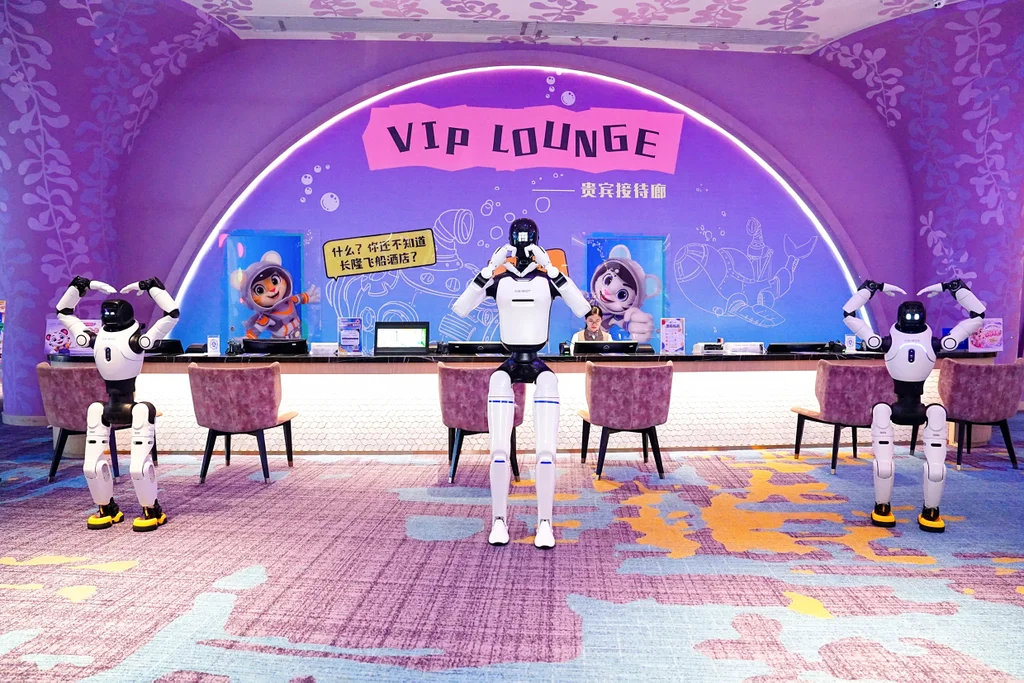
But beyond the global robotics race, the other big story here is the way this deployment can change the visitor experience in theme parks. Just compare AgiBot’s 300-robot fleet roaming the walkways at Chimelong to Disney parks’ current state of robotics. While they were pioneers for decades, the House of the Mouse’s most advanced mechanized characters are only clever remote-controlled animatronics that get wheeled out under constant supervision by handlers and engineers, surrounded by crowd buffers designed to protect both guests and expensive intellectual property. Very cute, but hardly relevant for the future of theme parks (or humanity, for that matter).
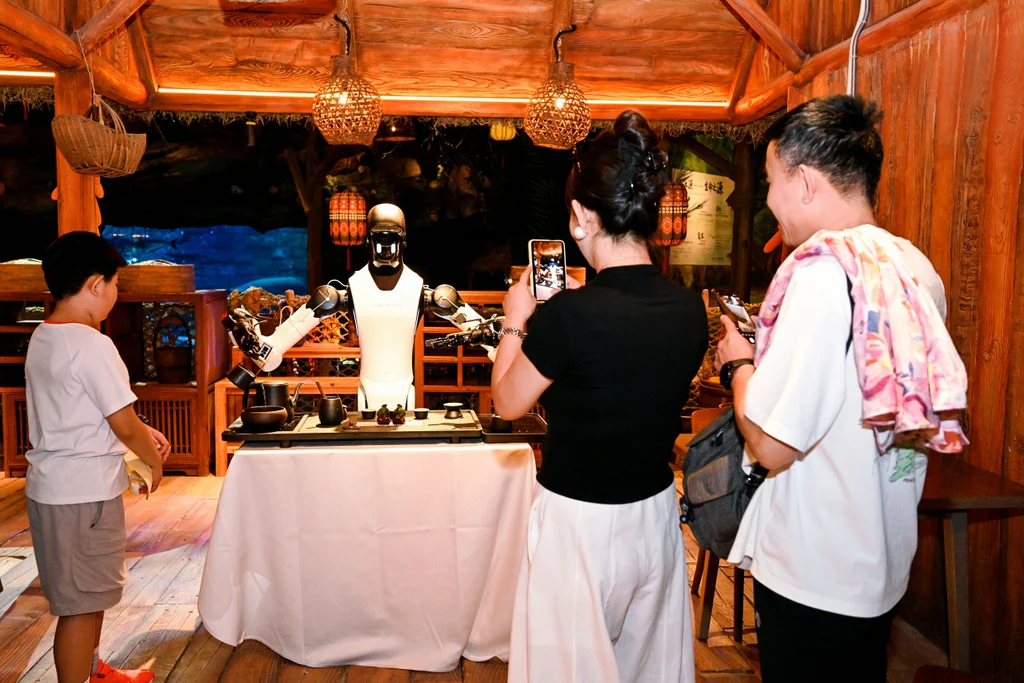
AgiBot’s fleet isn’t confined to a corner of the park or a single attraction. They work at the theme park and they mingle with the public on their own, the company tells me. Not just on a stage. Not behind glass. Not tethered to a hidden rail system or a technician with a joystick.
From illusion to reality
To see why this deployment may be a revolution rather than an evolution, rewind to 1964, when WED Enterprises—the original name of Walt Disney Imagineering—built an animatronic Abraham Lincoln for the New York World’s Fair. That single figure locked in the template the entire theme park industry has followed for six decades. A fixed mechanism wired to a tape loop, incapable of deviating from its programmed gestures by even a fraction of a second. Every classic dark ride since has run on the same logic: Guests move, the machine doesn’t, and a rope line or a boat channel keeps a fixed buffer between flesh and gears. The trick works only because the audience never gets close enough to break it.
Disney has chipped at that formula without ever breaking it. Its walking Olaf—an 88-centimeter, 14-kilogram (2.9-foot, 31-pound) snowman deployed in its Paris and Hong Kong parks in March—keeps its own balance on two short legs and shifts its weight to sell emotion the way an animator would draw it. But Olaf is not autonomous and it never leaves a controlled radius of its operator. The same is true of the prototype droids Disney has tested at its Star Wars: Galaxy’s Edge park area. It’s the same setup as Olaf.
Elsewhere, these tricks repeat at a smaller scale still. Dubai’s Museum of the Future runs a single droid as a conversational attraction. Six Flags experimented with one security bot patrolling park perimeters. Japan’s Henn na Hotel staffed its front desk with dinosaur robots before walking most of them back once real guests, real noise, and real chaos exposed how brittle an unsupervised machine can be outside a lab. Each of these is a pilot program running one robot, or a handful, in a fenced-off corner of a much bigger operation.
Chimelong’s is a fleet built on infrastructure nobody has deployed yet. The robots run on AgiBot’s “three intelligences in one” architecture, fusing locomotion, interaction, and manipulation into a single engineering stack. They’re coordinated through a dedicated 5G-Advanced network built with China Mobile, giving the fleet the low-latency communications to operate as a centrally managed multirobot system rather than 300 independent units bumping into each other. The unit that anchors this launch isn’t just any robot, either: It’s the 20,000th machine Agibot has produced, delivered straight to this project this past September.
Full immersion
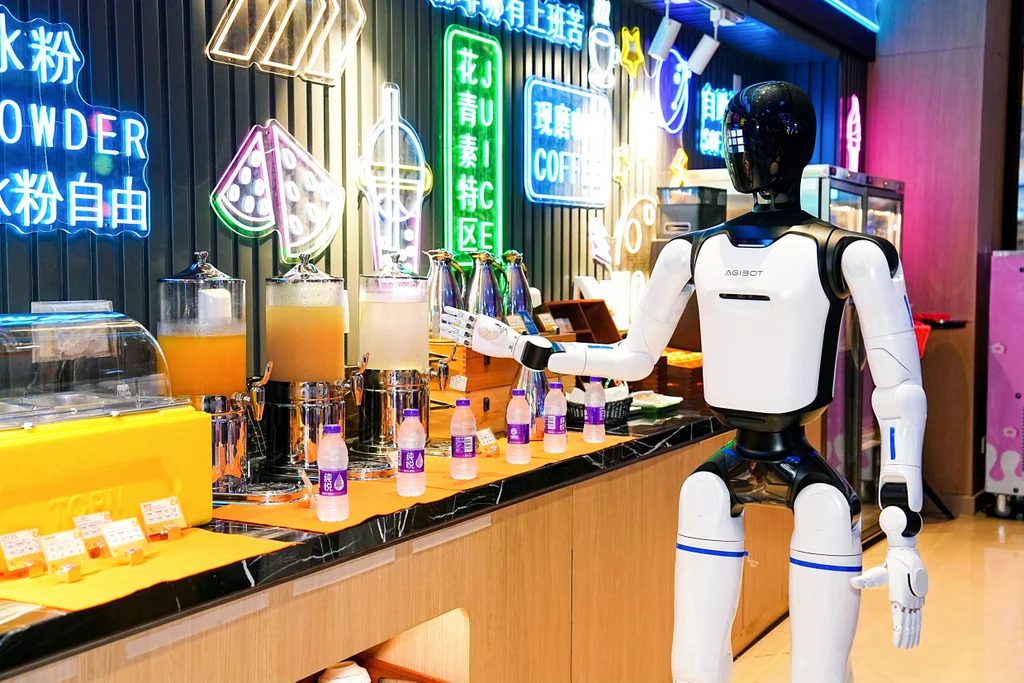
According to AgiBot, its humanoids perform tai chi, martial arts, gymnastics, and table tennis as live exhibitions. They give directions, answer questions, lead tours, and explain exhibits, the company says. They challenge visitors to physical games in which they interact. In Chimelong’s hotels, AgiBot points out that they greet arriving guests, hold multiturn conversations, and tailor assistance to individual travelers. Some even share the stage with human actors under real lighting and live music.
It’s not clear if the robots can pivot from playing Ping-Pong to helping a visitor find the restroom or if they are rigidly set to perform certain tasks. The company told us the robots are meant to provide novel interactive experiences within the park, with a technical team stationed on site for support. AgiBot wouldn’t put a number on that support staff, or say how many maintenance hands it takes to keep 300 autonomous machines running.
On safety, the company was more specific, telling us it has designated interaction zones where robots engage with visitors. The fleet layers active and passive protections like autonomous obstacle avoidance that halts a robot the moment it detects a pedestrian, plus an immediate shutdown triggered by even minor physical contact.
AgiBot confirmed that any data captured by its sensors gets anonymized so a third party can’t identify guests. The data is stored locally under Chinese regulations, but the company didn’t tell us for how long they retain it. I can only assume that they will keep all that anonymized forever, since this deployment will provide huge amounts of priceless data for their future AI world models. AgiBot and Chimelong have already opened a joint research center focused on embodied AI in tourism and cultural venues, and both companies say this is only the first phase of a rollout that will expand across Chimelong’s other resorts and hotels.
They didn’t share other information, like motor torque limits (basically, the strength these robots have to split a human in half), or exact fleet composition beyond “primarily humanoid, alongside some robotic dogs.”
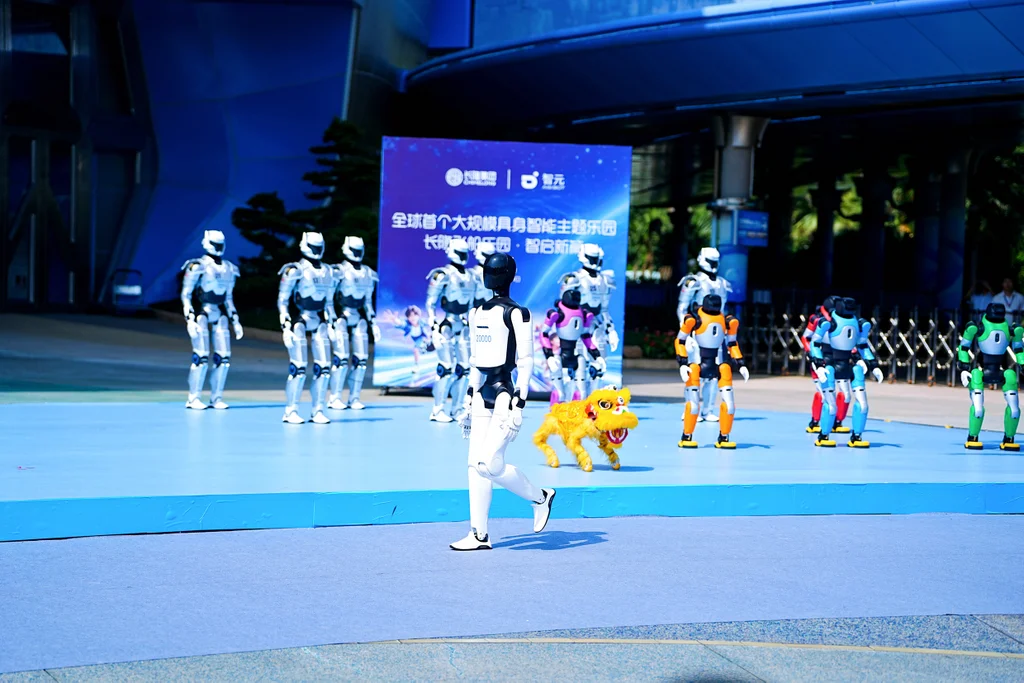
Which brings this back to the real story out of the theme park industry. What separates Chimelong from everything else we have seen so far is its scale and the fact that it’s not a demo. Three hundred robots are already clocking real shifts among real families this week. It’s the leading edge of the same government top-down infrastructure push that’s putting Chinese robots into malls, tourist attractions, museums, and eldercare homes on the way to what the industry keeps calling millions of homes and millions of stores.
Jeff Cardenas, CEO of the robotics company Apptronik, told me in 2023 that he wanted his Apollo humanoid to take on all types of labor you can imagine, from warehouse packaging to the assembly and maintenance of complicated machinery to last-mile package deliveries to supermarket restocking. Retail and public-facing work, not the home, will be the real proving ground for these machines.
It’s been three years since he said that, and we have yet to see any Western humanoid in public, on its own, regularly doing chores of any kind—let alone a mass deployment at Whole Foods or Disney World. In fact, Western technology analysts and robotics experts still predict that we will see humanoid robots regularly working in controlled semipublic and commercial service spaces—such as warehouses, logistics centers, airports, and large retail stores—by the mid-2030s.
Apparently China didn’t get the memo. At least on paper, the future has arrived, faster, and bigger than anyone predicted. Just not in Orlando, Florida.