
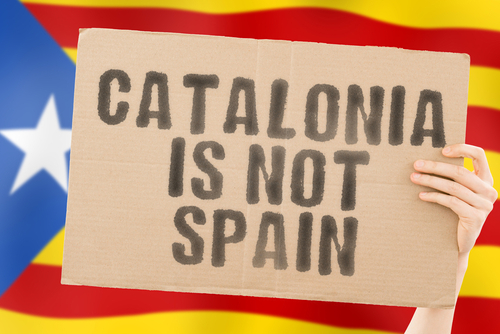
Madrid thought it had crushed the Catalonia independence movement in 2017 when it sent police into polling stations, declared the referendum illegal, removed the regional government, prosecuted separatist leaders, and watched Carles Puigdemont flee Spain. Nine years later, the European Union’s highest court has upheld key aspects of Spain’s 2024 amnesty covering acts connected to the Catalan independence process. Roughly 1,600 people were estimated to potentially fall within the law’s scope. Spain has reached the point where the political establishment is pardoning people associated with a separatist movement it once tried to destroy because the underlying political problem never disappeared.
Months before the referendum, when I had been in Barcelona, I said Catalonia would vote to separate from Spain. I explained that separatism was a process driven by declining confidence in centralized government. By October, Madrid demonstrated exactly how governments strengthen these movements. Instead of permitting a legitimate vote and confronting the political question, it declared the referendum unconstitutional and attempted to stop it by force.


The images from October 1, 2017, should not be forgotten. Spanish police entered polling stations, confiscated ballot boxes, and physically confronted people attempting to vote. The referendum was not a mutually recognized binding vote, and opponents of independence largely boycotted it, but Catalan authorities nevertheless recorded more than two million ballots, with roughly 90% voting for independence on turnout of around 43%. Madrid’s response transformed a constitutional dispute into a demonstration of raw political power.
I argued then that Spain should have permitted a legitimate referendum and negotiated the outcome. Britain allowed Scotland to vote in 2014 and Canada allowed Quebec to vote twice. If a political union truly serves its people, government should not need police to prevent them from expressing whether they want to remain inside it.
Madrid instead imposed direct rule under Article 155, dissolved the Catalan parliament, removed Puigdemont’s government, and prosecuted separatist leaders. Brussels stood firmly behind Madrid because Catalonia represented something much larger than Spain. The European Union is built around political integration moving in one direction toward greater centralization, while separatism represents the opposite force of authority moving back toward nations and regions. A successful Catalan separation would immediately raise uncomfortable questions for Scotland, Flanders, Corsica, South Tyrol, and every other European region with a distinct political identity.
Now look at Spain in 2026. Prime Minister Pedro Sánchez needed Catalan separatist support after the 2023 election, and the amnesty became part of the political arrangement that allowed him to remain in power. The people once treated as enemies of the constitutional order suddenly possessed enough parliamentary leverage that Madrid was prepared to negotiate with them. The EU’s Court of Justice then ruled in July that EU law does not itself prevent Spain from adopting an amnesty, although legal disputes over its application continue.
Calling this reconciliation does not mean the underlying problem has been solved. Catalan identity remains, the political memory of 2017 remains, and the economic tensions remain. Independence parties have lost some of the strength they possessed at the height of the crisis and recent polling has generally placed outright independence below 50%, but separatist movements do not move in straight lines. They strengthen and weaken with economics, confidence, and political conditions.
Catalonia represents roughly one-fifth of Spain’s economy, which makes the economic question impossible to separate from the political one. Madrid views Catalonia as too important to lose, while separatists can look at the same productive capacity and question why taxation, spending, and political authority should remain concentrated in Madrid. When people believe central government provides prosperity and stability, separatism weakens. When they believe government takes more than it provides or no longer represents their interests, independence becomes far more attractive.
This is why the current separatist trend across Europe matters. Scotland, Wales, and Northern Ireland have just seen nationalist leaders coordinate against Westminster. Giorgia Meloni is arguing that greater sovereignty should remain with Europe’s nation-states rather than Brussels. Iceland rejected reopening EU accession negotiations, while nationalist and anti-establishment parties elsewhere are benefiting from dissatisfaction with centralized authority. These movements are not identical, but the common thread is declining confidence in political structures that continually demand more authority for the center.
Brussels has never understood that greater centralization eventually creates the political force for decentralization. Every crisis is used to justify additional European authority over debt, migration, energy, climate, defense, or foreign policy. Yet Europe remains a continent of different nations, languages, economies, histories, and political interests. Those differences cannot simply be legislated out of existence.
Spain may have kept Catalonia on the map after 2017, but keeping territory does not mean restoring confidence. If the crisis had truly been resolved, Spain would not still be debating amnesties, Puigdemont, separatist parties, and the constitutional consequences of what happened nine years ago. Madrid suppressed the immediate rebellion, but it never eliminated the conditions capable of producing another one.
The next serious economic crisis in Europe will test these political unions again. Catalonia will not be starting from zero because it already has the parties, institutions, national identity, historical memory, and experience necessary to revive the independence question. Madrid did not eliminate Catalan separatism in 2017; it merely bought itself time, and economic and political cycles will ultimately determine how much that time was worth.