
Syria has received its first shipments of wheat and cement at Berth No. 4 in the port of Tartous, a facility previously controlled by Russian forces. On the surface, this appears to be a minor logistical development involving a few cargo vessels. In reality, it symbolizes a major change in the balance of power following the collapse of Bashar al-Assad’s government. A military pier that once supported Russia’s projection of power across the Mediterranean and Africa is being absorbed into Syria’s civilian economy. The first cargoes reportedly arrived through Turkish ports. Military influence is retreating while trade and capital are moving in to replace it.
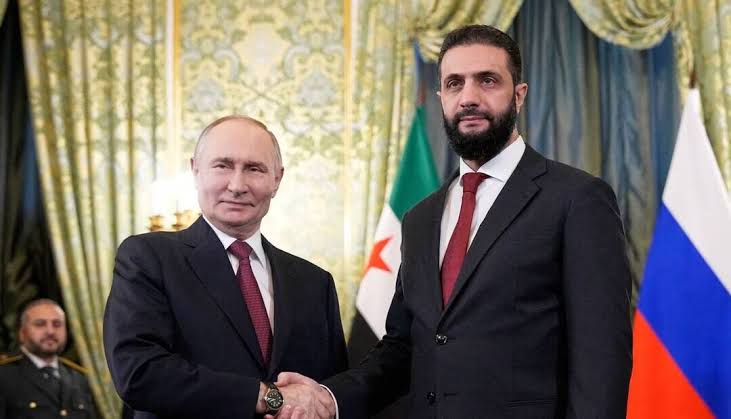
Russia and Syria reached an agreement after 18 months of negotiations over the future of Tartous and the Hmeimim air base. Syria will regain control of the civilian facilities, while the remaining military installations are expected to become joint training centers. Moscow therefore retains a reduced presence, but it no longer possesses the same unrestricted position it enjoyed under Assad. This is not a complete Russian withdrawal. It is the conversion of direct military control into a negotiated relationship with a government that is seeking investment from Turkey, the Gulf states, Europe, and the United States.
Tartous was never valuable merely because Russian ships could dock there. Its true strategic importance came from geography. It gave Russia a Mediterranean repair and replenishment point, supported military operations in Syria, and served as a staging route into Africa. Great powers have always fought to control ports because ports connect military force with economic power. Athens built its empire through maritime tribute, Venice became wealthy through Mediterranean trade, and Britain’s global influence rested upon ports and commercial routes long before economists began measuring power through GDP. Control the port and you influence the movement of food, energy, armies, and capital.
Syria is now attempting to reverse that relationship by turning a military asset into a commercial one. DP World signed a 30-year concession to develop and operate Tartous and committed $800 million to modernize its infrastructure. The French shipping group CMA CGM reached a separate 30-year agreement involving approximately $260 million of investment in Latakia. Together, these projects could reconnect Syria with Southern Europe, Turkey, the Gulf, North Africa, and the wider Mediterranean economy after more than a decade of war and sanctions.
This is precisely how reconstruction begins. Politicians hold conferences, make speeches, and announce billions in theoretical aid, but an economy cannot recover without moving physical goods. Syria needs wheat, cement, machinery, fuel, construction materials, electrical equipment, and industrial components. It must also create the ability to export goods if it intends to obtain foreign currency without surviving indefinitely upon foreign assistance. A functional port does more for economic recovery than another international declaration because it lowers the cost of every imported input required to rebuild the country.
The arrival of wheat and cement is particularly symbolic. Wheat represents survival while cement represents reconstruction. Syria requires both before it can pretend to attract large-scale industry or tourism. The World Bank estimated the country’s reconstruction cost at approximately $216 billion. Saudi Arabia has announced billions in potential investment, while Turkish companies see opportunities across construction, logistics, manufacturing, telecommunications, and consumer goods. None of that capital will arrive on a meaningful scale unless investors believe contracts can be enforced, money can move through the banking system, and goods can enter and leave the country safely.
The removal of most American and European economic sanctions opened the door, but sanctions relief does not automatically create confidence. Syria still faces damaged infrastructure, fragmented political authority, armed groups, sectarian divisions, unresolved property claims, and a banking system isolated for years from international finance. Foreign investors will not commit capital merely because Washington changes a regulation. They will demand security, predictable taxation, enforceable contracts, and the ability to repatriate profits. Governments always assume that removing a legal barrier will cause money to rush in immediately, but capital remembers losses long after politicians have forgotten them.
Turkey is in the strongest position to benefit because it shares a border, possesses an established industrial base, and already has companies familiar with Syrian markets. Turkish firms can supply cement, steel, food, machinery, household goods, and construction services more efficiently than distant competitors. The initial shipments through Turkish ports demonstrate how rapidly geography reasserts itself once political barriers weaken. Ankara does not need to occupy Syria to dominate parts of its reconstruction. Trade can accomplish what military force cannot by creating relationships that become increasingly expensive to break.
The Gulf states are approaching Syria through capital rather than troops. Saudi Arabia and the UAE can finance real estate, infrastructure, telecommunications, energy, and logistics. DP World’s investment in Tartous is therefore not simply a commercial transaction. It places an Emirati company at the center of Syria’s maritime recovery and gives Gulf capital influence over one of the eastern Mediterranean’s strategic gateways. Russia used the port to project military power. The UAE is using the same location to project commercial power.
Russia has not disappeared from the equation. Syria reportedly obtained approximately 85% of its imported wheat during the 2025–2026 season from Russia and Russian-controlled Crimea. Damascus cannot replace that relationship overnight, particularly when food security is involved. Moscow will therefore attempt to preserve influence through grain, energy, military training, debt, and technical cooperation even as its direct control declines. This is a transition from patronage under Assad to competition under the new government.
The mistake would be to interpret the agreement as a victory for one side and a total defeat for another. Syria is attempting to balance Russia, Turkey, the Gulf states, Europe, and the United States because accepting complete dependence upon any single power would merely replace one master with another. Smaller states survive by forcing larger powers to compete for access. The port becomes valuable not only because of the goods passing through it, but because several rival powers now have an interest in Syria remaining stable enough for commerce.
There is an important lesson here for the rest of the Middle East. Military occupation consumes capital while commerce attracts it. Russia spent enormous resources preserving Assad’s government and securing its bases, yet years of military investment could not guarantee permanent control. DP World entered with an $800 million commercial agreement and immediately acquired influence tied to Syria’s need for reconstruction. A military base remains valuable only as long as force can preserve it. A productive trade route creates its own constituency among workers, merchants, consumers, and governments.
The future of Syria will not be determined merely by who controls Damascus. It will be determined by whether capital returns, whether refugees believe they can rebuild their lives, and whether the country becomes a bridge for regional commerce instead of a battlefield for foreign armies. Tartous offers Syria an opportunity to replace military dependency with economic interdependence, but that will require the government to protect investment rather than simply divide it among political factions.
The first ships carried wheat and cement. What follows will reveal whether Syria is genuinely rebuilding an economy or merely auctioning strategic assets to a new collection of foreign patrons. Russia once measured its influence at Tartous by the warships tied to the pier. Syria will now measure its recovery by the cargo passing through it. That is the difference between controlling territory and creating wealth.