
In a private call before his confirmation vote, the AG said Trump officials are working to make the decision ending the national right to abortion “permanent in every single state.”
In a private call before his confirmation vote, the acting AG said Trump officials aim to make the decision ending the national right to abortion “permanent in every single state.”
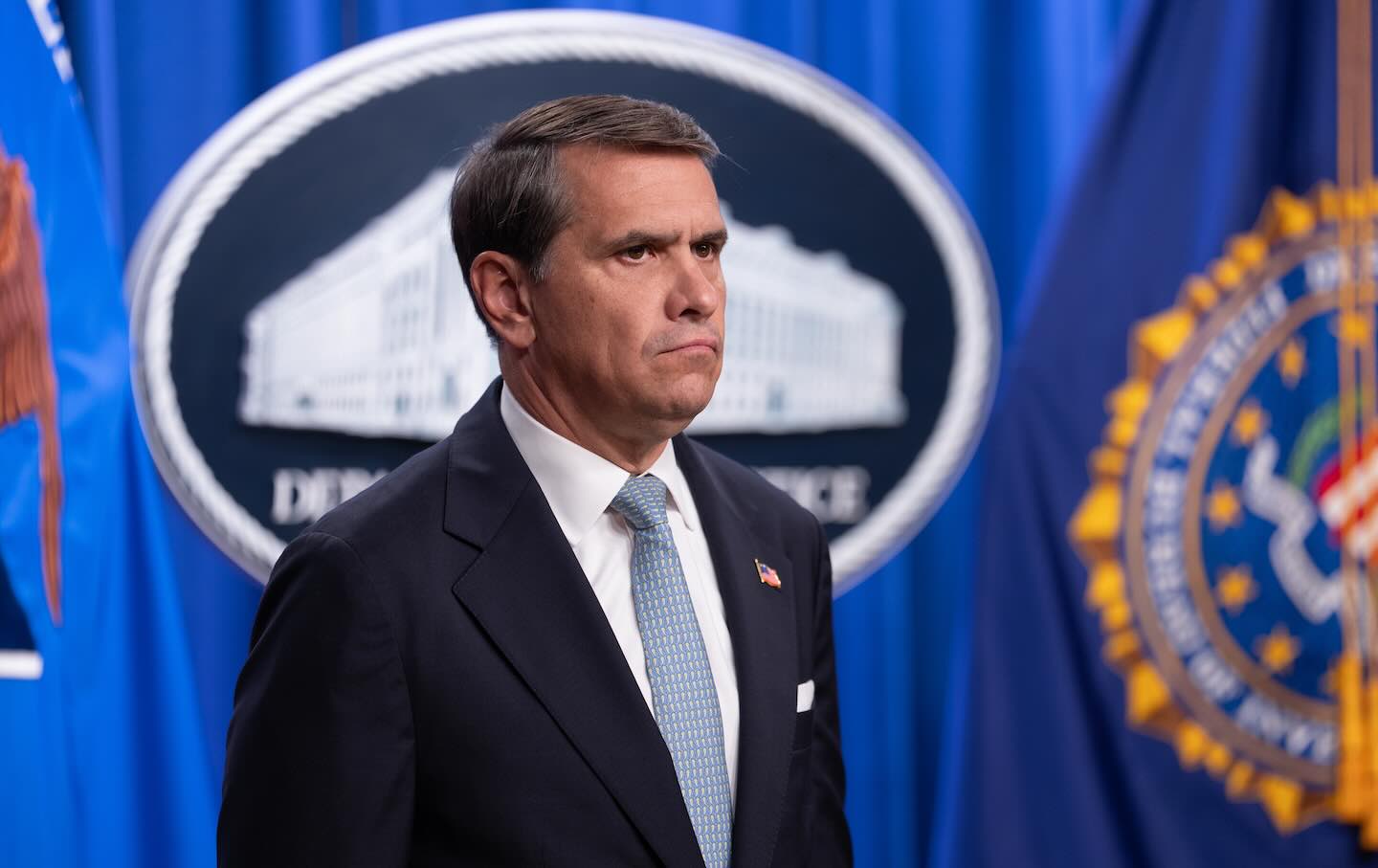
Todd Blanche during a news conference at the Department of Justice in Washington, DC, on August 5, 2026.
(Aaron Schwartz / Bloomberg)
When the Supreme Court handed down Dobbs v. Jackson Women’s Health Organization in 2022, overturning Roe v. Wade, its defenders insisted the ruling was an act of judicial restraint and a decision that returned the question of abortion to democratic majorities in each state. The United States’ top lawyer, Todd Blanche, apparently has other ideas.
On a July 30 conference call hosted by the White House Faith Office —not meant for public ears, though the audio later surfaced on YouTube—the acting attorney general told religious leaders that the administration is working to ensure that the Dobbs decision “becomes permanent in every single state.” He acknowledged that “we don’t have complete victory yet,” but promised the faithful, “Victory will be soon and it will be permanent.”
Blanche seems to have in mind a project that goes far beyond enforcing existing federal law or upholding current state abortion laws. Trump’s pick to lead the Justice Department could use the agency as a tool to impose abortion restrictions on all states, even those that protect reproductive rights through their own democratic processes and state Constitutions.
The primary tool Blanche has signaled deploying is the Comstock Act, an archaic federal law passed in 1873 that made it a federal crime to mail any “thing” to “procure an abortion,” including pills but also any article used in abortion care. For most of the 20th century, the anti-obscenity law lay dormant, superseded by Roe and regarded as an artifact of a bygone and unfortunate era. After Roe was overturned, Biden’s Justice Department issued a formal opinion concluding that the Comstock Act could not be used to impose a blanket ban on mailing abortion medications, so long as the sender did not intend the drug to be used unlawfully, which could be almost impossible to prove.
During his confirmation hearing in July, Blanche, Trump’s nominee and former criminal defense attorney, agreed under questioning from Senators Ted Cruz and John Cornyn to order a review of that Biden-era interpretation. If the Trump DOJ rescinds the opinion, it may be the first step in the agency’s attempting to enforce the Comstock Act’s abortion provisions after 100 years of disuse.
Under Blanche’s leadership, mailing or receiving mifepristone and misoprostol, the two drugs in medication abortions, could result in federal criminal charges. That would not just affect patients in Texas or Alabama. It would affect patients and providers in California, Colorado, New York, Illinois—states that have not only protected abortion but also have expanded access to it. Comstock would apply nationwide, with no exceptions carved out by the act’s text and with a five-year prison sentence for the first offense.
Medication abortion now accounts for the majority of all abortions in the United States. Since Dobbs, mail-order access to abortion pills, dispensed via telehealth providers operating in states with legal protections (“shield” laws), has become a lifeline for patients in states with bans and the predominant way in which they end pregnancies. Shield statutes, now passed in 18 states and Washington, DC, seek to protect providers from out-of-state criminal, civil, and professional attack; eight shield states extend those protections to telehealth for mailed medication abortion. To be clear, no shield law dictates what any other state does regarding its own abortion laws. But Blanche, on the July 30 call, signaled his DOJ also would target those shield laws, particularly those with telehealth protections.
The DOJ, for its part, has tried to walk back the most alarming reading of Blanche’s remarks on the covertly recorded conference call. A spokesperson said his comments about making Dobbs permanent in every state were “mischaracterized” and concerned only mail-order abortion drugs and not, the agency implied, a broader federal takeover of abortion policy.
That clarification raises more questions than it answers. Dobbs said nothing about mailed abortion pills or how states might regulate them. If Blanche’s purpose was to apply existing law, there would be no need for a DOJ review reversing the prior administration’s opinion. The Biden-era opinion is the status quo based on century-old cases interpreting the act; rescinding or revising it is a new policy choice.
His own words on the faith leaders’ call—promising that the administration is “putting practices and policies in place so that other states and other organizations can’t attack” the choices of states with abortion bans—suggests an agenda that sees state-level abortion protections, like shield laws, as threats to be neutralized and a de facto national abortion ban as the outcome to achieve.
This week, the Senate Judiciary Committee advanced his nomination on a party-line vote. Senators Susan Collins of Maine and Lisa Murkowski of Alaska announced that they would vote against him, with Collins directly citing his pledge to anti-abortion groups to prohibit the mailing of abortion medication nationwide, while Murkowski similarly cited “statements that have been made to anti-abortion groups.” But Senator Bill Cassidy effectively sealed his confirmation by announcing shortly after Murkowski’s statement on Friday that he would support Blanche’s nomination.
The confirmation of Todd Blanche as attorney general will represent a new facet of the post-Dobbs landscape. The debate over abortion access has been primarily a story of state-level politics: ballot measures, state constitutional amendments, legislative sessions, and court challenges fought state by state and county by county. That landscape could change.
An attorney general committed to enforcing the Comstock Act would shift the battleground to federal law enforcement, a domain where neither state legislatures nor state courts have the final word. And a DOJ that treats the interstate shipment of abortion pills as a federal crime would, in effect, impose the most restrictive state-level standards on the entire country. A patient in Minnesota whose doctor prescribes pills via telehealth could find that avenue cut off even though abortion remains legal in the state. A physician in Massachusetts, acting under Massachusetts’s shield law, who prescribes remotely to a patient in Idaho could face federal prosecution and jail time.
The elected representatives of states like Michigan, Arizona, and Nevada have chosen to protect abortion access, as have the voters in Kansas, Montana, Kentucky, Ohio, and Vermont. An attorney general armed with the Comstock Act and the resources of the Justice Department could attempt to override every one of those choices.
Whatever one’s view on abortion, enforcing Comstock would be an alarming exercise of federal power against the backdrop of unprecedented executive overreach.
The path for Comstock enforcement is not straightforward, however. No doubt the DOJ will be sued if it tries to revive the act for criminal prosecutions. Searching through the mail for abortion “things” will be expensive, intrusive, and unpopular. And the reproductive rights movement, as it has done since Dobbs, will advance other means to put pills in the hands of people. Still, the reality that abortion cannot be stopped should not distract from why Blanche made his statements in the first place: to find solidarity with, and ultimately direct federal resources toward, an anti-abortion movement that seeks to end abortion everywhere, no matter the costs.