
The Trump administration has chalked up the drop in insurance coverage to a crackdown on fraud. Data shows that rising costs is the real reason.
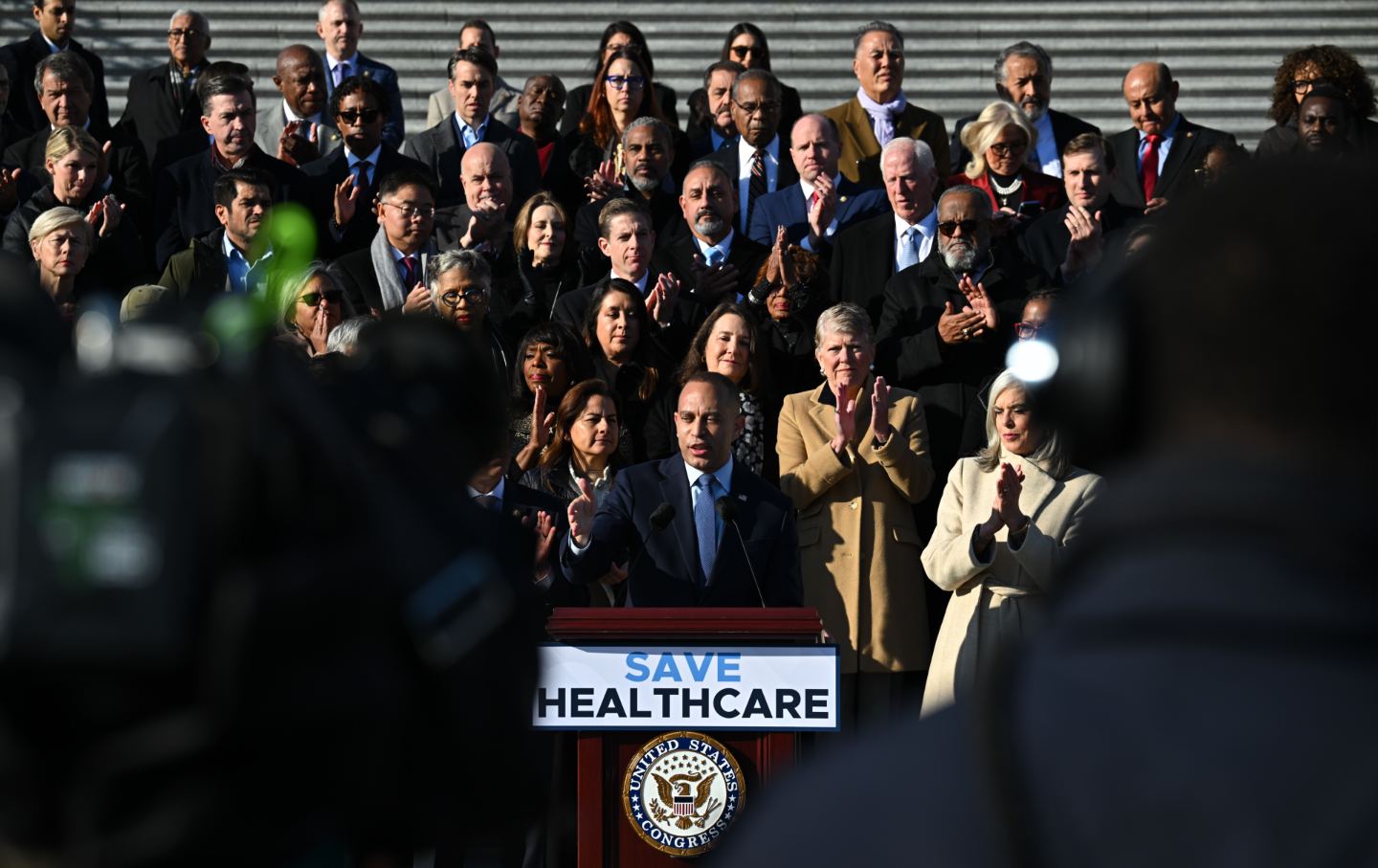
Representative Hakeem Jeffries (D-NY) speaks during a December 2025 press conference on the steps of the Capitol where Democratic lawmakers called for extending expiring Affordable Care Act subsidies.
(Graeme Sloan / Bloomberg via Getty Images)
ReShonda Young, a 51-year-old owner of a health and nutrition supplement store in Waterloo, Iowa, has been self-employed for over a decade. Out of the last ten years, she had employer-based insurance for just one—through her late husband, who passed away three years ago. Every other year, she’s turned to the Affordable Care Act to get health coverage. “I’m really dependent on the marketplace,” she said.
Two years ago, she enrolled in a “gold” plan, the top tier on the ACA marketplace. It was affordable for her—it cost $94 a month with a $1,500 deductible and out-of-pocket maximum of about $5,000—and offered a great network of doctors. “It was just a really solid plan. I was super happy with it,” she said. Then she got a letter last year saying that her premium for her plan would be increasing to $592 a month—a 530 percent increase. “I’m like, ‘Yeah I cannot do that,’” she said.
In 2021, Congress expanded premium tax credits that reduced costs for over 20 million people who, like Young, obtained their health insurance on ACA marketplaces but didn’t previously qualify for the assistance. The subsidies helped more than double enrollment while they were in effect and helped bring the share of Americans covered by health insurance to record highs. But the expansion was set to expire at the end of 2025.
Bipartisan majorities in both the House and Senate supported extending the subsidies, and during debate over HR1, the Republican mega-bill focused on taxes and healthcare, members of Congress proposed amendments to extend them. “HR1 was the obvious vehicle to do that,” Anthony Wright, executive director of the healthcare advocacy organization Families USA, told me. But “the Republican leadership blocked them.” House Democratic leader Hakeem Jeffries successfully brought forward a discharge petition to force a bill extending the tax credits onto the House floor, only to have the measure fail in the Senate.
After Republicans failed to act and the subsidies evaporated this year, premiums have skyrocketed, forcing many Americans to downgrade their coverage. The share of people selecting bronze plans—the lowest tier, with smaller provider networks and the highest out-of-pocket costs—grew substantially, from 30 percent of marketplace enrollees to 40 percent. “People have responded by transitioning to lower-premium plans to try to save money and at least get some kind of coverage, but it’s often difficult for them to get the care that they need when they need it,” said Claire Heyison, health insurance and marketplace senior policy analyst at the Center on Budget and Policy Priorities.
Meanwhile, the share of people who dropped their coverage altogether has shot up. Nearly 3 million fewer people enrolled in and paid for marketplace coverage in 2026 than in 2025, a 13 percent decrease—the largest drop in enrollment since the marketplaces opened up in 2014. Previously, declines in enrollment have “usually been in the low single percentages,” noted Heyison.
Current Issue

The reason for the drop-off “is not rocket science,” Wright said. After huge cost increases in the wake of the expiration of the expanded premium tax subsidies, “It’s not a surprise that millions of people dropped coverage and millions more downgraded.”
Young knew she couldn’t forfeit coverage altogether, especially after being diagnosed with breast cancer a few years ago. “Not having insurance is not an option,” she said. “But the plan that I had also was not an option.” She reached out to insurance brokers to see if she could get an employer plan, but she was told she wouldn’t be able to get anything better than what she could find on the marketplace. So she downgraded to a bronze plan that has a $7,500 deductible and $10,000 out-of-pocket max.
Her co-pays are also more expensive. She now pays $100 every time she goes to the doctor, up from about $20 on her previous plan. “The goal is not to have to go to the doctor,” she said. Her strategy hasn’t worked out so well this year, however. She’s been dealing with a retina problem that required two laser surgeries and a half dozen doctor visits this spring, costing her about $600.
To absorb the extra costs without her late husband’s income to help her, she’s had to make “lots of changes and big decisions,” she said. After 20 years of being a landlord, she’s been forced to sell some properties to make sure “I’ve got enough of a cushion to be able to cover my health.”
The Trump administration has chalked up the majority of the decrease in insurance coverage to cracking down on supposed fraud, claiming in a report by the Department of Health and Human Services that the increases in enrollment during the Biden administration were due to “weakened program integrity safeguards” and enrollment that is “suspected to be improper, phantom, or fraudulent.” But if there is fraud in the marketplaces, Heyison said, it’s mostly brokers and agents who enroll people without their knowledge to make a commission. “Individuals are not typically fraudulently paying for Affordable Care Act marketplace coverage,” she said.
Data suggests that the increase in costs is the root of the problem. A large share of those who dropped coverage this year are the people who no longer quality for premium subsidies. In a survey conducted earlier this year, 71 percent of those who had dropped or switched coverage said cost was the main reason. All states but one have seen declines in marketplace enrollment—New Mexico, the only state to experience an increase, was also the only one to use its own funding to keep the enhanced premium tax credits. Some of the people who lost coverage may be able to qualify for Medicaid or get insurance through their employers, but one in 10 survey respondents said they were now uninsured.
Ellen Allen is still insured, but just barely. The 64-year-old self-proclaimed eighth-generation West Virginian is the executive director of West Virginians for Affordable Health Care, a nonprofit with a two-person staff. Until taking the job three years ago, Allen relied on employer health insurance, but her current organization can’t afford a group policy. Instead, it pays her a stipend that she takes to the marketplace, where she found a plan that she was happy with. She received the expanded premium tax credits, which helped lower her cost so that the stipend covered her out-of-pocket expenses.
That is, until this year. Her premium increased from $479 to $2,000 per month for a plan that offers less and costs her more out of pocket. In order to afford the monthly premium, she dropped her vision and dental coverage. Even so, she’s feeling the squeeze. “It’s taken money out of our household,” she said. She and her wife had started a bathroom renovation, but they’ve since put that on an indefinite hold. They’ve started clipping coupons. They love to travel, but they’ve put off their semiannual trip abroad for the foreseeable future.
Allen has been working since she was 12 and said that she has been looking forward to retiring next year. She’ll be able to enroll in Medicare then, but thanks to how much of their savings has had to go to healthcare costs this year, “We’ll be living pretty close to the bone, even though we’ve saved our whole life to plan for this,” she said. She thinks she might end up having to get a part-time job.
“It was stunning to me that every single person that West Virginia citizens sent to Washington, every single one, abandoned the healthcare needs of West Virginians,” she said of her Republican congressional representatives. “It was stunning to me how little regard they had.”
As they failed to include an extension of the premium tax subsidies in HR1, Republicans enacted changes to the Affordable Care Act that have led to even more coverage losses. One provision prohibits premium tax credits from going to legal immigrants who have had green cards for fewer than five years. New York State had used those tax credits to finance an extension of its basic Essential Plan and expand eligibility for higher-income residents. With this new restriction, however, the state is redirecting some of the money to keep covering immigrants by shrinking the plan’s expansion. That meant that, as of July 1, 450,000 higher-income New Yorkers lost Essential Plan coverage, which represents the most rapid loss of health insurance in the state’s history, according to the Fiscal Policy Institute, which also predicted that most people kicked off will remain uninsured.
Popular
“swipe left below to view more authors”Swipe →
One of them was Lily Fang. Fang had been working remotely full-time for a tech start-up, moving from place to place, until last summer, when she decided to leave her job. She had been spending a lot of time with a partner and friends in New York City, and she needed health insurance, so she decided to officially become a state resident in order to enroll in the Essential Plan. Her coverage was free, with no monthly premium or annual deductible.
Then she got a notice this spring that she was going to be kicked off the plan. She looked into getting other coverage on the ACA marketplace, but it would have cost a few hundred dollars a month for a plan with a $4,000 deductible. She and her partner considered getting a domestic partnership so she could be covered under his employer’s plan, but that, too, was too costly. Fang, who is 30 and healthy, is going without coverage for now. “I’m just trying not to get into accidents,” she said. “It’s pretty stressful.” In the back of her head is an idea to move abroad to one of the many countries that has universal healthcare. She lived in France for a year and speaks both French and Spanish. She and her partner have even discussed getting married to make it cheaper for her to go on his plan. “But I think it feels kind of unromantic to do that for health insurance,” she said.
The turmoil in the ACA marketplace is only likely to get worse. The individual mandate originally included in the Affordable Care Act, a financial penalty for not having health insurance meant to coax everyone to participate in the system, essentially no longer exists after Republicans zeroed it out in legislation they passed in the first Trump administration. As more people drop coverage completely, the ones left behind are costlier to cover. “People with more health needs are more willing to pay the additional price, and people with fewer health needs are willing to go without and take their chances,” Heyison explained. In response to the higher cost of covering sicker people left behind, insurers are already requesting big premium increases for next year on top of this year’s increases. After five years of single-digit rate increases, last year was in the double digits, and next year is looking to repeat that pattern. That, in turn, “leads more people to drop coverage, and the cycle continues,” Wright said. An actuarial firm estimates that enrollment could drop as far as 17 to 26 percent by year’s end.
Republican Senators Susan Collins and Bernie Moreno have proposed legislation that would restore the credits for two years. The proposal has drawn bipartisan interest, but it’s currently being held up over a fight over whether the Hyde Amendment, which bans federal funding for abortion in most cases, should extend to the state-run health exchanges.
“It is tragic that we are rolling back the progress that we showed was possible,” Wright said.
For her part, ReShonda Young has a message for the people in charge who left her with so few health insurance options. “I just wish that our elected representatives, when they’re making decisions, understood and could see the real people behind all the decisions that they’re making,” Young said. “You guys are playing politics with our lives.”
More from The Nation

The lessons from a primary win that can be applied to defeat a Republican in November.

The company is set to sell voter data to ICE in a $125 million deal.

The outcome of the Michigan primaries calls Democratic conventional wisdom into question. Just don’t expect Ken Martin to do anything about that.

Antitrust law exists so that a free press and an open market never hang on the temperament of one well-meaning billionaire.