
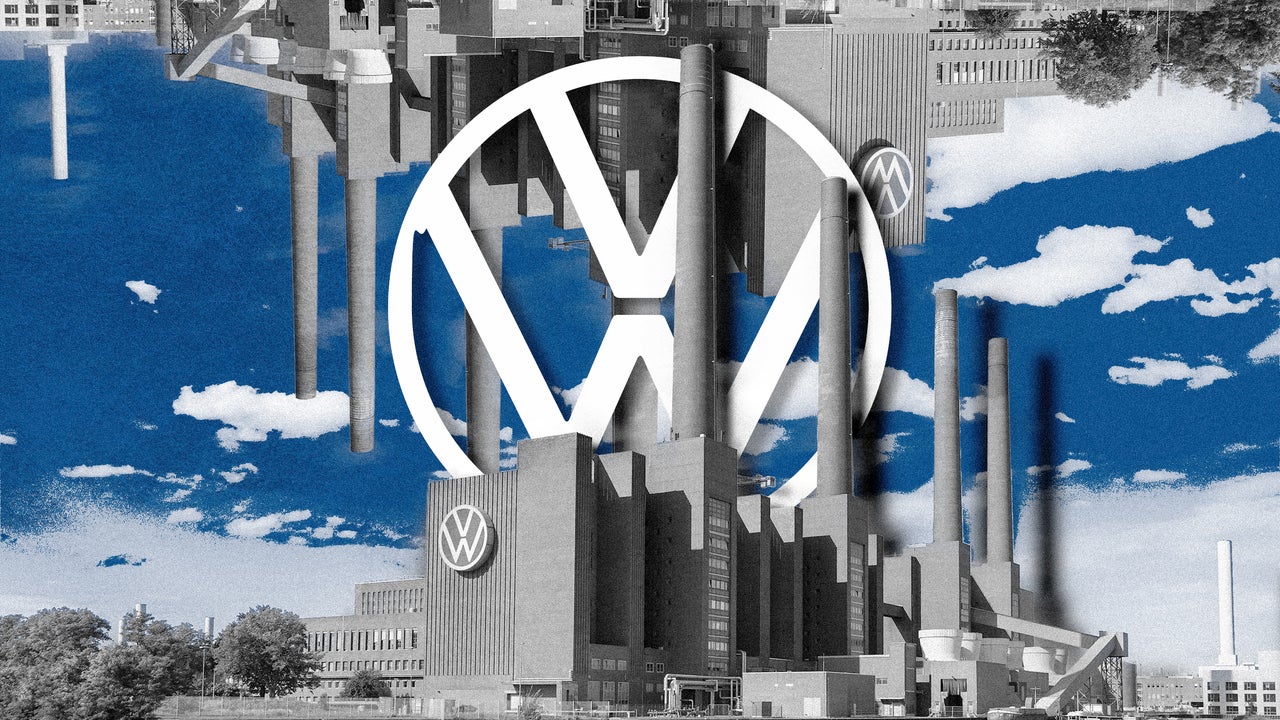
If you want to understand why so many of our industrial giants are in trouble, you could do worse than study what is happening right now in Wolfsburg, Germany. Per The Wall Street Journal, Volkswagen’s leadership is reportedly weighing the most drastic restructuring in the company’s 89-year history: eliminating up to 100,000 jobs (roughly one in six global employees), winding down production at four German plants, and slashing investment by 15%. The unions have promised to fight it “with all our might.” Shares of the automaker’s stock are trading at low levels not seen in 16 years. China, once VW’s profit engine, saw the company’s sales tumble 20% in a single quarter as BYD and its compatriots eat VW’s lunch.
It is tempting to read this as a story about electric vehicles, or Chinese competition, or tariffs. Those are the proximate causes. The deeper story is that Volkswagen perfected a business model for an economy that is disappearing—and kept perfecting it long after the warning lights started flashing.
The employment machine
Volkswagen was never just a car company. It was deeply embedded in the socio-technological frameworks of its time. The concept of the “People’s Car” began in 1934 when Adolf Hitler commissioned Austrian engineer Ferdinand Porsche to design an affordable, mass-produced vehicle for the German public. The company was formally established on May 28, 1937, by the Nazi-controlled German Labor Front.
It was, by design, a jobs machine, a vast, vertically integrated apparatus for converting steel, capital, and labor into mass-market vehicles and mass employment. Volkswagen makes its own components. It runs its own plants. It even makes the sausages served in the company cafeteria. It employs some 657,000 people, anchors entire regional economies, and operates under a governance structure in which the state of Lower Saxony and powerful works councils hold formal power. For decades, this was a strength: Scale bought cost advantage, integration bought quality control, and social embeddedness bought political protection and labor peace.
Here is the problem. Every one of those advantages assumed a particular kind of world: a world of mass markets, where value lived in physical assets, where doing everything yourself was cheaper than coordinating with others, and where the winning move was to produce more of the same thing at ever-lower cost. That world is dematerializing before our eyes. Value has migrated from the physical to the intangible—from the engine block to the software stack, from the dealership to the data, from owning the asset to orchestrating the ecosystem. In the emerging economy, a car is less a product than a platform, and the companies winning in China (as well as from-scratch auto startup Tesla) understood this from the start. They don’t do everything themselves. They center on what matters and let ecosystems do the rest.
Volkswagen, meanwhile, kept optimizing the machine. When your identity is “we make everything, everywhere, for everyone,” every proposal to stop doing something feels like betrayal. So nothing gets stopped. The result is a company that is simultaneously everywhere and centered nowhere.
We are living through a turning point—literally
The researcher Carlota Perez has shown that every technological revolution follows a similar arc: a frenzied installation period in which financial capital pours into the new infrastructure, then a crisis, then a turning point at which institutions reorganize around the new technologies, and finally, a potential golden age of deployment. By her framework, we are at precisely such a turning point now—the moment when the assumptions of the old production regime stop working and the logic of the new one takes over. Even the Bank for International Settlements, hardly a hotbed of revolutionary sentiment, used its most recent annual report to signal that the old macro-financial order is giving way to something structurally different.
Turning points are brutal for incumbents built on the previous paradigm’s logic, because the very things that made them great—scale, integration, standardization, mass employment—flip from assets to liabilities. Volkswagen’s crisis is not a management failure in the ordinary sense. It is what it looks like when a mass-production-era institution collides with a dematerializing economy. The tragedy is that the collision was visible years in advance, and the company’s governance structure was purpose-built to prevent an effective response.
Cost-cutting is not a strategy
Which brings us to the restructuring plan. Cutting 100,000 jobs and closing four plants may well be necessary. It is emphatically not sufficient. A smaller version of the same machine is still the same machine. The question Volkswagen’s leaders should be asking is not “how much smaller do we need to be?” but “what is our center?”
Strategic centering—the idea I’ve been developing in my forthcoming book—holds that in a dematerializing economy, sustainable advantage comes not from what you own or how big you are, but from a clear organizing center that does three things. First, it bounds your opportunity set, so you know which of the infinite possibilities in front of you are yours to pursue and which are not. Second, it resolves capital allocation, so resources flow to the center rather than being squandered across legacy commitments. And third, it enables permissionless action, so people deep in the organization can move at market speed because they know what the company is for, without waiting for a committee in Wolfsburg to bless every decision.
Measured against those three functions, Volkswagen’s current predicament comes into sharp focus. Its opportunity set is unbounded—10 brands, every segment, every geography, every technology bet hedged. Its capital allocation is resolved politically rather than strategically, which is how you end up investing billions everywhere and decisively nowhere. And permissionless action is close to impossible in a structure where labor representatives, regional government, and family shareholders can each veto change. Contrast that with Bayer’s Dynamic Shared Ownership experiment, which—whatever its growing pains—at least recognizes that a 20th-century hierarchy cannot compete at 21st-century clock speed.
What a centered Volkswagen might look like
I don’t pretend to know what Volkswagen’s center should be—that is a choice only its leaders can make, and making it thoughtfully will be crucial if the company is to survive. But the reported plan to separate the core VW brand from the components business hints that someone in Wolfsburg is beginning to think this way. A centered Volkswagen might decide it is fundamentally a mobility software and experience company that contracts for manufacturing scale. Or a manufacturing ecosystem orchestrator that supplies the world’s carmakers, including Chinese ones. Or Europe’s champion of affordable electric mobility, full stop. Each of those is a defensible center. What is not defensible is trying to remain all of them at once, minus 100,000 people.
The choice will be agonizing, because choosing a center means grieving for the things you will no longer be. That is why companies at turning points so often reach for the restructuring playbook instead: Head count is quantifiable; identity is not. But the arithmetic of cost-cutting only buys time. Boeing went from a centered engineering-excellence operation to one where cost-cutting and financial engineering dominated. The results were literally tragic.
Volkswagen still has enormous assets: engineering depth, brand equity, manufacturing craft, and—not least—a crisis severe enough to make real change discussable. Turning points, for all their pain, are also the moments when institutions get to choose what they will become. The window is open in Wolfsburg. It will not stay open long.