The Palmetto State will let primary voters nominate Graham’s successor. Maine, on the other hand, is letting a party convention pick Graham Platner’s replacement.
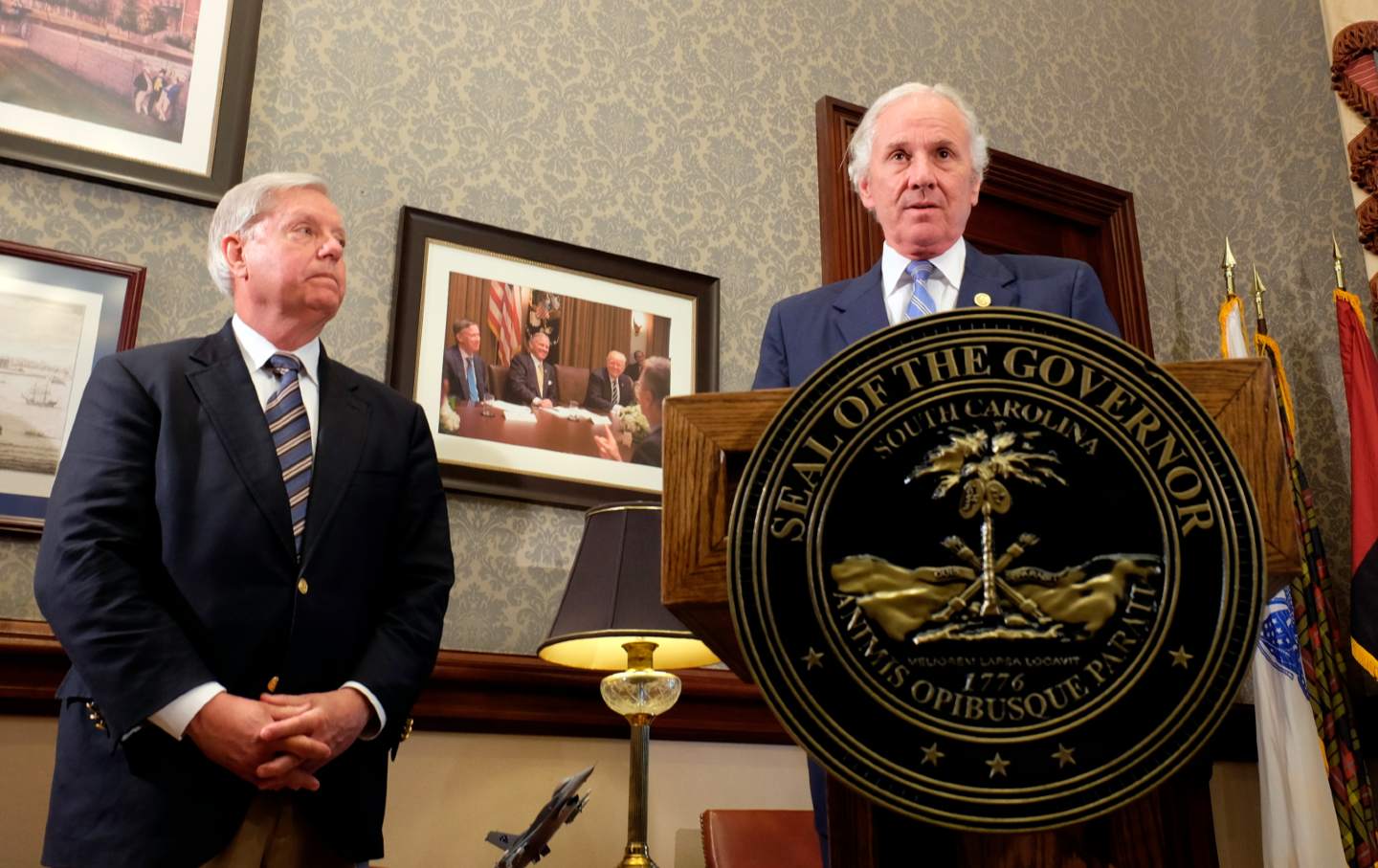
South Carolina Governor Henry McMaster, right, joined by US Senator Lindsey Graham, speaks to reporters on Tuesday, April 6, 2021, in Columbia, SC.
(Michelle Liu / AP)
The sudden death of South Carolina Senator Lindsey Graham, a onetime Republican “maverick” who abandoned most of his pretenses toward independent political thinking in the service of Donald Trump’s presidency, has upended the politics of the state and nation that he served for 32 years in state and federal office.
Graham was such an enduring Capitol Hill character that his unexpected passing sparked a steady stream of reflections Sunday on the complex legacy of a conservative foreign-policy hawk who once warned Republicans, “If we nominate Donald Trump, we will get destroyed… and we will deserve it,” but ended up declaring years later, “Donald J. Trump, in my view, is the greatest president of all time.”
Yet, American politics is a fast-moving train, and the reaction to Graham’s death at age 71 was instantaneously coupled with speculation about who would succeed the four-term senator, who was up for reelection in November. Under South Carolina law, Republican Governor Henry McMaster will quickly choose an interim appointee to serve out the Graham term that ends in January. But the real selection of a successor will be made—as it should be—by the people of South Carolina.
South Carolina is now one of two states in the 2026 electoral cycle where partisans must select a new Senate nominee and mount a November campaign that could decide control of the chamber. The other is Maine, where Democratic US Senate nominee Graham Platner filed paperwork Friday to formally end his candidacy, in response to a number of controversies, including an allegation of assault by a former girlfriend, which Platner denies.
Under Maine law, Platner had to file that paperwork before 5 pm on July 13. In doing so, he created an opening that must be filled by July 27. But Maine statutes don’t specify how a vacancy on the party line should be filled. So Democratic leaders in the state have cobbled together a process that starts with county caucuses on July 18 and 19 and then leaves the final choice to a convention where just 601 delegates—101 of them party committee members—will decide who faces Republican Senator Susan Collins.
Maine Democratic leaders promise they will maintain “a public and open process.” But critics associated with the Maine Coalition for Fair Nominations have complained about party insiders’ “rushing this process in a way that results in loss of trust.”
Current Issue

Contrast Maine with South Carolina, where state law outlines a far more democratic process.
South Carolina law mandates that an actual primary will be held to replace Graham. Republicans who want to succeed the senator will have from July 21 to July 28 to file for a place on the ballot. A special Republican primary election will then be held on August 11. If no candidate wins a majority of the primary vote, a runoff election on August 25 will settle it. Turnout is likely to be high because, as the Ballotpedia website notes, “In South Carolina primaries are open, meaning any voter can participate in any one party’s primary.”
So that’s it: South Carolina has a fast, rules-based process that is designed to maximize participation. A crowded field of GOP contenders is shaping up to choose the Republican who will oppose the impressive Democratic nominee, Dr. Annie Andrews, in a contest that commentator Chuck Todd describes as “a generational opportunity” to name a new senator in a state where congressional turnover is rare.
The Maine model does not compare well with South Carolina’s approach.
To be clear here, the onus is not entirely on the leaders of the Maine Democratic Party. They must follow a state law that, when it was written, failed to anticipate circumstances like the one that has developed, and that leaves Mainers with fewer options—including a much narrower window for filling that empty spot on the November ballot. It’s also important to note that Maine Democratic Party executive director Devon Murphy-Anderson and other party leaders have used social-media platforms to keep Mainers informed and to promote participation in the process.
But the South Carolina model simply seems superior from a small-d democratic standpoint—so superior that states across the country should consider adopting it as part of a much broader, and highly necessary, reform of how vacancies in the Senate are filled.
This drive for reform should go beyond primaries.
Under the US Constitution, all vacancies in the House of Representatives must be filled by special elections. In other words, no one is allowed to serve in the House without first facing voters in a general election. And, in the vast majority of states, those general elections for the House are preceded by primaries.
But it’s not the same for the Senate.
Despite the fact that the Senate is supposed to be elected, governors have since 1913 interpreted a vague section in the 17th Amendment of the Constitution (which established the direct election of senators) as allowing them to fill vacancies by appointment.
Popular
“swipe left below to view more authors”Swipe →
As such, many senators, including currently sitting ones, have served portions of their tenure without ever facing the voters. These unelected senators cast critical votes on issues of war and peace, taxation and spending, and the scope and character of the federal government. Often, their cloture votes make the difference in determining whether an issue is addressed or neglected.
When he chaired the Constitution Subcommittee of the Senate Judiciary Committee in the 2000s, Wisconsin Democrat Russ Feingold proposed a constitutional amendment to bar the appointment of senators and to require that all vacancies be filled by voters, as opposed to governors and party insiders.
“People deserve a voice in choosing the senators who represent them in Washington,” explained Feingold. “The constitutional amendment I have proposed requiring the direct election of all senators is the best way to give them that voice.”
Feingold was right. But his proposal didn’t get traction in a change-averse Senate. Now that attention is again focused on Senate vacancies, it would be a good time to renew Feingold’s push for an amendment, and to work at the state level to make sure that voters, rather than party leaders, get to choose their nominees for open Senate seats.
This is what democracy should look like.
More from The Nation


On July 4, 2026, a large group of masked members of Patriot Front entered the Washington, DC, Metro system. This artwork is inspired by a Reuters photograph by Cheney Orr.

Democratic leaders have rightfully lost credibility. But that’s no excuse for political adventurers to seize the moment and pump up false saviors.