
Close Menu
    Facebook X (Twitter) Instagram
    TRENDING :
    • Senator Lindsey Graham, 71, dies after a ‘brief and sudden illness’
    • The 25 housing markets where home prices went parabolic over the past 40 years
    • Maine After Platner | The Nation
    • 5 career truths nobody tells you
    • Best Bookkeeping Examples for Small Businesses
    • The new rules of leadership start with emotional intelligence
    • Companies keep talking about the motherhood penalty. They’re missing the motherhood advantage
    • What Are Hard Money Loans for Business Startups?
    Populist Bulletin
    • Home
    • US Politics
    • World Politics
    • Economy
    • Business
    • Headline News
    Populist Bulletin
    Home»Business»The 25 housing markets where home prices went parabolic over the past 40 years
    Business 3 Mins Read

    The 25 housing markets where home prices went parabolic over the past 40 years

    Business 3 Mins Read
    Share Facebook Twitter Pinterest LinkedIn Tumblr Telegram Email Copy Link
    Follow Us
    Google News Flipboard
    Share
    Facebook Twitter LinkedIn Pinterest Email


    Want more housing market stories from Lance Lambert’s ResiClub in your inbox? Subscribe to the ResiClub newsletter.

    Single-family home prices have risen dramatically across the United States over the past four decades. But the gains haven’t been even across the board.

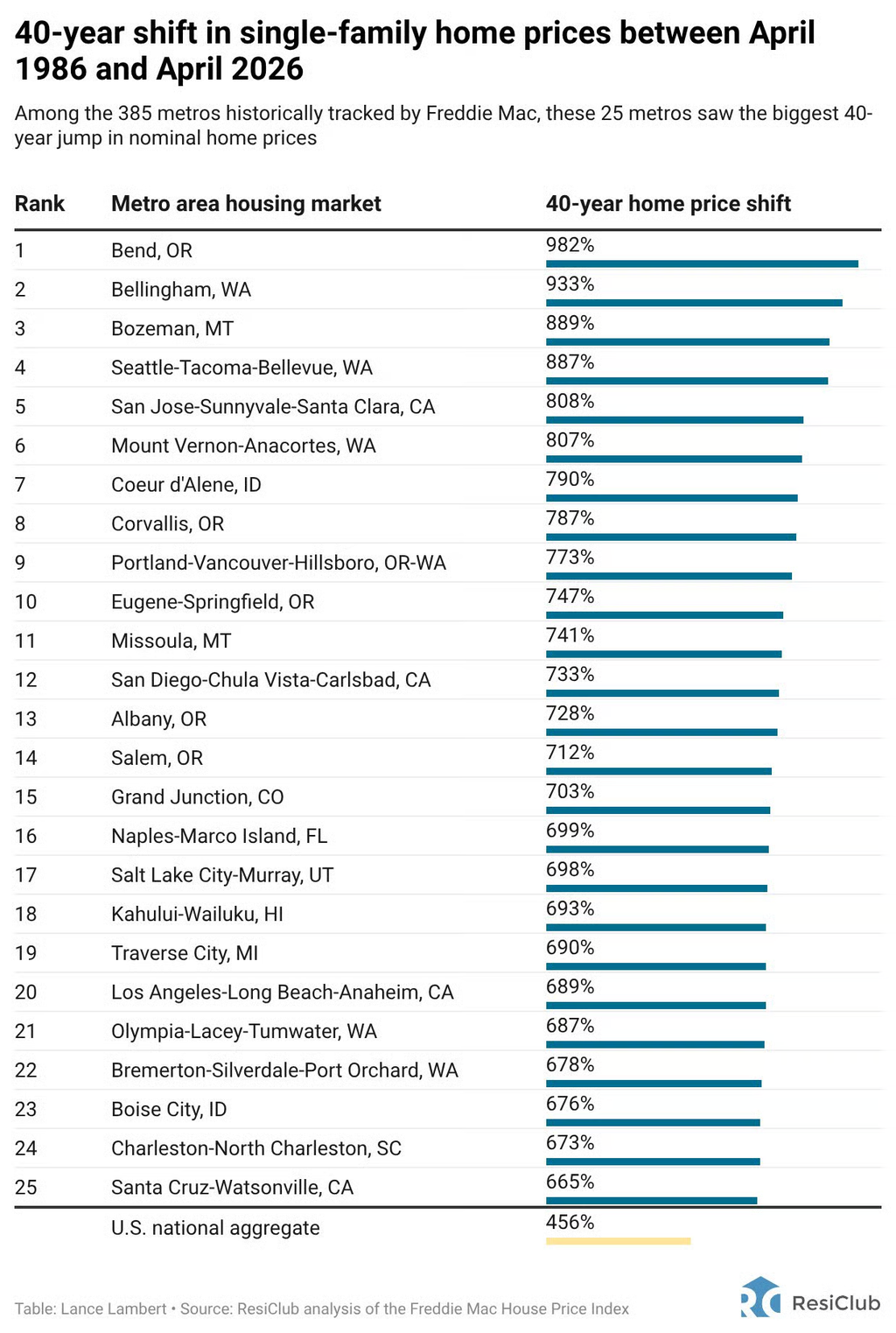
    The map below highlights the 25 metro areas that have seen the biggest increase in single-family home prices over the past 40 years.

    (function(){function e(){window.addEventListener(`message`,function(e){if(e.data[`datawrapper-height`]!==void 0){var t=document.querySelectorAll(`iframe`);for(var n in e.data[`datawrapper-height`])for(var r=0,i;i=t[r];r++)if(i.contentWindow===e.source){var a=e.data[`datawrapper-height`][n]+`px`;i.style.height=a}}})}e()})();

    At the top of the list are:

    1. Bend, Oregon (+982%)
    2. Bellingham, Washington (+933%)
    3. Bozeman, Montana (+889%)
    4. Seattle-Tacoma (+887%)
    5. San Jose (+808%)

    Generally speaking, the nation’s biggest home price gains over the past 40 years have occurred in desirable Western metros, particularly across the Pacific Northwest and Northern California. 

    Overall, 22 of the 25 metro areas are located west of the Mississippi River. That pattern isn’t a coincidence.

    Over the past several decades, many of these markets experienced stronger-than-average wage growth as high-paying industries—including technology, finance, and professional services—expanded. Higher incomes gave households greater purchasing power, allowing buyers to bid home prices higher over time.

    The importance of local income growth becomes clear when comparing markets with very different economic trajectories.

    Let’s consider the Youngstown, Ohio, and Seattle-Tacoma metro areas. Since April 1986, single-family home prices have increased 297% in Youngstown, compared to 887% in Seattle. Over that same period, national home prices have risen 456%.

    While both metros experienced the same national housing cycles—from the inflationary boom of the late 1970s to the housing crash and the pandemic-era surge—their long-term economic stories diverged dramatically.

    Seattle-Tacoma benefited from decades of robust wage growth as the region emerged as one of the nation’s leading technology and innovation hubs, anchored by companies like Microsoft and Amazon. Higher-paying jobs attracted workers from across the country and around the world, giving households greater purchasing power to bid up home prices.

    Youngstown experienced the opposite trajectory. As manufacturing employment declined during the era of deindustrialization, the region saw much slower income growth and weaker population trends. With less purchasing power flowing into the local housing market, home prices appreciated at a much more modest pace.

    Demand is only one side of the equation. The pace of home price appreciation also depends on how quickly housing supply can respond. Many Western markets face natural geographic constraints—from coastlines and mountains to protected public lands—that limit where homes can be built. 

    In many cases, including in housing markets like Seattle, those physical barriers have been compounded by stricter land-use regulations and slower homebuilding. Those constraints have made it harder to build enough homes to keep up with demand.

    Of course, long-term winners don’t always lead in the short run. Several Pacific Northwest housing markets have recently entered a period of cyclical cooling as inventory has increased and price growth has moderated.

    Big picture: Over multiple decades, the housing markets that paired strong income growth with persistent housing supply constraints have consistently generated the nation’s largest home price gains.


    Source link

    Share. Facebook Twitter Pinterest LinkedIn Tumblr Email

    Related Posts

    Senator Lindsey Graham, 71, dies after a ‘brief and sudden illness’

    July 12, 2026

    5 career truths nobody tells you

    July 12, 2026

    Best Bookkeeping Examples for Small Businesses

    July 12, 2026
    Top News
    US Politics 13 Mins Read

    Zohran Mamdani on FDR, LaGuardia—and Trump

    US Politics 13 Mins Read

    Politics / December 18, 2025 In an exclusive interview with The Nation, the mayor-elect goes…

    The State of the Union Was a Rally for an Ailing Strongman

    February 25, 2026

    Trump administration sanctions Russian oil giants to pressure Putin to end Ukraine war

    October 24, 2025

    How to stop punching the clock at work and have more work-life balance

    December 25, 2025
    Top Trending
    Business 7 Mins Read

    Senator Lindsey Graham, 71, dies after a ‘brief and sudden illness’

    Business 7 Mins Read

    U.S. Sen. Lindsey Graham, one of President Donald Trump’s closest allies in Congress…

    Business 3 Mins Read

    The 25 housing markets where home prices went parabolic over the past 40 years

    Business 3 Mins Read

    Want more housing market stories from Lance Lambert’s ResiClub in your inbox?…

    US Politics 1 Min Read

    Maine After Platner | The Nation

    US Politics 1 Min Read

    Ad Policy Graham Platner, Democratic US Senate candidate for Maine, during a…

    Categories
    • Business
    • Economy
    • Headline News
    • Top News
    • US Politics
    • World Politics
    About us

    The Populist Bulletin was founded with a fervent commitment to inform, inspire, empower and spark meaningful conversations about the economy, business, politics, government accountability, globalization, and the preservation of American cultural heritage.

    We are devoted to delivering straightforward, unfiltered, compelling, relatable stories that resonate with the majority of the American public, while boldly challenging false mainstream narratives that seem to only serve entrenched elitists, and foreign interests.

    Top Picks

    Senator Lindsey Graham, 71, dies after a ‘brief and sudden illness’

    July 12, 2026

    The 25 housing markets where home prices went parabolic over the past 40 years

    July 12, 2026

    Maine After Platner | The Nation

    July 12, 2026
    Categories
    • Business
    • Economy
    • Headline News
    • Top News
    • US Politics
    • World Politics
    Copyright © 2025 Populist Bulletin. All Rights Reserved.

    Type above and press Enter to search. Press Esc to cancel.