
Want more housing market stories from Lance Lambert’s ResiClub in your inbox? Subscribe to the ResiClub newsletter.
Since the pandemic housing boom fizzled out in the summer of 2022, some overheated parts of the country—particularly in the West, Southwest, and Southeast—have experienced home price declines from their peak (see this map).
While many of these markets have seen only modest drops, a few metro areas, such as Cape Coral-Fort Myers, Florida, and Austin, have undergone what I’d consider “material” home price corrections, falling 18.9% and 27.3%, respectively, from their peaks.
These regional home price declines raise the question: How many mortgage borrowers currently have negative equity and are actually underwater?
To find out, ResiClub once again reached out to ICE Mortgage Technology.
1.5% —> The share of outstanding U.S. homeowner mortgages with negative equity* (i.e., underwater) at the end of May 2026, according to data from ICE Mortgage Technology provided to ResiClub this week. Back in April 2025, that figure was 1%.
23% —> The share of outstanding homeowner mortgages with negative equity (i.e., underwater) at the end of September 2009, according to Cotality/FirstAmerica.
Why on a nationally aggregated basis, are there still not many homeowners underwater despite home price declines in some markets?
- Nationally aggregate existing home prices are still pretty close to all-time highs. While many pockets of the West, Southwest, and Southeast have seen existing home prices decline from at least some from their pandemic housing boom peak and new-home prices have rolled over from their peak, nationally aggregated existing single-family prices are still pretty close to all-time highs.
- Amortization of ultralow mortgage rates. Many homeowners locked in ultralow mortgage rates during the pandemic housing boom. With fixed rates around 2% to 3%, those monthly payments included a larger proportion of principal repayment from the start. That means borrowers have been paying down their balances more aggressively than they would under higher-rate loans. As of Q1 2026, 49.9% of outstanding mortgage holders still have rates below 4%, which has helped some borrowers build equity faster and give them a greater buffer.
- Few buyers actually purchased at the peak in correction markets. Even in boom-to-correction markets like Austin or Cape Coral, Florida, only a small share of homeowners bought at the absolute top of the market in spring 2022. Most current homeowners in those areas bought before the peak. This limited exposure at the peak helps explain why negative equity, so far, hasn’t been a big problem, even in some of the hardest-hit metros.
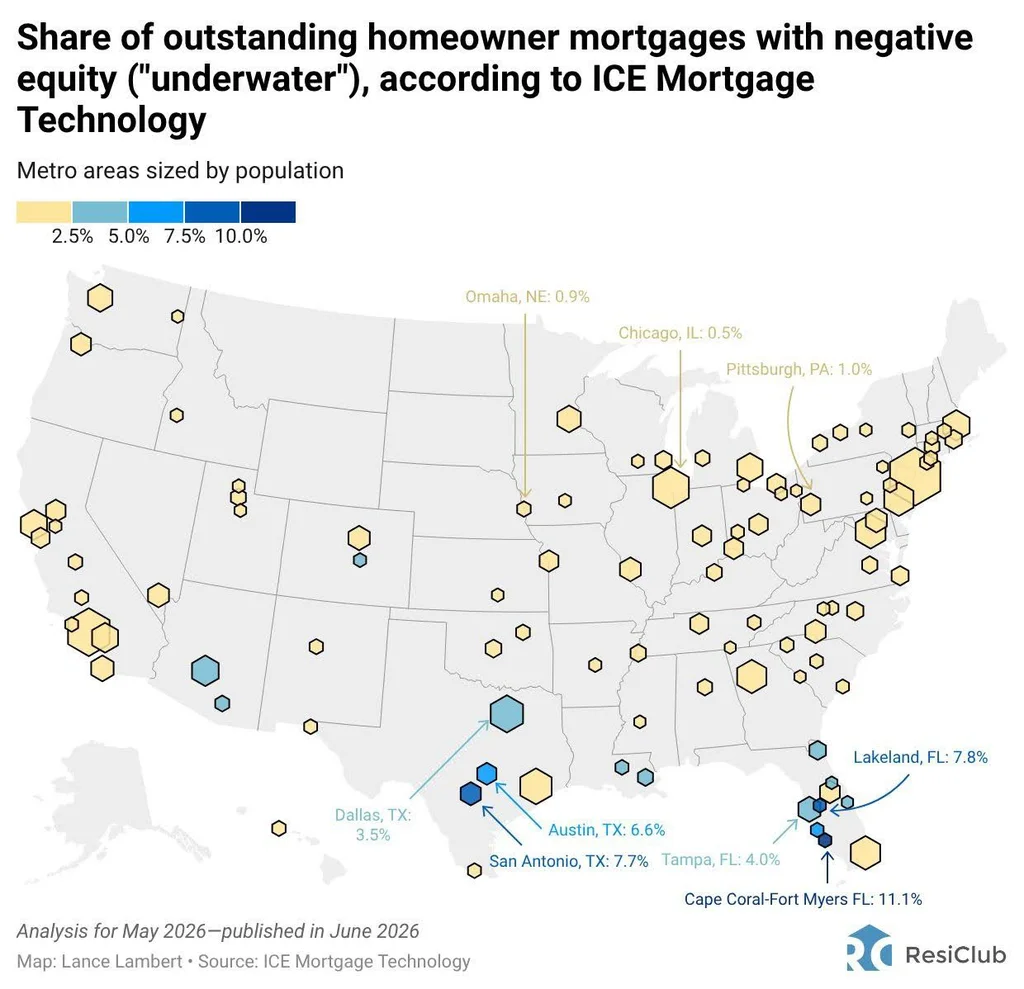
While only 1.5% of outstanding U.S. homeowner mortgages have negative equity, there are a few pockets of the Sunbelt where that share is now higher than 5%.
Click here to view an interactive version of the map below
Among the 100 major metro areas for which ICE Mortgage Technology provided data to ResiClub, these 10 metros have the highest share of homeowner mortgages currently underwater:
- Cape Coral-Fort Myers, Florida —> 11.1%
- Lakeland, Florida —> 7.8%
- San Antonio —> 7.7%
- Austin —> 6.6%
- North Port, Florida —> 5.3%
- Jacksonville, Florida —> 4.1%
- Tampa, Florida —> 4%
- Baton Rouge, Louisiana —> 3.5%
- Dallas —> 3.5%
- Deltona, Florida —> 3%
Among the 100 major metro areas for which ICE Mortgage Technology provided data to ResiClub, these 10 metros have the lowest share of homeowner mortgages currently underwater:
- Bridgeport, Connecticut —> 0.1%
- San Jose, California —> 0.1%
- Boston —> 0.2%
- Los Angeles —> 0.2%
- Hartford, Connecticut —> 0.2%
- Madison, Wisconsin —> 0.3%
- Grand Rapids, Michigan —> 0.3%
- Oxnard, California —> 0.3%
- New Haven, Connecticut —> 0.3%
- New York-Newark, New Jersey —> 0.3%
The table below shows the vintage breakdowns for the 30 major metro area housing markets with the highest share of underwater mortgage borrowers.
Click here to see an interactive/sortable version of the table below, including all 100 of the metros examined by ICE Mortgage Technology.
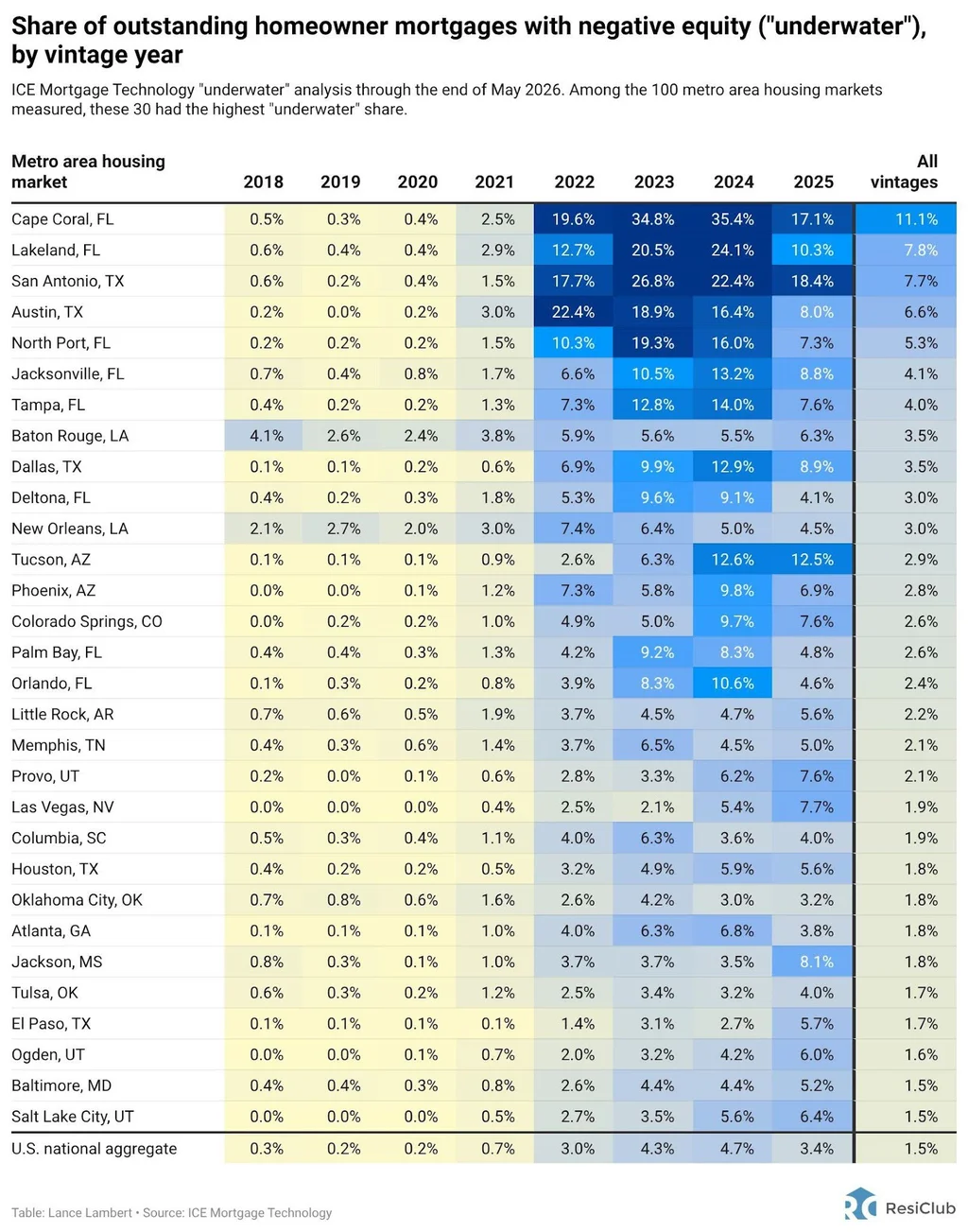
Even in markets like Cape Coral (11.1%) and Austin (6.6%) that have higher shares of outstanding homeowner mortgages currently underwater, that’s still far off from the levels seen at the height of the GFC era bust. For comparison, back in September 2009 a staggering 68% of mortgage borrowers in Nevada, 48% in Arizona, and 45% in Florida were underwater.
So far, in the down markets, it’s really just the 2022, 2023, 2024, and 2025 vintages being impacted.
And in those down markets, it’s thin-equity borrowers, such as FHA and VA borrowers who put down as little as 3.5%, who are more likely to have crossed into actual negative equity (for evidence, see this chart).
Big picture: If home prices in parts of the Southwest, Southeast, and West continue to experience mild home price pullbacks, the share of recent borrowers who are underwater in those markets will rise beyond the levels we’ve outlined today. However, barring a major downward shift, it still wouldn’t come close to the depths of negative equity seen in 2009 or 2010.
*Negative equity means a homeowner owes more on their mortgage than the current market value of the home. In the housing sector, this is historically referred to as being underwater. Of course, some borrowers who don’t have negative equity—but are only slightly equity positive—could still be in the hole after factoring in transaction costs, and other borrowers/homeowners who made a standard down payment, in particular those who bought in spring 2022 in markets like Punta Gorda, Florida, or Austin, might have positive equity but could still have a home worth less than their purchase price. The latter two examples aren’t what the industry calls underwater, even if they are effectively in the hole.