
In an exclusive excerpt from his new book, the Georgia senator writes about why we must keep the faith in the promise of our democracy—and fight for that promise to be realized.
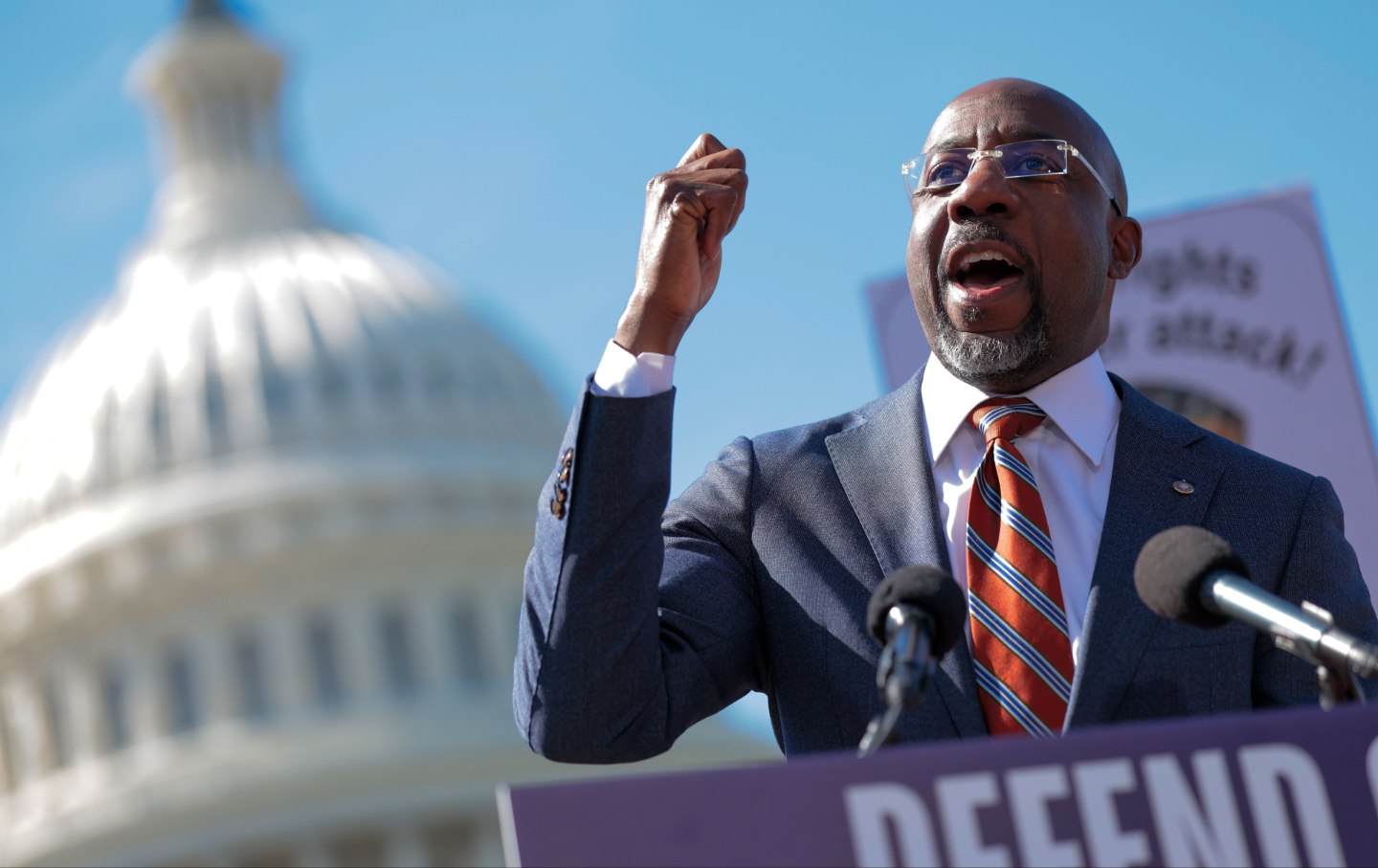
Senator Raphael Warnock (D-GA) attends a rally to speak out against the SAVE America Act outside the US Capitol on March 18, 2026, in Washington, DC.
(Heather Diehl / Getty Images)
There is a deep worry and anxiety in the air these days about America and its future. As a United States senator and a voice for the people of Georgia, I feel it and I encounter it as I move around. In various ways, I hear it. Strangers walk up to me and ask, “Are we going to be OK?” Or they say, “Please save us.” “Please fight for us.”
And no wonder. They see the unabashed assault on our democratic institutions, the burning and looting of our government by those at the highest levels of government, the bending of norms and breaking of laws, the corruption and the grift, the widening chasm of wealth inequality, the stumbling into an illegal war of choice with no clear objectives or way out, the unvarnished hatred and bigotry. The President and his enablers are trying to divide us so they can reign over us. The question is, will we keep the faith and fight for a nation as good as its promise? Or will we give in to those who are trying to weaponize despair?
We have wrestled with the trauma of tyranny before. In his journal, James McHenry, a Maryland delegate to the Constitutional Convention in 1787, recounts a story from the last day of the convention. A woman from Philadelphia asked Benjamin Franklin, a convention delegate and the then-governor of Pennsylvania, an important question about the new system of governance. She asked, “Well, Doctor, what have we got, a republic or a monarchy?” “A republic,” he replied, referring to a government in which people elect their leaders. “If you can keep it.”
If you can keep it.
That is the challenge that confronts us as we approach America’s 250th birthday. Can we keep it? Given the long and arduous journey to freedom and the broken promises along the way, some may well ask another question: Is it worth the fight? In a nation still battling its old demons and divisions, they ask, “Should I just give up on America?” But that’s not possible. At least, not for me. I choose not to leave, physically, mentally, or emotionally. America is my home. My ancestors helped build this country at a time when the Constitution did not even recognize them as fully human. They fought and died in wars against our foreign enemies, even as the powers that be warred against them at home. They endured great suffering for every millimeter of progress. Right here. They kept the faith.
Nowadays, keeping the faith is not easy. Owing to partisan games and gridlock, the outsized voice of big corporate money, and the legalized bribery and lack of integrity in our political and electoral system, we have seen an increasing divide between the basic, everyday needs of ordinary citizens and what a government that claims to be by the people and of the people is able to deliver for the people.
Current Issue
This serious and devastating rupture in the sacred covenant we have with one another allows anger, cynicism, and despair to set in like a cancer in the body politic. In that sense, it is more than a political problem. Rather, it is a spiritual crisis with political implications. It is fertile ground for an authoritarian to emerge, promising that he alone can fix it. In that sense, Donald Trump is both a problem and a symptom of a problem.
It is no wonder many have lost faith. For too long, too many people have been left behind. That is the desperation that I hear in the voices of those who say to me, “Please, fight for us!” Everyday Americans rightly sense the ways in which powerful interests and dark money have poisoned the ecosystem of our electoral politics, squeezing out their voices and making it increasingly difficult for the people to be heard and for their needs to be met in their own house. What is politically possible on issues from housing and healthcare to gun safety has been sharply narrowed, even when ordinary citizens on the left and the right, their disagreements notwithstanding, agree.
For example, according to a Fox News poll, most Americans would support some universal background checks for the owners of firearms. Yet we cannot get even get a vote on the issue because of the power of the gun lobby! Another example: When I came to the Senate, Democrats passed a law that finally gave Medicare the ability to negotiate with pharmaceutical companies over the price of prescription drugs. But why did we have to pass a law just so Medicare could have permission to negotiate?! And why was it only for 10 drugs? It is because of the power of Big Pharma! Increasingly, somebody other than the people owns the house of the people’s democracy, and everyday Americans can feel it in their lives and in their pocketbooks!
In other words, we are stuck. And the predictable language of partisan politics is too puny a vocabulary for what ails us.
America needs a kind of revival, a renewal of faith. A faith bold enough to dream big, and wide enough to include us all. Faith in ourselves as an American people. Faith in the basic goodness of our neighbors. Faith in the ongoing, perfecting work of a democracy. I am asking us to take the long view, to sense the ways in which the cries of our children and the writhing of a planet in peril summon us to a grander and nobler vision.
This pastor in the Senate prays that we might embrace it fully. I would call on us all to pray—and for those who claim no religion, I mean pray in the broadest sense of the word. A vote is a kind of prayer for the world we desire for ourselves and our children, and our prayers are stronger when we pray together. We must pray with our lips and our legs, our hands and our feet. I would say to those who say to me, “Fight for us,” that I am and I will. But here’s the thing. You cannot outsource democracy. Democracy is the political enactment of a spiritual idea, that each of us has within us a spark of the Divine, and therefore we ought to have a voice in the direction of the country and our destiny within it. We must all fight to keep it.
There is an old West African proverb that says, “When you pray, move your feet.” Ours is the world’s oldest and greatest democratic republic. But great patriots have always had to move their feet—to stand and fight to win it, to keep it, and to expand the meaning of its promise.
It was the movement of feet at the Battle of Saratoga that began to turn the tide for American troops in their valiant fight for freedom, convincing them that they could indeed be victorious in the struggle against the tyranny and tariffs of the British. Harriet Tubman, a deeply spiritual and prayerful woman, moved her feet to secure not only her own freedom but also the freedom of some seventy other enslaved persons during thirteen incredibly dangerous missions to the South. With an eloquence consecrated by principled action, William Lloyd Garrison, Frederick Douglass, Harriet Beecher Stowe, and other abolitionists moved not only their feet—they moved a president and a nation toward emancipating itself from the ugly contradiction of slavery. The now-censored stories of women’s suffrage, civil rights, and the dignity and inclusion of the disabled, as well as the LGBTQ+ community standing up at Stonewall, are all chapters inked in the blood, sweat, and tears of citizens who dared to move their feet. They understood, like Franklin, that America is a republic if you can keep it.
I have found inspiration in the ancient wisdom of the biblical prophet Isaiah, whose words I have been preaching in sermons across the length and breadth of our nation for many years. In the book of Isaiah, chapter 40, God speaks a word of hope to a people physically and politically exiled, a people spiritually and emotionally exhausted. All the familiar landmarks that gave them a sense of security, including the Temple, are in flux. There is a vacuum in leadership. The future seems uncertain, and the people are desperately insecure, wondering if they will ever find their way back home. It is such a tough time that God tells the prophet, “Comfort my people” and “speak tenderly” to them.
Isaiah responds to the call with a kind of moral topography. A justice-centered geography. The words are familiar to Jews and Christians alike, and to anyone who has ever heard the spectacular sounds of George Frideric Handel’s Messiah. Isaiah imagines a future full of hope:
Every valley shall be exalted, and every mountain and hill brought low; The crooked places shall be made straight, and the rough places smooth; And the glory of the Lord shall be revealed, and all flesh shall see it together. (Isaiah 40:4–5, NKJV)
It is a grand vision. First, valleys are exalted, and mountains and hills are made low. We live in a time when increasingly the high sit very high and the low sit very low. Vast wealth inequality seems intractable, and it is getting worse, with tragic implications not only for the poor and working class but for the future of the whole land!
But at a time when it has been turned into a dirty word, I make bold to say that we need more equity. We may well argue about how to get there, but increasing wealth inequality and intractable racial inequity are unsustainable for a nation that would remain prosperous and free. The low places must come up a little higher, and the high places come down a little lower. In other words, we need a leveling of the playing field—not equal outcomes but equal opportunity. Isaiah speaks not merely of a return to the land but of a bold reimagining of the land. As we return once again to the meaning of America, on the occasion of the 250th anniversary of its independence, I ask, what might it mean to boldly imagine a big future where valleys are exalted, and mountains and hills are made low?
Beyond equity, I, like Isaiah, imagine something else—a commonwealth characterized by integrity. Isaiah says, “The crooked places shall be made straight.” To be sure, there have always been crooked places in our politics. But perhaps nothing in our lifetime has created the context for more legalized corruption than the Supreme Court’s awful 2010 decision in Citizens United. In a decided departure from decades of precedent, the court ruled that a limit on independent spending by corporations and special interest groups during elections was unconstitutional because it limited their First Amendment right to free speech. The only time such limits should be allowed, the court said, was to prevent “quid pro quo corruption” such as bribes or the appearance of such corruption. Justices who sided with the majority opined that existing disclosure rules would keep election spending transparent and enable voters to assess donors’ motives.
The late Justice John Paul Stevens, a registered Republican who often sided with the court’s more liberal wing, wrote a long, stinging dissent, distinguishing corporations from individuals and the right of individuals to free speech. “At bottom, the Court’s opinion is thus a rejection of the common sense of the American people, who have recognized a need to prevent corporations from undermining self-government since the founding, and who have fought against the distinctive corrupting potential of corporate electioneering since the days of Theodore Roosevelt,” he wrote. “It is a strange time to repudiate that common sense. While American democracy is imperfect, few outside the majority of this Court would have thought its flaws included a dearth of corporate money in politics.”
Sixteen years later, Americans wonder why it is so difficult to make more meaningful progress on clean energy even when it is the cheapest energy; why our healthcare system is so broken and prescription drugs are so high; why our children are trapped in virtual worlds of non-reality and algorithms built by billion-dollar tech companies that leave them anxious, lonely and depressed; and why we cannot muster the collective will to save our own children from senseless gun violence—to do away with the strange and dubious American exceptionalism that makes us the only nation not at war in its own homeland where the massacre of schoolchildren is routine.
Believe it or not, there are many good people in Washington, but they are stuck between children’s coffins and campaign coffers. The system is corrupt. “Your princes are rebels and companions of thieves. Everyone loves a bribe and runs after gifts. They do not defend the orphan, and the widow’s cause does not come before them.” (Isaiah 1:23)
Crooked places create more and more rough places. I was born in one of those rough places. But through good federal legislation and public policy, America carved out a narrow but realistic path for me. That is why a kid who grew up in public housing, the 11th of 12 children in his family and the first college graduate, is now serving in the United States Senate. What keeps me up at night is the realization that, for all my grit and determination, it would be significantly harder for me to achieve that now than it was back then. Americans feel in their gut that we are moving in the wrong direction, and they are right. We are in a spiritual crisis, and it is our moral assignment to make the rough places smooth.
Popular
“swipe left below to view more authors”Swipe →
It is work that a divided nation cannot accomplish. We must do it together. Isaiah says, “The glory of the Lord shall be revealed and all flesh shall see it together.” I used to read this text and think that what it meant was that the glory of God is so grand, so extraordinary, that when it is revealed, all flesh cannot help but see it. Nowadays, I read it in the reverse. I think the prophet is teaching us how to see the glory of God. We must first behold one another in our rich and variegated human beauty. In the eyes of the other, we get a glimpse of God’s radiant glory. “All flesh shall see it together.”
These are dark and difficult times in America. The easiest thing to do is to give up. That’s why we need a new and bold re-imagining of the land as a place of boundless possibility, a land where every child has a chance because their outcome is not based on their parent’s income. I still believe that a nation as great as ours can ensure that all its citizens enjoy a decent and dignified life, access to healthcare, clean air and clean water, efficient transportation, and infrastructure moving commerce to people and people to good paying jobs that allow them to retire with security and pass on the American promise to their children. We suffer not from a paucity of resources, but a poverty of courage and moral imagination. We Americans can still do great things together. It is what it means to be an American and I refuse to believe otherwise.
In that sense, the first three words of our Constitution were not just the opening words to a sentence but spelled the beginning of a new chapter in human history. Those three words are a creed: We, the people. We must never allow anyone, any movement or megalomaniac, or any politician’s self-serving ambitions, to rob us of our creed. This is our inheritance. We, the people. In this dark and difficult moment in American history, I still believe in “We, the people.” I still have faith in America. I still believe that we shall overcome.
More from The Nation
Amid all the talk of “electability,” a Midwestern state’s radical history points to what’s possible.

Colorado voters continue the left rebellion in Democratic primaries.
As the United States marks its 250th anniversary, the nation has strayed from the promise engraved at Liberty’s feet.
The battle between James Talarico and Ken Paxton has been overwhelmed by demagogic gender politics.