
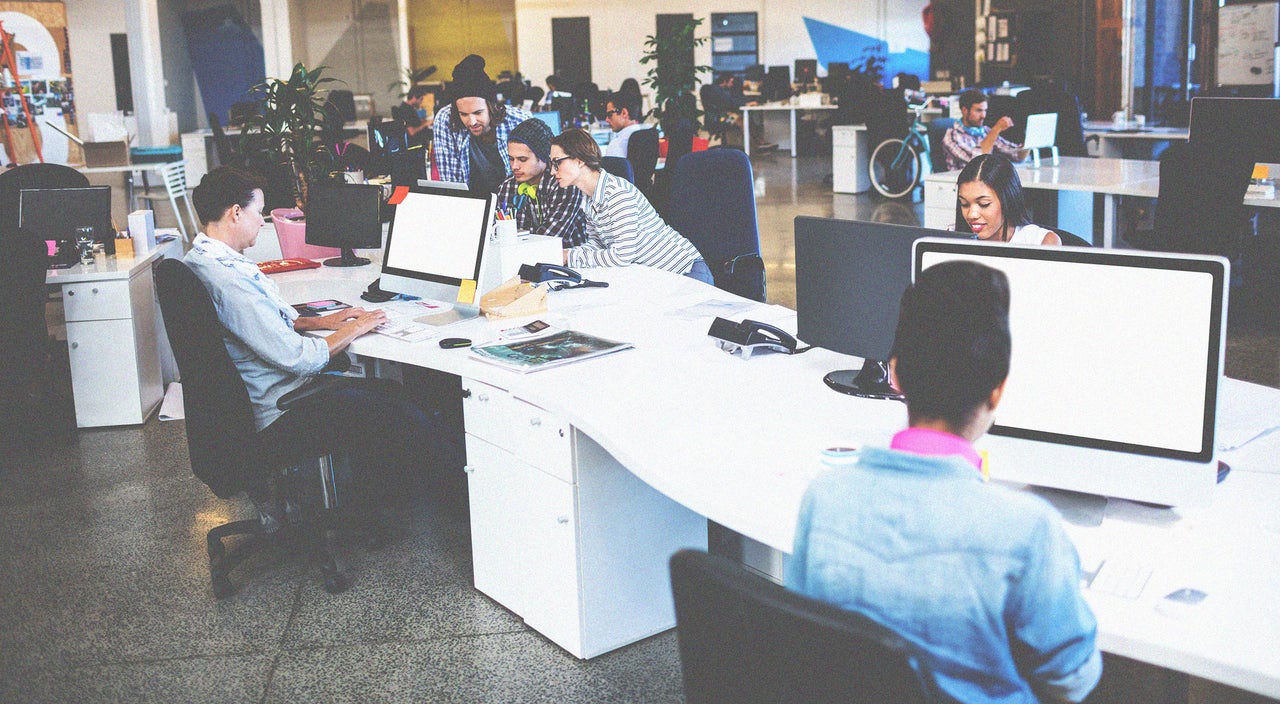
Since her employer mandated a return to the office, Alex quickly found herself missing the peace and quiet she had once taken for granted while working from home.
As someone who works in healthcare communications, she spends much of her day handling sensitive information and taking confidential calls. But in the office, finding a private space to do that can feel impossible.
“Being in the office made it easy to overshare but not do more work,” Alex tells Fast Company. She asked that her real name not be used, so she wouldn’t be identifiable to her employer. “It just feels like almost anything but work is happening.”
Her managers are often not in the office when she is, with in-person meetings frequently replaced by Zoom calls. Meanwhile, the workplace itself often feels more social than productive.
“It’s a comedy of competing priorities,” she says. “I’ll be talking to someone about the worst day of their lives and right outside my door, somebody’s talking about their dad’s colonoscopy again.”
More than three years since the start of the return-to-office era with “The Great Return” of 2023, workers and employers remain locked in a debate about productivity and stolen time. Beneath it all is the sense that many workers believe modern offices no longer support the way they actually work.
Some are questioning whether open-plan offices designed around visibility and collaboration still fit the realities of their day-to-day jobs that are filled with Zoom meetings and Slack messages.
“I’ve just been kind of confused about what the goal is,” Alex says. “It feels like me coming into the office is almost more about demonstrating that we’re using the space rather than that we’re using it well.”
Taylor Glissman, an account executive in the PR industry, experienced a different version of the same problem when her previous employer shifted from fully remote work to a strict RTO policy.
While she enjoyed spending time with colleagues and having a clearer separation between home and work life, she found it difficult to concentrate in an environment where interruptions felt constant.
“I was positioned right next to a busy walkway, where my bosses and upper leadership would frequently pass,” Glissman tells Fast Company. “I felt very aware of how open the area was. It made me feel on edge never knowing who was behind my shoulder or trying to get my attention when I had headphones on. I had nothing to hide, but it made me uncomfortable.”
Eventually, she realized much of her stress stemmed from the lack of privacy.
“On days where I really felt drained, I’d sit in my car for an hour at lunch just to have some quiet alone time,” she says.
Priorities have changed, but offices haven’t
According to a report by workplace experience platform HqO, using data from workplace survey company Leesman, the activities workers value most have shifted significantly since the pandemic.
“This narrative that a lot of people push for when you come back to the office, which is all about social collaboration—that very much is a top-down narrative that is not backed up by the data,” Chase Garbarino, CEO and cofounder of HqO, tells Fast Company. “When people come into the office, they want to be able to concentrate too.”
Workers may be returning to offices that were designed for a different era of work. Between 2018 and 2019, 38% of workers said video calls and conferences were an important part of their work. Between 2022 and 2025, that figure rose to 57%.
Meanwhile, the importance of collaborating on focused work fell from 66% to 48%, while reading and creative thinking both became significantly more important workplace activities.
“The quiet thing is very real,” Garbarino says. “Pre-COVID, everybody was numb to just throwing on headphones and dealing with it. Then, everybody got used to peace and quiet.”
Amanda Jones, a reader in Organizational Behavior and The Future of Work Education at King’s Business School in London, says employers are often overlooking how dramatically work itself has changed.
“You can’t apply the same policy after the pandemic when people have experienced this new way of working,” Jones tells Fast Company. “They’ve changed their life, and work demands have changed, and online meetings have changed.”
Leaders tend to focus on attendance, but attendance alone won’t solve workplace challenges, she says. Offices which are built around hot-desking and open-plan layouts don’t make much sense for employees who spend a significant chunk of their day on video calls. Attendance, she says, is not the same as collective presence.
“Either people are very frustrated that they can’t book a desk near the people they need to interact with, or they’re trying to do an online meeting and it’s really noisy,” Jones says. “The planning required to manage that time effectively is very different to how it used to be—and they haven’t quite got there yet.”
The new office divide
Not everyone experiences the office in the same way. Some thrive on the energy and social interaction. Others find themselves constantly distracted or self-conscious that they’re being judged for disturbing everybody.
“For extroverts, the connection, the open office space, all of that opportunity appeals to them,” Natalie Pickering, an organizational psychologist who works with CEOs and HR teams, tells Fast Company. “But introverts are dissatisfied because that’s not how they recharge and it’s not the best way of doing their work.”
Research has consistently shown that background noise drains cognitive resources and makes concentration more difficult. People’s brains continue processing surrounding conversations and sounds, Pickering says, even when they’re trying not to.
After years of having greater control over their work environments, many employees are finding it difficult to adjust to losing that autonomy.
“I think it is quite frustrating, and quite infantilizing in a way,” Pickering says. “Correlation between autonomy and burnout exists at so many levels, and the more that we’re removing that, you’re going to see burnout continue to elevate.”
For Glissman, the solution was often to work outside normal office hours. She found herself arriving before colleagues, or staying later simply because it was easier to focus.
“It was so much quieter and more peaceful,” she says. “I didn’t need noise-cancelling headphones on, and I didn’t feel on edge that someone was at the side of my desk trying to get my attention.”
The challenge for employers is that workers’ expectations of the office have changed. For many employees, the commute, the distractions, and the loss of flexibility only feel worthwhile if the workplace offers something they can’t get at home.
“If you’re going to go into an office, that feels like a day where you need to get the most out of it,” Jones says. “So it almost becomes more frustrating if you can’t.”