
Around the world, governments are scapegoating LGBT people to build popular support for their erosion of individual rights—often under the guide of protecting children.
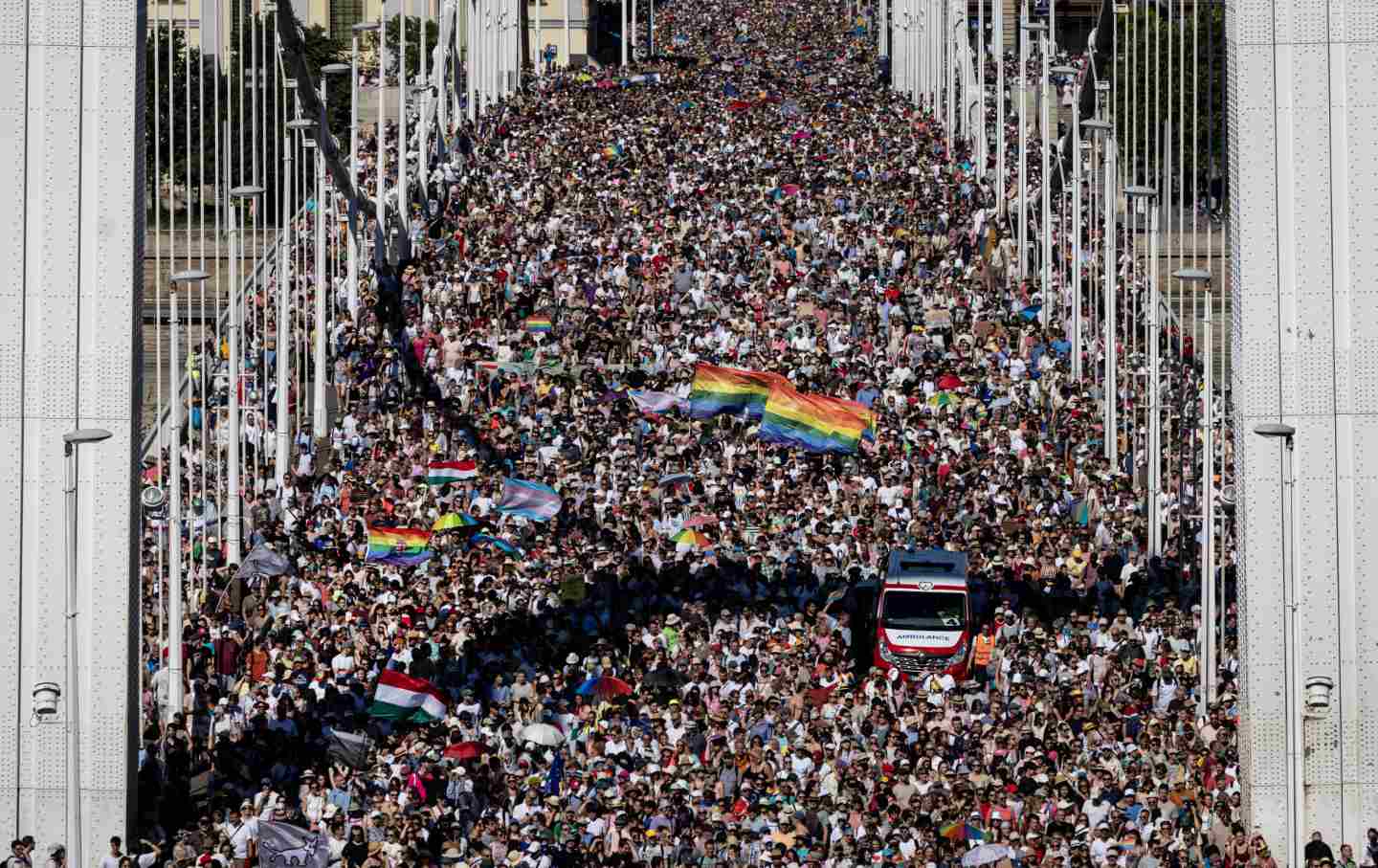
Participants cross the Elisabeth Bridge during Budapest Pride in June 2025. Viktor Orbán’s now-ousted government cited the protection of children as its rationale to ban Budapest Pride, but demonstrators marched anyway.
(Janos Kummer / Getty Images)
Since taking office, the Trump administration has aggressively attacked the rights of lesbian, gay, bisexual, and transgender (LGBT) children. After announcing a narrow view of sex as binary and fixed at birth, the administration has opened investigations into schools that teach about gender and sexuality or support transgender children, withdrawn from civil rights settlements for transgender students in schools, and sought to withhold federal funding and target medical providers in an effort to functionally ban gender-affirming care for children nationwide. These attacks follow an election where right-wing campaigns reportedly spent more than $215 million on television advertisements that disparaged transgender people, with anti-trans messaging flooding the airwaves in the final weeks of campaigning.
But the Trump administration is not the only government that has targeted LGBT people to build popular support for its erosion of individual rights. Around the world, authoritarian governments and illiberal leaders are adopting a similar playbook. While LGBT rights advocates have won important victories in recent years, particularly around the decriminalization of same-sex activity and the recognition of same-sex partnerships, a global resurgence of anti-LGBT rhetoric and the scapegoating of LGBT people has also fostered new restrictions and threatened to roll back critical protections.
Russia’s government criminalized the “International LGBT Movement”—a legal and factual mischaracterization of a diverse, decentralized global human rights causes—and subsequently banned nine groups that serve LGBT people, labeling them “extremist.” Lawmakers in Türkiye are reportedly considering reintroducing legislation that would criminalize speech and conduct “contrary to biological sex and general morality.” In Argentina, President Javier Milei’s administration has used executive decrees to curb groundbreaking gender-identity legislation and diminish crucial protections.
Deploying homophobia and transphobia to shore up illiberal governance is not new. In the 1990s, President Robert Mugabe of Zimbabwe loudly demonized LGBT people when a strong political opposition emerged as a contender to his rule. In 2013, Russia sparked global criticism when it broadly banned “propaganda of nontraditional sexual relations among minors,” which included supportive content about LGBT people in spaces where children might encounter them. Within a decade, the ban expanded beyond advocacy that might reach children, curbing the information and ideas that anyone could receive. Governments in Belarus, Georgia, Hungary, Kazakhstan, Kyrgyzstan, Mali, Nigeria, and Uganda have adopted similar laws. Leaders have capitalized on anti-LGBT sentiment to win elections, proposing harsh new restrictions or putting anti-LGBT measures on the ballot as their popularity wanes.
In recent years, this has taken the form of authoritarian governments targeting “gender ideology,” a label that has been used to condemn gender equality, reproductive rights, and comprehensive sexuality education.
Often, leaders have justified violations of LGBT people’s rights by cynically invoking children, peddling the false stereotype that LGBT identity and expression is inherently harmful to young people. These campaigns not only cast LGBT people as a physical threat to children but also as an ideological threat.
Current Issue

Authoritarian governments have used child-protective rhetoric to undermine freedoms of expression, association, and assembly as well. In Hungary, Viktor Orbán’s now-ousted government cited the protection of children as its rationale to ban Budapest Pride, which had been running for three decades, and prosecuted organizers who held demonstrations anyway. China has dramatically cracked down on LGBT organizations across the country in recent years, invoking the need for young people to marry and have children.
They have also used this child-protective rhetoric to disrupt and terrorize LGBT families. Governments in Hungary and Slovakia, for example, have claimed that acting in the best interests of the child requires heterosexual parents to pass constitutional amendments banning adoption by same-sex couples. In the United States, officials in Texas have even weaponized child-abuse investigations to target parents who help their children obtain gender-affirming care.
These laws blatantly violate the human rights of LGBT people. But they also harm children themselves. Russia’s propaganda law, for example, has decimated counseling and mental health support for LGBT young people, putting mental health professionals and children themselves at risk.
Countries as diverse as Argentina, Bulgaria, El Salvador, Niger, Paraguay, and the United States have also restricted age-appropriate discussions and curricular materials about gender and sexuality in schools. These laws reinforce the message that being LGBT is abnormal or inappropriate, which reinforces the bullying, isolation, and stigma with which so many LGBT children struggle. They also deprive LGBT children of comprehensive sexuality education that is relevant to them, and an essential part of their right to health.
The government’s imposition of a rigid gender binary can also jeopardize children’s physical and mental health. In the United States, 27 states have prohibited and sometimes criminally punished best-practice medical care for transgender children, despite ample evidence that this care can be beneficial and even lifesaving.
In some instances, state officials have even weaponized these child-protective rationales to punish LGBT children, framing them as a threat to their cisgender, heterosexual peers. The discredited theory of “rapid-onset gender dysphoria,” or the idea that transgender identity can spread through social contagion, has been similarly misused to suggest that transgender children pose a threat to others simply being recognized and respected for who they are. In Eswatini and elsewhere, students suspected of being LGBT have been threatened with expulsion or expelled from school, putting their right to education at risk because of the spurious belief that they will corrupt their peers.
The policies these governments are adopting undermine everyone’s rights—including the rights of children themselves. To push back, advocates need to fight not only for LGBT people’s rights but the rights of children as well. As long as children are treated solely as objects of protection and not as people with rights of their own, they’ll continue to be invoked in the name of shrinking individual liberties and space for dissent. Human rights advocates need to equip children to thrive, not just protect them from harm.
A critical bulwark against regressive restrictions is the international children’s rights framework. The Convention on the Rights of the Child, which entered into force in 1990, is the most widely ratified human rights treaty in the world. With the notable exception of the United States, every United Nations member state has ratified it and agreed to be bound by its terms.
The convention recognizes that children have rights, including the rights to life, to an identity, to expression, to access information, to religion and belief, to association and assembly, to privacy, to the highest attainable standard of health, and to a standard of living necessary for their development.
It also emphasizes that “the best interests of the child shall be a primary consideration” in actions involving children, that governments have an obligation to protect and care for children, and that the rights and responsibilities of parents should support the evolving capacities of the child as they grow up.
The Committee on the Rights of the Child, the international expert body that monitors compliance with the treaty, has been clear that these provisions support rather than restrict the sexual and reproductive health and rights of children. While the committee has urged states to curb anti-LGBT laws, it is ultimately up to states to take those recommendations seriously and put them into practice.
As illiberal leaders cynically invoke children to restrict the fundamental rights of LGBT people, then, what would a children’s-rights approach entail?
First, human rights advocates should call on governments to respect the rights of children, including their rights to express an identity, access information, and receive sexual and reproductive health care. Governments should consider what children need and want rather than reflexively subordinating the rights of children to the preferences of parents or guardians.
This means taking action against laws and policies that coerce children into a cisgender, heterosexual mold. Children should be protected from conversion practices and medically unnecessary genital surgeries when they are unable to meaningfully consent.
School officials should recognize children’s autonomy to choose their own name, pronouns, gender identity, and gender expression, and should respect children’s desire for confidentiality when they fear parental notification. And they should ensure that transgender children are able to obtain medically indicated gender-affirming care, including mental health care, without undue barriers.
Of course, particularly in adolescence, children may be confronted with difficult choices about their sexual and reproductive health, which can have lasting consequences. But instead of treating children solely as vulnerable objects of parental decision-making, governments should ensure that children have meaningful support and affordable, accessible, and affirming resources that might allow them to make decisions that are right for them.
Popular
“swipe left below to view more authors”Swipe →
Second, advocates should insist that governments protect the rights and best interests of all children.
Although authoritarian governments often invoke the need to protect children, they almost always imagine a child who is—or who they believe should be—cisgender and heterosexual. Lawmakers who restrict gender-affirming care, for example, often tout the small number of adults who may decide they are cisgender and regret receiving gender-affirming care as children, despite reported rates of regret being far lower than many other medical procedures. They rarely give the same consideration, however, to transgender adults who may regret undergoing puberty inconsistent with their gender identity as a result of being unable to obtain that care, which might call for greater access to that care.
Laws that prohibit classroom instruction on sexual orientation or gender identity are framed by supporters as protecting children from “age-inappropriate” content. However, these laws harm LGBT learners by making their own identity invisible, shameful, and unsupported at a critical developmental stage. Furthermore, they tacitly encourage intolerance and bullying from peers.
Protecting the safety and well-being of children means all children, without discrimination.
Finally, governments should actively prepare children to be part of a society with others who may look, act, or think differently than they do. The forced conformity of a narrow view of gender and sexuality harms LGBT children, but it harms all children who are robbed of that exposure to richness and diversity.
Governments have an obligation to fulfill the rights to education, to health, and to public participation without discrimination. That requires them to ensure that children have access to information and media that reflect the reality of children’s and their families’ experiences. They should guarantee access to information that reflects their needs and the diversity of the world around them, including age-appropriate comprehensive sexuality education.
Instead of forcing transgender children into rigid sex categories, governments should seize the opportunity to teach children about gender diversity and why it is important for transgender children to have access to spaces and activities that respect their gender identity. Similarly, governments should address bullying and discrimination, including on the basis of sexual orientation and gender identity, with an emphasis on promoting mutual acceptance and respect.
And governments should embrace opportunities for students to organize and advocate for themselves, including in the formation of gay-straight alliances and other LGBT student organizations. Children have an obvious stake in democratic governance, and their influence can be powerful. Throughout history, youth movements have been an engine of progressive social change, from the anti-apartheid movement in South Africa to the pro-democracy movements in Latin America and Eastern and Central Europe.
Parents can be important defenders of their children’s rights as well. In Uganda, for example, mothers of LGBT children wrote to President Museveni to support their children and urge him not to sign the draconian Anti-Homosexuality Act. Although Museveni signed the law, that family support can be critically important to LGBT children. In the words of Mama Dennis, a woman with a transgender daughter, “I will keep defending her. Our children are not criminals.”
There are some small signs for optimism that illiberal policies can fall. Hungarian voters have elected a new government that appears set to repeal a “propaganda” law passed by a previous government, and prosecutors have announced they will drop the cases against Pride organizers. After Lithuania enacted an anti-LGBT “propaganda” law in 2009, the Constitutional Court struck it down in 2024, finding that depictions of diverse families are not harmful to children and affirming children’s right to access information.
But these victories require tackling restrictions head-on. As authoritarian governments and illiberal leaders wield anti-LGBT sentiment to constrain rights, empowering children and taking their rights seriously is as crucial as ever.
With the midterm elections now firmly upon us, the question is whether Democratic candidates will do more than merely occupy ballot lines as mild alternatives to the red-hot crisis that is Donald Trump.
As Trump spends over $1 billion a day on a globally destabilizing war on Iran and admits that he doesn’t “think about Americans’ financial situation,” millions across the country are struggling with the surging costs of essentials. Democrats must seize this moment and advance bold, small-“d” populist ideas—not settle for cynical caution that once again snatches defeat from the jaws of victory.
The Nation elevates progressive ideas, movements, and elected officials achieving real change across the country into the national conversation. At the same time, our journalists are exposing how crypto and AI-funded super PACs are spending hundreds of millions of dollars to knock out candidates they oppose, reporting on the devastating impact of the Supreme Court’s evisceration of the Voting Rights Act, and sounding the alarm on attempts by red states to quickly redraw electoral maps, disenfranchising Southern Black voters.
We can play this critical role because of support from readers like you. This June, we’re raising $20,000 to power The Nation’s independent journalism in the run-up to November’s immensely consequential elections.
It’s in our power to build a more just society, and your support at this critical moment brings us closer to that bold vision. I hope you’ll donate today.
Onward,
Katrina vanden Heuvel
Editor and Publisher, The Nation
More from The Nation

The amount of time spent in DC obsessing over Iran compared to the actual threat it poses to our country’s security is insane.
And how this is leading America’s Russia policy into dangerous places.
Presidential candidate Iván Cepeda talks to The Nation about US interference, his far-right opponent’s narco-paramilitary ties, and the unfinished business of the Petro government…
The newly leaked Memo of Understanding to end the conflict makes it clear that the president has nothing to show for his expensive, destructive fool’s errand.
Sovereign wealth, private equity money, and a network of oily alliances between FIFA and the world’s most reprehensible regimes have transformed the sport forever.