
Congress took an important symbolic step toward reasserting its authority over war powers. But much, much more needs to be done.
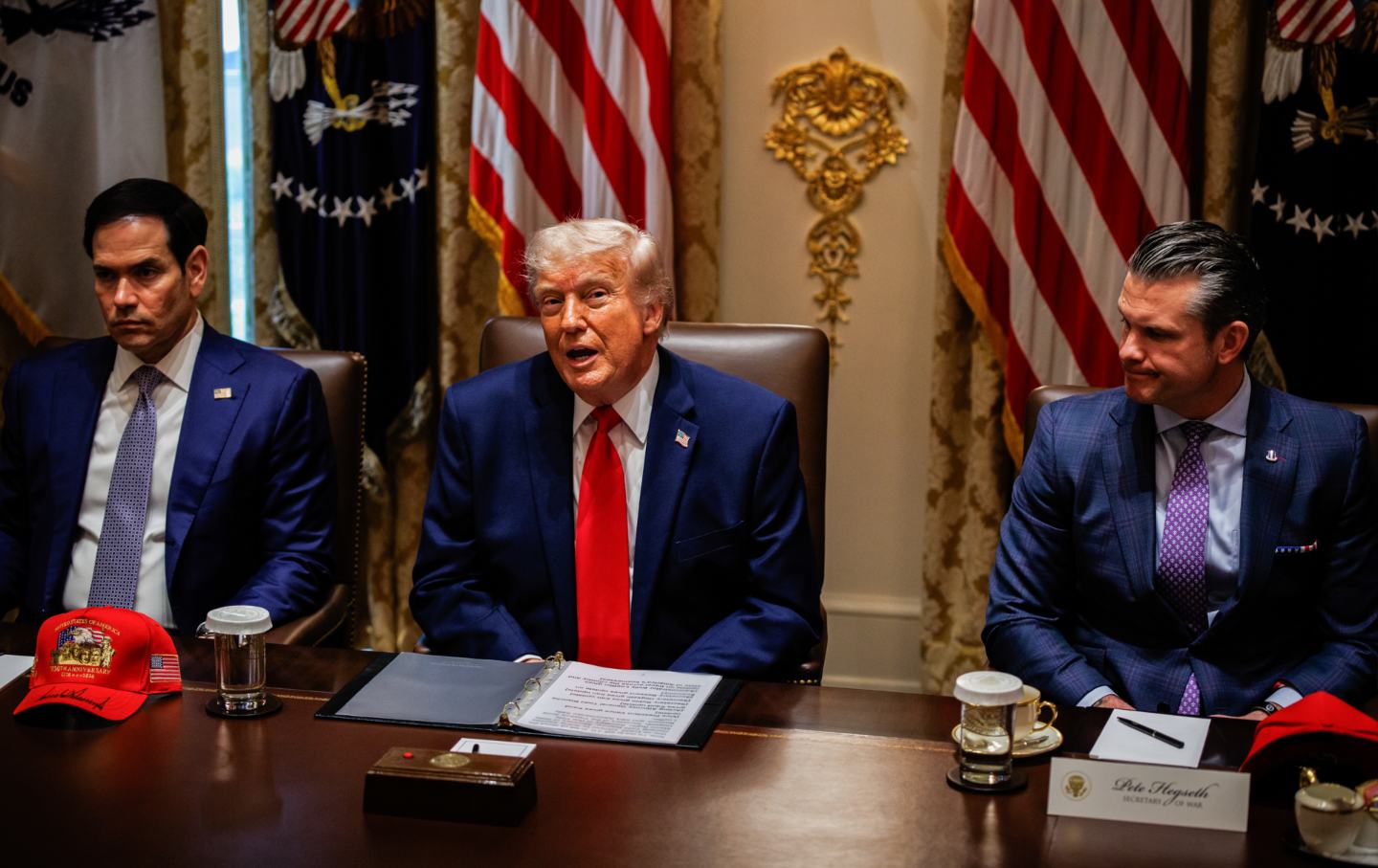
Marco Rubio, Donald Trump, and Pete Hegseth during a cabinet meeting at the White House, on May 27, 2026.
(Samuel Corum / Sipa / Bloomberg via Getty Images)
The anti-war cause won a rare and heartening victory on Wednesday when the House of Representatives passed a measure, the Iran War Powers Resolution, calling on Donald Trump to “remove United States Armed Forces from hostilities against the Islamic Republic of Iran.” The resolution passed by a vote of 215 to 208, winning bipartisan support from 211 Democrats and 4 Republicans who broke with the president—Thomas Massie of Kentucky, Brian Fitzpatrick of Pennsylvania, Tom Barrett of Michigan, and Warren Davidson of Ohio. While Massie and Davidson are long known for being staunchly anti-interventionist libertarians, the defections of the two other Republicans are significant because they are moderates who represent swing districts.
Fitzpatrick and Madison were surely motivated in part by the fact that the Iran war is overwhelmingly unpopular. A new poll by The Economist/YouGov shows that 68 percent of voters believe Trump “should make a deal to end the war in Iran as quickly as possible.” They and the rest of the bill’s supporters did well to pass a resolution that not only reflects popular opinion but also reasserts the constitutional role of Congress over the waging of war.
Yet passing a resolution is easier than enforcing it.
As The New York Times reports:
The House’s vote was only the first step in a complicated and likely uphill path for the resolution. It now heads to the Senate, which under the war powers law must take it up within roughly two and a half weeks. It does not need a presidential signature, but even if Congress were to clear the measure, its legal force would remain uncertain.
Getting the Senate to pass the measure could be difficult, but it is not impossible. Last month the Senate passed a similar resolution by a vote of 50 to 47, with four Republicans joining almost all Democrats (John Fetterman of Pennsylvania, now an infamous buffoon, being the sole member of his party to vote against the resolution).
If both the House and the Senate pass the resolution, it will not need the president’s support because it will be what is known as a “concurrent resolution”—in effect, a legislative veto. But what happens next is less certain, because it is unclear whether a concurrent resolution used in this manner is constitutional.
Current Issue

The Constitution could not be more explicit that the responsibility for declaring war rests with Congress. Yet, in practice, this power has been eroded by the massive expansion of the national security state, which has led to a centralization of power in the executive branch. The result is an imperial presidency that frequently wages war with minimal consultation with Congress, let alone explicit authorization.
In 1973, in a backlash against the Vietnam War and Richard Nixon’s abuses of power, Congress passed the War Powers Resolution. Under Section 5(c) of that law, a concurrent resolution should be enough to end a war.
But a decade after the passage of the War Powers Resolution, the Supreme Court ruled against the practice of legislative vetoes in the case of INS v. Chadha (1983). Although narrowly dealing with an immigration case, the decision had a far-reaching impact. Within the Reagan administration, an anonymous memo on the case (possibly written by future Supreme Court Chief John Roberts) gloated that “this is a historic ruling in favor of the executive branch. There are nearly 200 statutory provisions containing legislative vetoes. Some prominent examples include the War Powers Act…”
That view has persisted. In January, Vice President JD Vance stated that “every president, Democrat or Republican, believes the War Powers Act is fundamentally a fake and unconstitutional law.” Although Vance didn’t name the Chadha decision, it was clearly what he had in mind. (As often in politics, Vance is a naked hypocrite here, since in 2023 he argued that the War Powers Resolution should be used to constrain Joe Biden’s support of Ukraine).
But Vance was counting his chickens before the eggs had hatched. The impact of Chadha on the War Powers Resolution remains untested. In an essay in Just Security, legal scholar Michael J. Glennon points out that there were important disagreements among three justices in the Chadha case: Chief Justice Warren Burger (who wrote the majority opinion), Lewis Powell (who wrote a concurrence), and Byron White (who wrote a dissent). As Glennon observes:
The veto at issue in Chadha was the most common variant: Congress delegates authority to the executive and then reserves the right to retract it.
But Section 5(c) of the War Powers Resolution is structurally distinct. The Resolution delegates nothing. It explicitly provides that nothing in it “may be construed as granting any authority to the President… he would not have had” in its absence. Section 5(c) does not retract delegated authority: it marshals Congress’s own constitutional power against an executive exercise of overlapping—or, in the terminology of the Framers’ design, concurrent—constitutional authority.
Justice Lewis Powell recognized this distinction. Concurring separately, Powell declined to reach the broad constitutional question Burger’s majority addressed. He referred explicitly to the War Powers Resolution and observed that the validity of a legislative veto “may well turn on the particular context in which it is exercised.” He would, he said, “be hesitant to conclude that every [legislative] veto is unconstitutional on the basis of the unusual example presented in this litigation.” Justice White, too, noted in dissent that the war powers context was categorically different.
Glennon also argues there are grounds to overturn Chadha as not in keeping with subsequent court decisions. A similar analysis appeared on the podcast of Lever News.
This means that the Iran War Powers Resolution is not merely a foreign policy issue but also a constitutional one—and makes it likely that the Supreme Court would have the final say on the question.
Popular
“swipe left below to view more authors”Swipe →
Unfortunately, there are few grounds for optimism in a legal victory. It’s uncertain whether the courts will even take up the issue. Further, the current iteration of the Supreme Court, which has been all too willing to support an expansive view of presidential power (unless it involves cases where the preferences of big business are at stake, as in tariff powers), cannot be counted on to back the legislative branch in this case.
The Iran War Powers Resolution is thus likely to be merely a symbolic victory. The imperial presidency is deeply entrenched and will require Congress to continue to battle against executive usurpation of power on many fronts. One promising avenue is using its power of the purse to limit and direct military spending. But the struggle to limit presidential militarism won’t come easily and will require anti-war forces in Congress to be stronger than they are now.
A properly functioning constitutional democracy would give Congress real power to start and end wars. The fact that this power is now just symbolic is a scandal. The challenge is to find ways to claw back the powers Congress has lost.
With the midterm elections now firmly upon us, the question is whether Democratic candidates will do more than merely occupy ballot lines as mild alternatives to the red-hot crisis that is Donald Trump.
As Trump spends over $1 billion a day on a globally destabilizing war on Iran and admits that he doesn’t “think about Americans’ financial situation,” millions across the country are struggling with the surging costs of essentials. Democrats must seize this moment and advance bold, small-“d” populist ideas—not settle for cynical caution that once again snatches defeat from the jaws of victory.
The Nation elevates progressive ideas, movements, and elected officials achieving real change across the country into the national conversation. At the same time, our journalists are exposing how crypto and AI-funded super PACs are spending hundreds of millions of dollars to knock out candidates they oppose, reporting on the devastating impact of the Supreme Court’s evisceration of the Voting Rights Act, and sounding the alarm on attempts by red states to quickly redraw electoral maps, disenfranchising Southern Black voters.
We can play this critical role because of support from readers like you. This June, we’re raising $20,000 to power The Nation’s independent journalism in the run-up to November’s immensely consequential elections.
It’s in our power to build a more just society, and your support at this critical moment brings us closer to that bold vision. I hope you’ll donate today.
Onward,
Katrina vanden Huevel
Editor and Publisher, The Nation
More from The Nation

“Our democracy is in deep trouble,” says Nina Schwalbe, “from vaccines to abortion to science, to SNAP, to rule of law.”
It’s an attempt to rile up the MAGA base over reforms to the immigration system 60 years ago.

June is Pride month, a celebration of identity, freedom, and the beauty of being unapologetically yourself.