
Her opponent, Representative Angie Craig, campaigned for the DFL nod for months, but declared she would no longer seek its endorsement two days before the party convention.
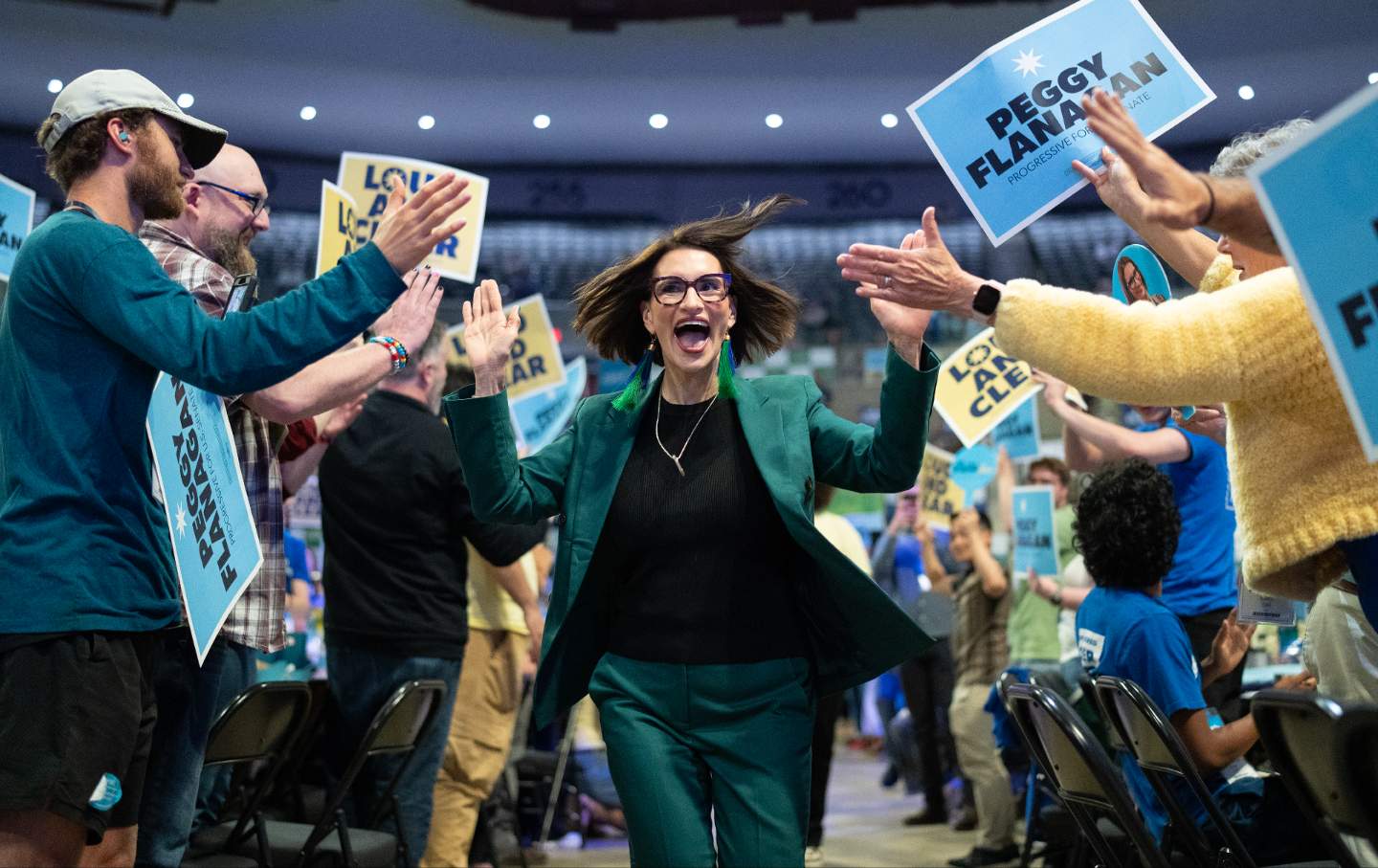
Lieutenant Governor Peggy Flanagan, who is running for the Democratic nomination for Senate, runs towards the stage after receiving the DFL endorsement during the Minnesota Democratic-Farmer-Labor (DFL) Party Convention in Rochester on May 30, 2026.
(Alex Kormann / The Minnesota Star Tribune via Getty Images)
Minnesota Lieutenant Governor Peggy Flanagan ran around the Democratic-Farmer-Labor Party convention all day Saturday in a dark emerald-green suit, with matching Native-beaded earrings, trying to talk to everyone. Later that day, she won the DFL nomination by acclamation in her race to become the state’s next US senator, and the crowd roared.
But Flanagan is still facing an opponent in her August Democratic primary. Representative Angie Craig campaigned for the DFL nod for months, but two days before the party convened in Rochester, she declared that she would no longer seek the endorsement, and wouldn’t attend the convention.
Related Article
“It’s not really democracy when 1,200 people get to pick who our candidates are in America. It doesn’t allow every voice to be heard,” Craig said at a news conference Thursday, in front of a few dozen supporters.
“If you can’t show up and face your own party, then you’re not ready to face Republicans,” Flanagan countered in a video posted to social media.
This race isn’t over. Craig, a lesbian mother of four, has support from the state’s big LGBTQ groups, endorsements from many establishment Democrats and four times the funding of Flanagan right now (though the DFL endorsement will open party money and major campaign infrastructure resources for Flanagan). In 2018, Craig won a purple district on the outskirts of Minneapolis and she touts her centrist record as better preparation for a statewide race.
“Minnesotans have always proved that organized people can beat organized money,” Flanagan countered at the convention. “Senator Paul Wellstone was famously outraised 7-1,” she reminded me Monday on the phone.
Current Issue

Heading into the weekend, local media reported that Flanagan could count on support from at least 75 percent of the convention delegates. In April her campaign told The Nation that she had won more DFL delegates than Craig in over 90 percent of the 117 local-unit conventions, essentially giving her a lock on the DFL’s endorsement. It turns out that was closer to 95 percent.
And while Craig claims that only “1,200 people” made the DFL decision, in fact 40,000 people participated in precinct caucuses, and 57 percent of delegates were first-timers. Until recently, Craig herself was actively seeking the DFL nod, sending “Team Craig” representatives to 113 of the 117 unit conventions. But Flanagan was clearly winning all along, even in Craig’s own congressional district, where the lieutenant governor picked up 70 percent support. All of that seems to have led the congresswoman to pull out of the process two days before the convention began.
Craig was beginning to change her tune about the DFL when I interviewed her in March. “I wanna respect the people who participate in this process, but it’s less than 2 percent of primary voters,” she told me. She went on to depict Flanagan as the insider, while she, the candidate with the big campaign fund, is the upstart. “I’m still the outsider in Minnesota politics,” she told me. “Peggy has been in the political class in Minnesota for her entire life.”
That’s one way to depict Flanagan’s background. She was raised by her struggling single mother, Pat Flanagan, a DFL activist who relied on government programs to raise her daughter while she went back to college. Flanagan still describes herself as “the girl with the different-colored school-lunch ticket,” which tipped off classmates that she got free school lunches. She worked organizing for Paul Wellstone, the late DFL hero, while still in college, and then went on to a range of social justice organizing jobs. A member of the White Earth Ojibwe tribe, she would be the first female Native senator in American history.
When I tell her Craig is calling herself the outsider in the race, Flanagan responds, “I think that’s interesting, in the most Minnesota way possible”—and I think that’s a play on “Minnesota nice.”
“Congresswoman Craig is someone who has served in Washington for eight years and who has consistently been funded by corporate special interests,” she continues. “So claiming to be an outsider is an interesting tactic, which I think is simply grounded in the fact that people are sick and tired of Washington Democrats who are bending to Republicans.”
But the DFL endorsement has not always won primaries for its recipients. Flanagan herself, running with Governor Tim Walz, didn’t get it in 2018, and the team won anyway; so did wealthy former Democratic Governor Mark Dayton, elected in 2010.
Craig has signaled that she will try to tie Flanagan to the welfare fraud scandal that has rocked Minnesota, which helped Trump justify Operation Metro Surge, the deployment of ICE and Customs and Border Patrol agents to Minneapolis. “The number-one issue for general-election voters is fraud here in Minnesota,” she told me in March, a fact I didn’t hear from any other politico in the state. She has continued to push the issue.
“I’ve won a district that Donald Trump carried,” Craig said at her press conference last week. “The job of our Senate candidate is to hold this U.S. Senate seat and to help DFLers up and down the ticket.”
Should Craig lose in August, the issue that will, and should be, cited is her January 2025 vote for the Laken Riley act, which empowered immigration enforcement officials to detain and deport undocumented people merely charged, not convicted, with crimes, including nonviolent crimes. Many so-called frontline (read purple district) congressmembers did as well; many have since publicly recanted.
Popular
“swipe left below to view more authors”Swipe →
Craig ultimately recanted in March, but that was after the ICE surge had enraged much of the state, and led to the murders of poet Renée Good and nurse Alex Pretti. Many credit Trump’s Operation Metro Surge with driving the interest of those 57 percent of newcomer delegates to the DFL; the February 3 caucuses came only days after Pretti’s murder and were a tangible way to express political anger and activism.
At the DFL convention, outgoing Senator Tina Smith introduced Flanagan. “Minnesotans, I know what this job takes,” Smith told the crowd. “We are ready for leaders that demand change, and that is why there is no better leader for this moment than Lieutenant Governor Peggy Flanagan.” The delegates seemed to agree. “Peggy’s speech was energizing and the reaction in the room was uproarious,” her friend and DFL ally Javier Murillo told me. “The moment that got the loudest crowd reaction was when she said, ‘We got here in part because too many Democrats have been weak.’ The people in that room, all committed Democrats, are as mad at their own party as polls reflect nationally. They’re tired of Democrats who aren’t standing up or, worse, cave to the Trump administration in votes like the Laken Riley Act.”
“I was not completely prepared for how it felt delivering the speech from the stage,” Flanagan told me Monday. “The support, the enthusiasm, it really felt like a movement moment. I know we are going to be outspent, but we will not be out-organized.”
More from The Nation

If AI devours entire industries, who believes that the precariat’s newest members will receive more support than autoworkers and textile makers before them?
America’s 250th anniversary celebrations are falling apart because of the president’s tawdry display of narcissism.

I followed agents from Illinois to North Carolina to Minnesota. To my surprise, they loved my coverage.