
Welcome to AI Decoded, Fast Company’s weekly newsletter that breaks down the most important news in the world of AI. You can sign up to receive this newsletter every week via email here.
Inside the SpaceX S-1 Black Box
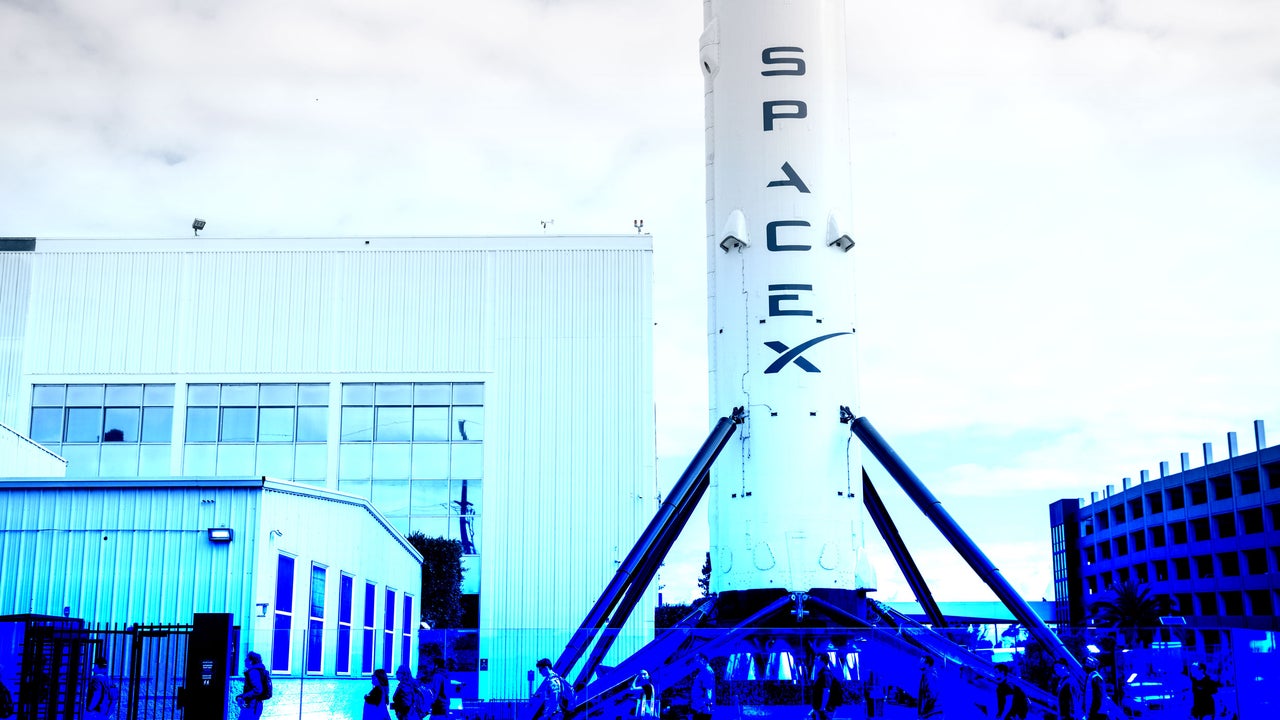
SpaceX’s S-1 investor prospectus landed last week, and it proves to be equal parts legitimate satellite connectivity business and AI hopium. The document spends 47% of its time discussing artificial intelligence, describing SpaceX’s addressable market as overwhelmingly AI and AI-related. Based on that, despite having relatively little AI business today, SpaceX hopes to raise somewhere between $75 billion and $80 billion from investors, with the entire company valued at $1.75 trillion.
Right now, SpaceX’s Starlink business is its main source of real revenue. Starlink generated $11.4 billion in revenue in 2025, accounting for 61% of the company’s total revenue of $18.7 billion. Based on generally accepted accounting principles (GAAP), that represents a 39% margin (and a 63% margin on earnings before interest, taxes, depreciation, and amortization, or EBITDA.). If SpaceX were judged purely on satellite internet execution, its financial thesis would be solid.
SpaceX is known primarily as a rocket-launching company, but its business of launching satellites into orbit is a money loser. The S-1 filed with the SEC shows that the company’s Space division posted an operating loss of $657 million in 2025 on revenue of $4.08 billion, alongside $3 billion in R&D spending. Musk and company nevertheless have big plans for the division. The S-1 describes future revenue streams including rocket travel between cities around the world, asteroid mining, and manufacturing on the moon and Mars.
But SpaceX’s main proposition to investors, and its central justification for a $1.75 trillion valuation, is its AI business. (SpaceX acquired Musk’s xAI business in February.) The S-1 states that 93% of its total addressable market of more than $28 trillion comes from AI models, apps, and services. More than 80% of that market ($22.7 trillion) consists of large organizations that may buy access to SpaceX’s Grok AI models in hopes of streamlining business operations. SpaceX believes it can compete with market leaders OpenAI, Anthropic, and Google for a sizable share in the future.
That’s pretty big talk for an AI division whose largest revenue stream comes from renting out graphics processing units (GPUs) in its Colossus data centers to rival Anthropic. SpaceX is bringing in $1.25 billion per month ($15 billion annually) from that business, by far the largest component of its AI revenue. If xAI were truly a serious contender in the enterprise AI market, it would presumably be using every bit of compute power available to it. The S-1 acknowledges that xAI, with its flagship Grok model and assistant, controls just 3.4% of the AI market today.
And, as the PitchBook analyst Franco Granda recently pointed out, the S-1 leaves unanswered some major questions about the state of SpaceX’s AI business:
- No Grok subscription numbers: The filing avoids breaking out standalone subscription metrics for the Grok assistant.
- No X subscription numbers: There are no clear standalone subscription revenue figures for the platform to support the integrated narrative.
- No developer API revenue: For a company positioning itself at the frontier of AI development, measurable ecosystem revenue from developer APIs is nonexistent.
- No take rate on 1 gigawatt of deployed compute: SpaceX hypes the scale of its data centers, but the S-1 remains quiet on what software margins or transaction fees it actually captures from that deployed power.
So potential SpaceX investors are being asked to take the health and long-term potential of the xAI business largely on faith. “Anyone buying SpaceX above $1.5 trillion is primarily buying the AI thesis,” Granda concluded.
OpenAI and Anthropic are also expected to pursue IPOs in the near future, with both companies reportedly targeting valuations around $1 trillion. Unlike SpaceX’s AI division, though, they already have significant revenue to support those ambitions. Anthropic said in February that its annualized revenue run rate had reached $14 billion, while reports say OpenAI’s ARR has climbed to $25 billion.
Lack of guidance could make teachers a barrier to AI in school
School administrators are eager to integrate AI into curricula and classroom activities, but the burden of making that happen is falling largely on teachers, many of whom have received little training or support. That’s a key finding in a new report from Gallup and the Walton Family Foundation, which found that 60% of K–12 teachers now use AI in their classroom work, while roughly eight in 10 educators report receiving no formal guidance on how to apply these tools to their daily responsibilities.
Specifically, 71% of teachers say they’ve received no direction on using AI for coaching or feedback on their own teaching, while 69% are essentially winging it when it comes to using AI for one-on-one student tutoring. The same pattern shows up in tasks like grading (58%) and administrative paperwork (59%).
The report suggests that this lack of training and clarity is contributing to teacher burnout. Educators in high-need schools are even less likely to receive support than their peers in wealthier districts, creating a “guidance divide” that mirrors existing educational inequities, the researchers say. At the same time, Gen Z students increasingly expect AI literacy to be a core part of their education, and for AI itself to play a central role in learning.
The result could be that AI becomes just another optional digital tool, largely because teachers haven’t been given the support needed to meaningfully integrate the technology into the classroom. The report’s authors argue that this risks preventing AI from becoming the transformative force for personalized instruction that many advocates believe it could be.
Pangram will check for AI slop posts in real time on X
AI-detector software has a bad reputation. Initially embraced as a way to catch AI-savvy students cheating, these tools quickly became known for flagging legitimate writing as AI-generated. But Pangram may be different. Pangram claims a detection rate above 99.8% for content produced by major AI models, alongside a false-positive rate as low as 1 in 10,000. The company says those results are backed by independent research from the University of Chicago and the University of Maryland.
To bring attention to its detector, the Brooklyn-based company started conducting real-time AI slop detection on X in late 2024. Users can tag Pangram in posts they suspect were AI-generated, and the company responds in real time with a verdict such as “fully human written” or “fully AI generated.” (In some instances, the original poster deletes the post after receiving a positive “slop check.”)
For Pangram, the feature functions both as effective social media marketing and as a public proof of concept for its technology. It has become a defining part of the company’s online presence, giving users a quick way to check for AI slop amid growing anxiety over the spread of generated content online.
More AI coverage from Fast Company:
- These AI bots want to help fans navigate World Cup host cities
- Oracle and the AI boom’s hidden debt bomb
- Pope Leo XIV’s AI encyclical is getting a mixed reception from the tech world
- Girls Who Code CEO Tarika Barrett says AI skepticism can be a strength
Want exclusive reporting and trend analysis on technology, business innovation, future of work, and design? Sign up for Fast Company Premium.