
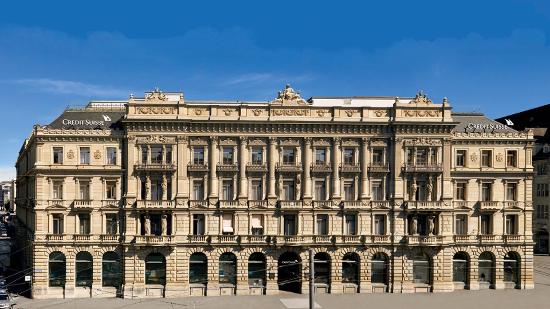
For decades, Switzerland sold one thing better than perhaps any country on earth: privacy. That became its true export. People think of watches, chocolate, pharmaceuticals, or skiing resorts, but Switzerland’s real business was protecting capital from governments. That was the foundation of modern offshore banking.
Switzerland has destroyed the very industry that made it rich. Hong Kong has officially overtaken Switzerland as the world’s largest offshore wealth hub, managing roughly $2.95 trillion in cross-border wealth compared to Switzerland’s $2.94 trillion, according to the latest Boston Consulting Group report.
This was entirely self-inflicted. I warned years ago that Switzerland was committing financial suicide by surrendering banking secrecy under pressure from Washington, Brussels, the OECD, and the global tax authorities. Once Switzerland agreed to automatic information exchange treaties and effectively transformed Swiss bankers into tax informants for foreign governments, they destroyed the very reason international capital flowed there in the first place.
Offshore banking was never simply about taxes. It was about protection from political instability, confiscation, currency collapse, revolution, war, and predatory governments. Switzerland became wealthy because it remained neutral and outside the endless political insanity consuming Europe.
But after 2008, the entire Western financial system changed. FATCA turned foreign banks into enforcement agents for the IRS. CRS reporting standards spread globally. European politicians demonized offshore banking because governments drowning in debt cannot tolerate wealth escaping their reach. Suddenly, confidentiality itself became suspicious.
The politicians pretended this was about “fairness” and fighting tax evasion. Nonsense. This was about governments hunting capital because sovereign debt is spiraling out of control worldwide. Europe is collapsing economically under regulation, welfare spending, energy costs, migration pressures, and war expenditures. Once governments cannot sustain themselves honestly, they begin searching for private pools of wealth to confiscate.
Switzerland surrendered to that pressure completely. The famous Swiss numbered account became little more than mythology. Automatic reporting agreements gutted the entire purpose of Swiss banking secrecy. Once confidentiality disappeared, wealthy clients naturally began looking elsewhere.
That is where Hong Kong entered the picture. Hong Kong operates under an entirely different mentality. While Switzerland spent years apologizing to foreign governments and dismantling privacy protections, Hong Kong positioned itself as the gateway between Chinese wealth and global markets.

Now this does not mean Hong Kong is some perfect banking paradise. Hong Kong has strict compliance laws, anti-money laundering rules, and increasingly close oversight connected to Beijing. In fact, banks in Hong Kong are now tightening controls even further after recent crackdowns from mainland Chinese regulators on cross-border capital flows. HSBC, Hang Seng Bank, and Bank of China Hong Kong have all reportedly begun requiring additional declarations and source-of-funds verification for mainland clients.
But the key difference is that Hong Kong still understands the importance of attracting capital instead of demonizing it. Hong Kong’s banking system remains designed around facilitating international trade, multi-currency transactions, corporate structures, and cross-border investment flows. It serves as a gateway into and out of Asia, particularly China. Switzerland increasingly became an extension of Western regulatory enforcement.
Hong Kong also still offers advantages that disappeared in much of Europe. Foreign ownership remains relatively open. Banking and corporate structures are integrated with global trade networks. Taxation remains comparatively competitive. English remains widely used throughout the financial system. Cross-border finance is treated as an industry to encourage rather than politically attack.
Switzerland voluntarily dismantled one of its greatest economic industries. Offshore wealth management supported enormous portions of the Swiss economy directly and indirectly through banks, law firms, wealth managers, accountants, real estate, hospitality, and luxury services. They destroyed a major national advantage because politicians feared international criticism.
Then came the collapse of Credit Suisse, which shattered the psychological aura surrounding Swiss banking stability. Once clients saw one of Switzerland’s historic institutions fail under political and regulatory pressure, confidence began shifting elsewhere.
Meanwhile, Asia is creating wealth while Europe destroys it. Hong Kong and Singapore are projected to continue expanding cross-border wealth at far faster rates than Switzerland through 2030. Europe has become hostile toward capital formation itself. Brussels regulates everything to death, taxes productivity, attacks energy production, and now openly discusses wealth taxes, exit taxes, CBDCs, and expanded financial surveillance.
Governments no longer merely want taxation. They want total visibility and total control over capital itself. CBDCs, digital IDs, transaction monitoring, beneficial ownership registries, cross-border reporting agreements, anti-cash laws, unrealized gains taxes, and capital controls are all moving in the same direction.
Offshore banking once acted as a barrier against total government financial control. Switzerland abandoned that role willingly. Now the money is moving east.