

The new Penn Station is going to be big, airy, and very bronze.
New renderings, obtained by the Gothamist on May 26, offer a first look at the official redesign plans for the iconic New York City train station, which has long been derided for its windowless interior and maze-like tunnels—a subterranean hub that The Verge has described as a “hell hole,” The New Yorker has dubbed a “grimy ant farm,” and Insider has called “the worst place in New York City.”
The renderings show a new station that, by contrast, is full of high ceilings, natural light, and bronze accents—and it calls back to an original version of the station that was considered an architectural marvel.
A yearslong process
The push to redesign Penn Station has been a yearslong saga that’s experienced multiple delays due to political headwinds, bureaucratic obstacles, and multiple shuffles of the leadership overseeing the plan. Most recently, Amtrak and the U.S. Department of Transportation (DOT) stepped in to take over the project from the MTA, bringing the project under the purview of the Trump administration. The architects behind the redesign are PAU and HOK, and Amtrak and the DOT officially selected a team of developers, led by Halmar and Skanska, on May 19.
Earlier this year, multiple White House officials pitched renaming the hub “Trump Station” to garner more financial support for the renovation, sparking concerns that the design would become a personal branding project for the President, à la the Kennedy Center and White House ballroom. The clearest evidence of the Trump administration’s involvement in the new Penn Station is a Presidential seal and Trump’s own name etched into the southwest corner of the building’s new entrance.
While the new design does resemble the classical style that Trump has doggedly pushed in his second term, the proposed Penn Station renovation appears to be largely taking its cues from its own original Beaux-Arts construction.
Inside the proposed new Penn Station
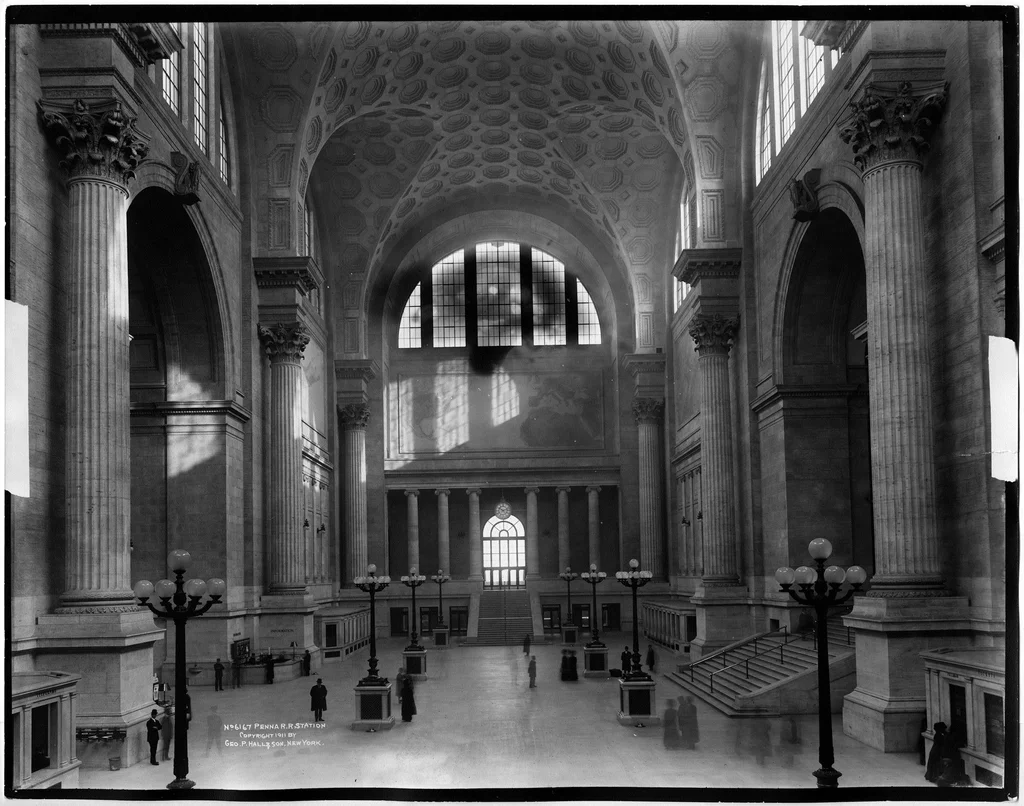
The original Penn Station was built in 1910 by Charles McKim of McKim, Mead & White, who took inspiration from the ancient Roman Baths of Caracalla. The building’s central waiting room was more than a block and a half long, full of tall, vaulted ceilings, Italian travertine, and more than 84 Doric columns. According to a piece from The New York Times, a hundred thousand people came to see the station on opening day, and “As the crowd passed through the doors into the vast concourse, on every hand were heard exclamations of wonder.”
In 1963, despite intense dissent, the building was demolished to make way for the entertainment arena Madison Square Garden, and the current Penn Station was planned as a fully underground station.
Now, decades later, the team behind the new design are essentially reversing course. According to records obtained by the Gothamist, the new Penn Station will include a massive train hall, which will require the demolition of MSG’s Infosys theater (a small venue within the entertainment complex) and part of the Garden’s walls to accommodate the structure.
Per the plan, there will be two new entrances to the station: one on Eighth Avenue where the Infosys theater currently sits, and another along 31st Street. A new bank of large windows will be installed along the grand entrance on Eighth Avenue, allowing natural light back into the station. In one document, the station’s developers wrote that they estimated only 3,400 square feet of the current station receives natural light, which they hope to boost to more than 55,000 square feet.
Like the original Beaux-Arts design, the new train hall will include rows of benches, columns, and a mezzanine level with several staircases leading down. The ceilings throughout the station are set to be raised almost everywhere, including by at least 50 feet at the Eighth Avenue entrance. Bronze accents are sprinkled throughout the space, including on the columns, a large clock, elevator shafts, and handrails. The station is scheduled to break ground in 2027, and Duffy estimates its cost to be around $8 billion.
In an interview with Dezeen earlier this month, PAU and HOK explained that the modern historical preservation movement “was in large part jump-started by the decision to build the current iteration of New York Penn Station, which replaced the previous classical structure.” They added that the new design “takes inspiration from this lost architectural gem while fitting with the major structures there currently.”