
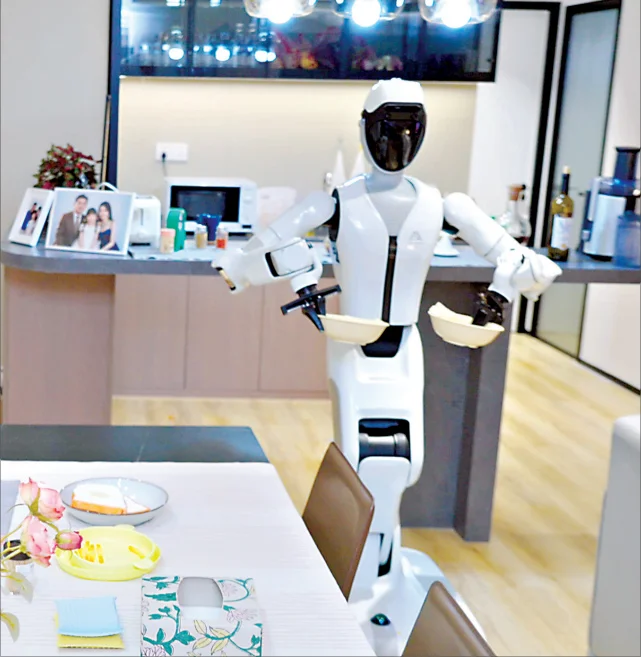
At last, the Jetsons are happening. Everyone’s long-held dream of having a humanoid robot at home to do all the household chores is almost here. Chinese tech firm GigaAI has announced the (allegedly) first commercial robotic butler ever. The company claims the first 100 pilot units will be deployed at the end of this month in employees’ homes. Then they will start deployment in Wuhan, for free!, in the first half 2027.
Called SeeLight S1, the robot is one of the many answers to China’s ongoing demographic crisis, which has been met by a Beijing directive that wants to put embodied AI wherever it is needed. Designed by GigaAI—a startup founded in 2025 and funded by Huawei’s investment arm—in collaboration with state-backed robotics research hubs Hubei Humanoid Robot Innovation Centre and the Hubei Humanoid Robotics Industry Alliance, the robot is a two-armed, wheeled machine that, according to the company, is the first general-purpose robot ever designed for the home. In demos, the S1 chops vegetables, fries eggs, loads a washing machine, hangs laundry, makes a bed, and opens curtains.
To keep things safe, built-in sensors are supposed to freeze its movements the instant it contacts a child or a pet. The S1 runs on embodied artificial intelligence—a digital brain wired directly into a physical body, capable of reading its environment and deciding what to do next without step-by-step instructions. Talking to the local newspaper Changjiang Daily, GigaAI’s CEO Zhu Zheng says that the S1 will eventually cost about $15,000 when it debuts at stores in June 2027.
But demos are all fun and laughter until the guy secretly controlling the bot takes his VR helmet off. Navigating a home is extremely hard for a robot. This isn’t a Roomba crawling around like a little turtle, bumping onto furniture in a 2D space. It’s a two-arm heavy machine that needs to navigate a very complex 3D environment that keeps changing. Guo Renjie—founder and CEO of robotics design company Zeroth—says that “home environments are non-standardized, where a robot faces an environment that changes every day.”
I spoke with Mark Rolston, founder and Chief Creative Officer of argodesign and formerly Chief Creative Officer at frogdesign, about humanoid robot design and the challenges they face in the real world. Rolston, who designed the robot Apolo for Apptronik—an Austin-based robotics company that specializes in developing general-purpose humanoid robots designed to work safely alongside humans—believes that it’s going to be very hard to see humanoids doing household chores anytime soon. “Sure, a humanoid may actually enter some homes in 2026. But come on. It’s not gonna do anything. There is no way. It’s not much more than a rich person’s ‘look what I got!’ It won’t get anything done,” he says.
While Rolston believes 2026 will be a “watershed moment” for robotics, there’s a lot to be done before getting to the homes. “It’s not going to be seeing C3PO through the streets or having robot baristas at Starbucks,” he tells me. First they will have to come to factories—which is already happening in China on a large scale. And then there’s the grocery store test: “The grocery store is a perfect collision of an uninvited machine to a very human moment, people sort of walking along the aisles, and grocery stores need a lot of query management, constant stocking.”
The new gold rush
The Chinese government, the country’s private corporations and university research labs think otherwise. They are already leaving American robotics far behind and they are doubling down on their investment and research.
Getting a robot to survive the chaos of a real home requires something factories have in abundance and kitchens do not: clean, structured data. According to the South China Morning Post, Shenzhen-based OneRobotics just locked down a large contract to collect real world data needed for these robots to understand the world around it. The company is deploying its OneRo H1 robots across actual homes, elder care facilities, and retail spaces to record high-frequency tasks like tidying kitchens and bathrooms.
The company says the project is “highly consistent with [the company]’s core strategy of focusing on embodied intelligence at home” and that the ultimate mission is to “bring AI robots into every household.” Meanwhile, other Chinese firms are pushing their humanoids into physical sports arenas—live, unpredictable environments—to stress-test their software and gather the kind of real-world data you simply cannot fake in a lab.
This is not a purely Chinese race. The global household robot market—which now is mainly robo vacuums like the Roomba, pool cleaning bots, and autonomous lawnmowers—was worth $41 billion last year and is on track to grow 20% annually through 2027. U.S. companies are testing the waters too: On May 14, 2026, San Francisco startup Gatsby sent an autonomous humanoid robot to clean a customer’s home, calling it “a milestone in consumer robotics.” But Gatsby is not selling robots. It wants to run an on-demand service model, like Uber for housecleaning—customers book through an iOS app and pay a flat $150 per session, no matter the apartment size. The machine handles wiping and floors on its own… but a human remotely takes over for the trickier jobs. That’s not what the Chinese have in mind, at all. They truly want smart robots as dexterous as humans, working on their own.
Don’t throw out your mop yet
None of this means your robot housekeeper is showing up next Tuesday. Like Rolston and Renjie, Wang Xingxing, founder and CEO of Unitree Robotics, acknowledges there is “significant potential” for home use but says it remains “challenging” right now.
Then there is the question of what happens when a full-sized machine shares your hallway. Humanoids pose real physical risks—they are capable of causing injuries as simple as falling over onto a person’s foot. For this reason, the robotics industry will limit early humanoid deployments to strictly regulated commercial environments like warehouses to perfect safety standards before entering homes—a position Jonathan Hurst, Chief Robot Officer at Agility Robotics, has laid out publicly.
When these machines do eventually reach living rooms, they will need to handle something subtler than dish-washing: Human comfort. Rolston argues that the design priority should be basic social acknowledgment. A robot that can glance at you as it passes, signaling “I see you and I’ll move,” goes a lot further than one that looks like a person.
We will see if GigaAI hits its timeline or pulls off an Elon Musk-style overdue underdelivery. But the destination is clear. The shift from machines that repeat to machines that think-and-act is already underway, and the money chasing it is staggering. Morgan Stanley projects the humanoid robot market will hit $5 trillion by 2050. The robot that chops your vegetables, folds your shirts, and makes your bed is coming. Whether it arrives in 2027 or 2028, one thing is clear: It’s happening and, like everything else with AI, it will probably get here faster than what we imagine.