
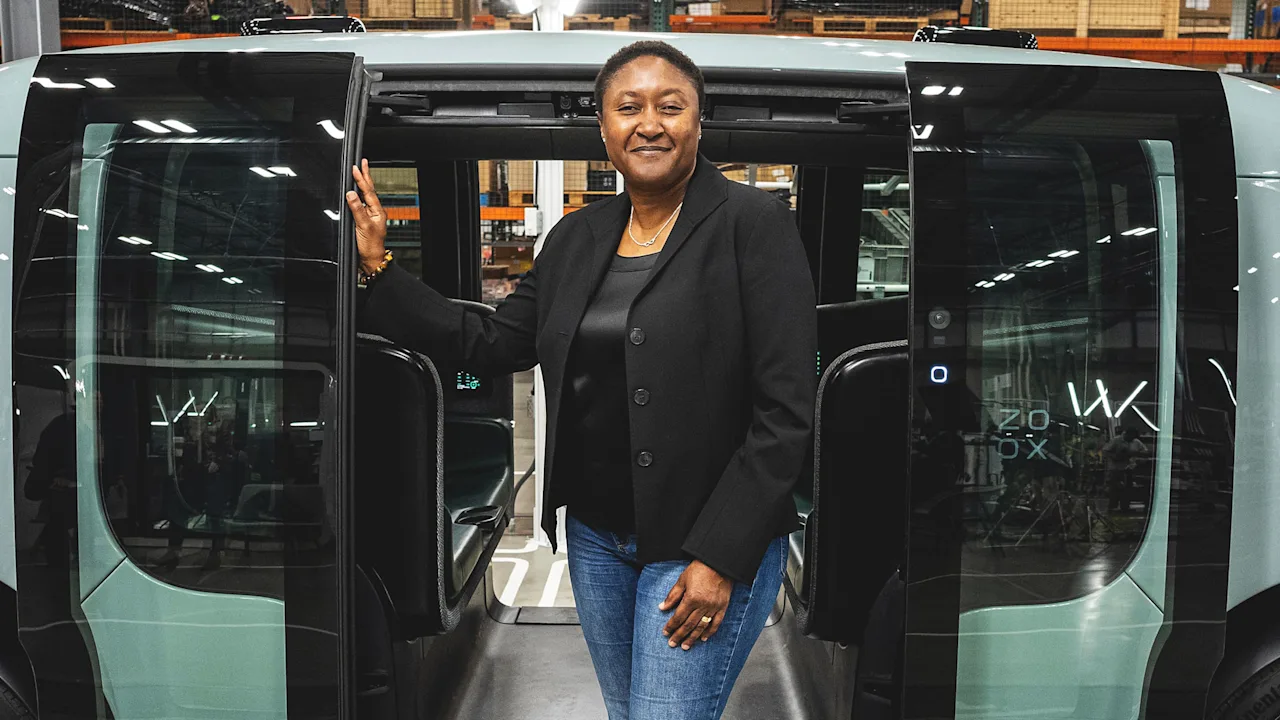
Robotaxis are multiplying across American cities. But are consumers actually ready to trust them? Zoox CEO Aicha Evans discusses the company’s strategy as an Amazon subsidiary, its intensifying rivalry with Waymo, and why a new partnership with Uber could be the key to getting autonomous rides from novelty to scale. Evans also reveals why she recruits what she calls an “invisible army of rebels” inside Zoox.
This is an abridged transcript of an interview from Rapid Response, hosted by the former editor-in-chief of Fast Company, Bob Safian. From the team behind the Masters of Scale podcast, Rapid Response features candid conversations with today’s top business leaders navigating real-time challenges. Subscribe to Rapid Response wherever you get your podcasts to ensure you never miss an episode.
Zoox is in the red-hot center of building a new mobility future: electric autonomous vehicles. You have a new partnership with Uber. Your robotaxis are operational in Las Vegas and San Francisco. How close are we, really, to a dramatically different mobility paradigm?
I think, as an industry, there’s been a lot of progress. We’re at the proof-point stage. Over the last 20 years, we’ve had a lot of “Oh, it’s happening tomorrow morning” and “Oh, it’s never going to happen.” We’re past that stage now. The proof points are there, for us and for fellow travelers. Now it’s a matter of starting to prepare for scale. But I’ve always been very consistent that this is not going to be like a consumer product where, all of a sudden, boom, 100 million people experience it. It’s going to be step by step, but we’re well on our way, which is really exciting.
Your most well-known fellow traveler, Waymo, has chosen to retrofit existing cars. You guys have opted for purpose-built vehicles with a striking design. It’s got two benches facing each other. There are no driver controls, no steering wheel. It doesn’t really look like a car. Why make that choice?
If AI is going to be doing the driving, it’s really about the customer experience and also about the best way to materialize this product. First, you have the safety aspect. In a regular passenger car that is architected for a human driver, the safest place to be is actually the front seat. For us, we were able to look at redundancy. We were able to look at our optimal sensor architecture so that we can see things, including occluded things. In Silicon Valley, sometimes maybe we think about the customer secondhand. Here, they thought about it firsthand and about the customer experience. It just does not feel like you’re in a car. What we’re seeing from folks, both people who ride and people in the communities where we ride, is curiosity. The first couple of minutes are, “Oh my gosh, what is this?” And then, “Wow, this makes so much sense.” Look, you’re not doing the driving, so why have a bunch of things that are involved in the driving?
You were part of the team that made Zoox a subsidiary of Amazon, which acquired it for $1.3 billion in 2020. How does Amazon help Zoox’s trajectory? Is it about financial resources, access to technology and AI? How is Zoox different than if it were on its own?
Focus, focus, focus. The financial backing is important. A strong relationship with AWS also goes without saying: the compute. One of the things I love about Amazon is the plurality and multitude of businesses and industries it has been in. We forget Amazon started by selling books.
So they’ve seen a lot. They’ve experienced a lot. There’s a lot of pattern recognition. There’s a lot of customer obsession. So we get a lot of advice. When something’s going really well: “Can you do more of that?” When something is going poorly: “Why is that? And how are you looking at bottlenecks?” This summer, it’ll be six years, so we’re way past the dating phase. I’ve been on both sides of M&A at big companies, and I would say Amazon gets maybe an eight and a half out of 10.
Eight and a half.
Yes. I have the freedom I should have. I tell people all the time, it’s not like when you have a startup that is fully in the private sector with a board. I’ve been on the other side, where you have VCs, institutionals and independents. There’s always a decision-maker and a boss. Make your peace with it. And we’re sending machines out there to drive among humans. People should ask us questions, whether it’s the regulators or our bosses. It is the right thing to do, and I welcome it, and we are better for it.
Your partnership with Uber, I’m curious how big a deal that is, because Uber also partners with Waymo. What makes that deal meaningful for you?
They do partner with almost everybody, which is great. If I were in their shoes, I would probably do the same. [Uber CEO Dara Khosrowshahi] has taken rides in Zoox, and Uber totally gets the differentiated experience. For Zoox, for almost 12 years now, we’ve been so focused on building the tech and building the processes. Over the last couple of years, we’ve really started thinking about commercialization and how we’re going to do this. I don’t see this category as just taking share from whatever exists today. I actually see an expansion of the market.
As far as Zoox and Uber, for us, it’s about learning. It’s about experimenting. I’m pretty sure if you arrive in Las Vegas, maybe you know about Zoox, maybe you don’t. Now you’ll see them on the Strip and be like, “What is that? Oh my gosh.” But I’m pretty sure you know about Uber. So right there, that makes it worth it to Zoox. And some transportation has nothing to do with pleasure. Frankly, it has to do with being utilitarian. If we can help serve that together and scale faster, the experiment will have worked.
Prior to Zoox, you spent some years at Intel. Are there things from that experience that you draw on, or is Zoox such a different business that you look elsewhere for lessons and inspiration?
Both. In general, I’m a curious person. I have this wonderful coach who taught me 15 years ago that it’s OK to ask for help. That is actually a sign of strength. So when I’m stuck, I’m known to pick up the phone and say, “Hi, I’m Aicha Evans from Zoox, an Amazon company. I need some help. So-and-so told me about you or introduced me to you.” But taking it back to Intel, I learned a ton there. I spent 12 years at Intel. It’s an important company. I root for that company to this day. I learned about hardware-software integration. I had a front-row seat to people who are hardware-only or software-only, and I was like, “Huh, that’s a problem.” I learned about process too. You’re going to laugh. If some ex-Intel or current Intel people who know me listen to this, they’re going to chuckle because I was known as a little bit of a rebel.
I complained about every process: “Why are we so slow and so dogmatic and so bureaucratic? Don’t you understand?” And yeah, well, guess what? Thank you. Thank you for that training, because then I came to Zoox, and it was still a very early start-up, a little less than 500 people. It had a lot of technology, but it really needed to be orchestrated and coordinated and to put processes in place, put orgs in place, put a common language in place, in order to succeed. So there are lots of learnings that I apply, but also lots of things not to do that I won’t tell you about.
That you won’t tell me. Yes. Because you have to move as fast as you can as well, not just slow. I guess that’s what being the rebel in that group means. I guess you want to have your own rebels within your own organization, but maybe not too many of them.
I want enough of them because you need a uniform distribution in all functions. One of the things at Zoox is that, because we’re vertically integrated, one day you’re talking to a traditional automotive engineer about chassis, battery, suspension, brakes and harnesses. The next day you’re talking to marketing about how much we want to emphasize safety, or not. So you want to make sure that, I call them affectionately, my invisible army, or the invisible army, is distributed across the corporation. But we also have to have a contract that we will debate, we will discuss, we will consider alternatives, but once we make a decision, we commit and we move, and we don’t revisit unless there’s evidence that assumptions were incorrect. Then we do a little bit of a feedback loop and keep moving forward.