
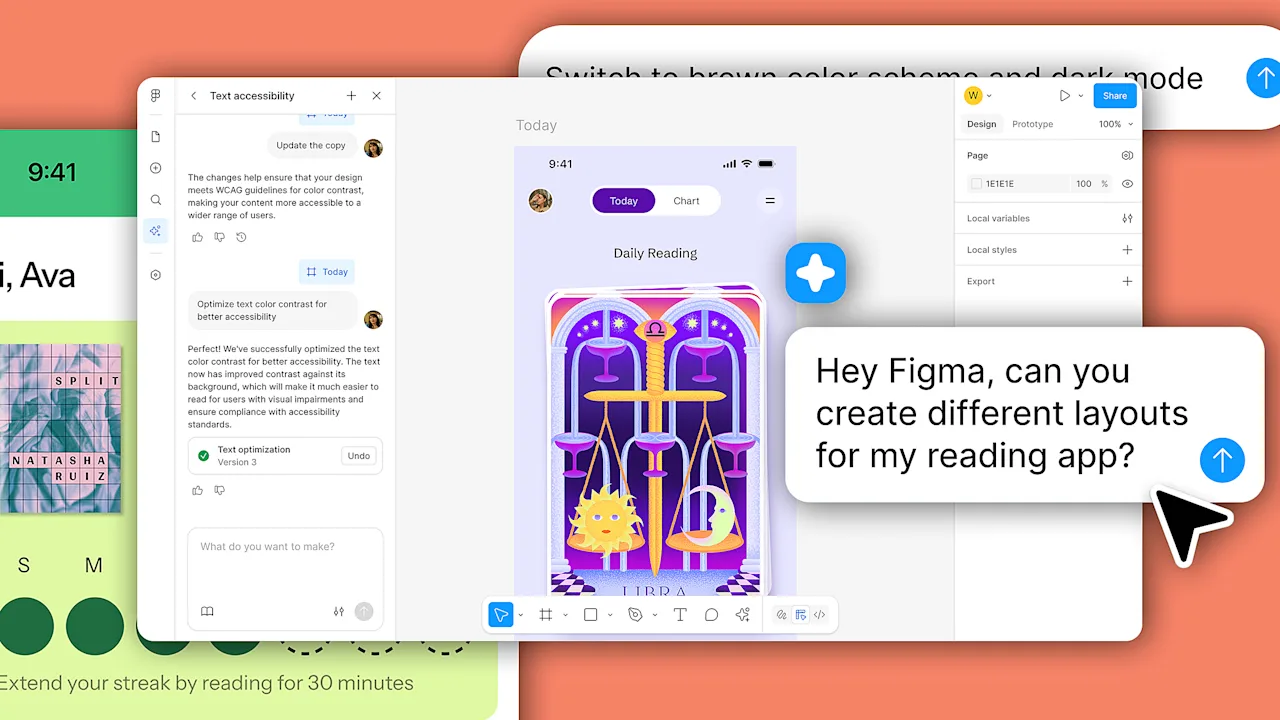
Today, Figma announced an AI agent built natively inside its collaborative environment. Forget the disconnected, floating prompt boxes we’ve grown so tired of; this system gives you multiple digital assistants right on your digital drafting board in Figma Design.
According to the company, it is capable of churning out interface elements and banishing the mindless drudgery of pixel-pushing, while keeping creators locked in their creative zone.
With the update, Figma is fundamentally reengineering the digital drafting board into an autonomous engine. By throwing the gates wide open—inviting the marketing department, code-wranglers, and project supervisors to play architect—the company is reshaping the very definition of who gets to be a creator.
Powered by a bespoke cocktail of algorithms educated specifically on UI architecture and the platform’s proprietary frameworks, this agentic system bridges the perilous gap between an abstract vision and a concrete, functional prototype.
How do Figma’s agents work?
Unlike other AI-powered UX exploration tools that create user interfaces using an isolated, sterile chat window that results in different screens for your app, Figma’s agentic design product is much more granular and offers what appears to be full control of individual elements down to every radial button and icon.
The natural language tool is embedded directly into Figma’s workspace and its elements. When you click on an app screen in your canvas, a star appears next to it, signaling that you can adjust the visuals with natural language. You just tell it what to do on the interface element you are working on.
It’s not only about making incremental adjustments, however. You can prompt the agent to generate initial design layers, explore multiple visual directions, change color palettes to one element or screen, or many, globally. It can handle the tedious work of formatting components, sometimes in bulk, like changing the spacing in the progress bar mentioned before and all the progress bars in your app.
Teams can deploy multiple agents simultaneously alongside their human colleagues, all of them working in tandem, controlled by different users. And crucially, the AI continuously reads the room, which means that it is constantly referencing your existing design system logic and the ongoing conversations right on the canvas, while you seamlessly toggle between typing commands and manually manipulating the design.
The agent tradeoff
The tool will undoubtedly be a time saver for seasoned designers. It will also be a way for non-designers to start designing. In theory, that’s awesome. Yet, this democratization is as terrifying as it’s exciting.
Much like generative video, handing AI design powers to non-creatives could lead to brilliant creations by those with a clear idea, but no skills or money to pay someone to execute it. But also it could be a fast track to a reality where the delicate art and science of product design is diluted into an endless ocean of sanitized, algorithmic sludge.
I brought this existential dread straight to Figma’s chief design officer, Loredana Crisan. She vehemently pushed back, arguing that automation doesn’t erase the artisan; it isolates their true value.
“When an agent can take you 80% of the way, that last 20% is how you stand out,” Crisan told me. To her, true distinction requires human taste. She insists that while automation undeniably raises the baseline quality for novices, “it also brings up the ceiling of what designers can envision. In the end, the more people who care about design—and the further we can help them push it—the better.”
The secret ingredient
Crisan says the key to Figma’s agent product is its “local context.” She told me that Figma doesn’t just rely on an omniscient, generalized oracle. “Under the hood, we use a variety of models for different tasks, some off the shelf and some we’ve fine-tuned ourselves,” she says.
More importantly, she stressed that “the ability to connect your own design libraries and reference other context on the canvas is what will make the agent outputs feel unique and relevant to your team.” The AI isn’t meant to operate in a vacuum.
“AI can help spark new ideas . . . but the designer is the one who picks the direction,” Crisan said.
Still, a beautiful concept on a canvas often shatters when it hits the brutal wall of engineering reality. Figma’s recent advancements for the Model Context Protocol (MCP) server promise a seamless trip from design to code, but I questioned how an AI resolves the inherent friction when a hallucinated layout defies the laws of Cascading Style Sheets (CSS) or backend constraints.
Crisan didn’t shy away from this harsh truth. “It’s true that sometimes visual concepts don’t translate well to engineering constraints. AI doesn’t change that dynamic entirely, but it does offer more tools to close the gap,” she says.
That gap closure, Crisan points out, relies on the broader ecosystem, noting that Figma Make, Figma’s ‘vibecoding’ tool, allows teams to instantly convert raw layouts into interactive, programmable applications.
“With our MCP server, you can bring context in and out of Figma to generate design-informed code without losing intent and fidelity,” she says.
Ultimately, Figma’s agent isn’t a magic wand that absolves us of critical thought. “AI is a tool, and the output depends on how you drive it,” Crisan says. If we treat this technology as a one-shot solution, we will drown in mediocrity. But if we use it to handle the grunt work, we might just reclaim the time needed to master the final, most crucial 20% of the craft.