
Want more housing market stories from Lance Lambert’s ResiClub in your inbox? Subscribe to the ResiClub newsletter.
During the pandemic housing boom, housing demand surged rapidly amid ultralow interest rates, stimulus, and the remote work boom. Federal Reserve researchers estimate “new construction would have had to increase by roughly 300% to absorb the pandemic-era surge in demand.”
Unlike housing demand, housing stock isn’t as elastic and can’t quickly ramp up. As a result, the heightened demand drained the market of active inventory and caused home prices to overheat, with U.S. home prices in June 2022 sitting at a staggering 43.2% above March 2020 levels.
The run-up was even greater in some metro markets, including Naples, Florida (+73%); Austin, Texas (+73%); Punta Gorda, Florida (+71%); Cape Coral-Fort Myers, Florida (+70%); and North Port-Bradenton-Sarasota, Florida (+69%).
Not long after mortgage rates spiked in 2022, the pandemic housing boom fizzled out. Since June 2022, the nationally aggregated housing market has been going through a period of recalibration—with U.S. home prices in March 2026 up just 2.2% above June 2022 levels, while weekly U.S. worker earnings during that same window jumped 14.7%.
However, some markets’ so-called recalibration window has gone further, and they’ve passed through a home price correction.
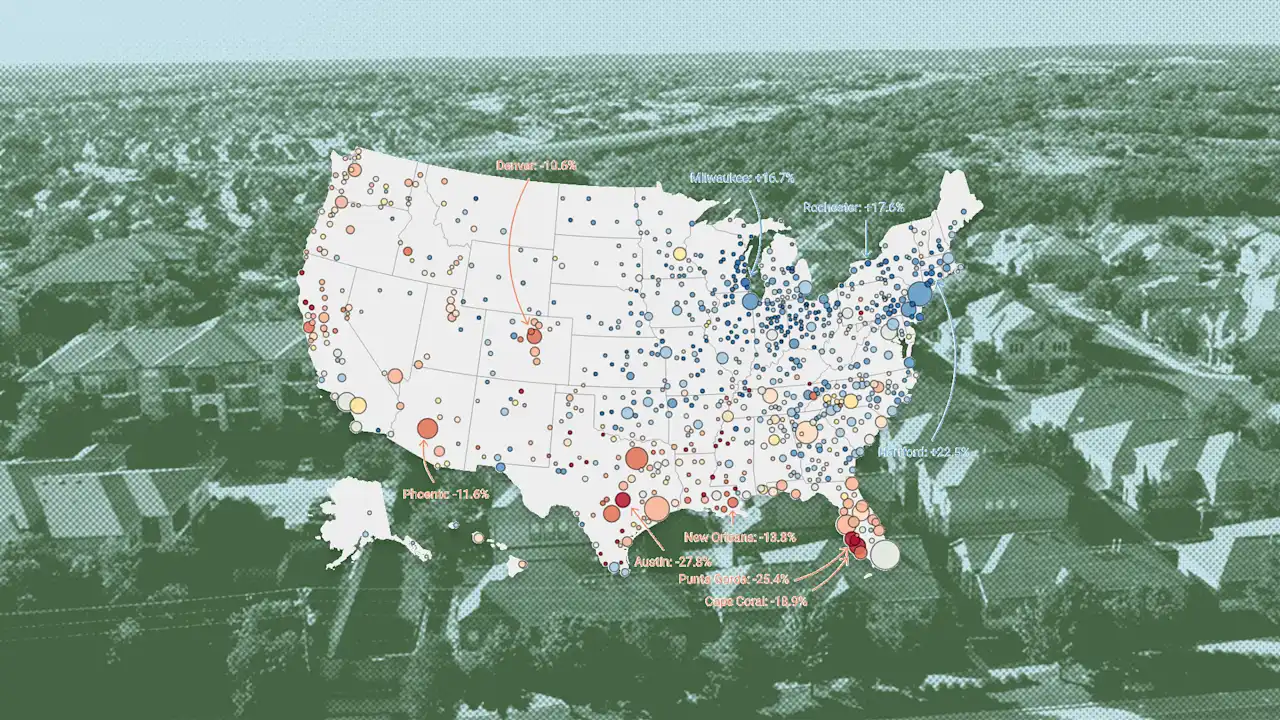
Among the nation’s 300 largest metro-area housing markets, these 15 markets have home prices this spring at least 10% below their local 2022 peak, according to ResiClub’s analysis of the Zillow Home Value Index:
- Austin-Round Rock-Georgetown, TX → -27.8%
- Punta Gorda, FL → -25.4%
- Cape Coral-Fort Myers, FL → -18.9%
- North Port-Sarasota-Bradenton, FL → -17.5%
- New Orleans-Metairie, LA → -13.8%
- Houma-Thibodaux, LA → -13.2%
- Boulder, CO → -11.8%
- Phoenix-Mesa-Chandler, AZ → -11.6%
- Naples-Marco Island, FL → -11.5%
- Lake Charles, LA → -11.4%
- San Antonio-New Braunfels, TX → -11.2%
- San Francisco-Oakland-Berkeley, CA → -11.0%
- Denver-Aurora-Lakewood, CO → -10.6%
- Dallas-Fort Worth-Arlington, TX → -10.1%
- Boise City, ID → -10.1%
Note: Just because a market is still down from its 2022 peak doesn’t guarantee that home prices are still falling there. At the latest reading, home prices are up year over year in metro New Orleans (+2.1%), and pockets of San Francisco are seeing notable pricing action this spring.
window.addEventListener(“message”,function(a){if(void 0!==a.data[“datawrapper-height”]){var e=document.querySelectorAll(“iframe”);for(var t in a.data[“datawrapper-height”])for(var r,i=0;r=e[i];i++)if(r.contentWindow===a.source){var d=a.data[“datawrapper-height”][t]+”px”;r.style.height=d}}});
Many of the softest housing markets, where home prices are down the most from their 2022 peak, are located in Southern and Mountain West regions. Many of those areas were home to many of the nation’s top pandemic boomtowns, which experienced significant home price growth during the pandemic housing boom, which stretched housing prices beyond local income levels.
Once pandemic-fueled domestic migration slowed and mortgage rates spiked, markets like Punta Gorda, Florida, and Austin, Texas, faced challenges, as they had to rely on local incomes to sustain frothy home prices. The housing market softening in these areas was further accelerated by the abundance of new home supply in the pipeline across the Sunbelt.
When and where needed, builders are often willing to reduce prices or make other affordability adjustments to maintain sales. These adjustments in the new construction market also create a cooling effect on the resale market, as some buyers who might have opted for an existing home shift their focus to new homes where deals are available.
In contrast, many Northeast and Midwest markets were less reliant on pandemic domestic migration and have less new home construction in progress. With lower exposure to that migration pullback demand shock—and fewer homebuilders offering large incentives—active inventory in these Midwest and Northeast regions has remained relatively tight.
As ResiClub has previously covered, there’s a moderate statistical correlation (R² = 0.30) between Moody’s Q2 2022 valuation score and the change in home prices from their 2022 peak through March 2026. If the San Francisco metro area—the largest outlier—is excluded, that correlation strengthens slightly (R² = 0.39).
window.addEventListener(“message”,function(a){if(void 0!==a.data[“datawrapper-height”]){var e=document.querySelectorAll(“iframe”);for(var t in a.data[“datawrapper-height”])for(var r,i=0;r=e[i];i++)if(r.contentWindow===a.source){var d=a.data[“datawrapper-height”][t]+”px”;r.style.height=d}}});
Among the 412 metro areas that Moody’s Analytics tracks, Punta Gorda has seen the biggest drawdown in “overvaluation” since the pandemic housing boom fizzled out in Q2 2022. It’s followed by New Orleans, Cape Coral-Fort Myers, Austin, and North Port-Bradenton-Sarasota.
In theory, as froth recedes and “overvaluation” comes down, so does downside risk. And that dynamic may already be quietly reshaping the risk profile in pockets of the Texas and Florida housing markets, where home prices have fallen and “overvaluation” has declined considerably since Q2 2022.