
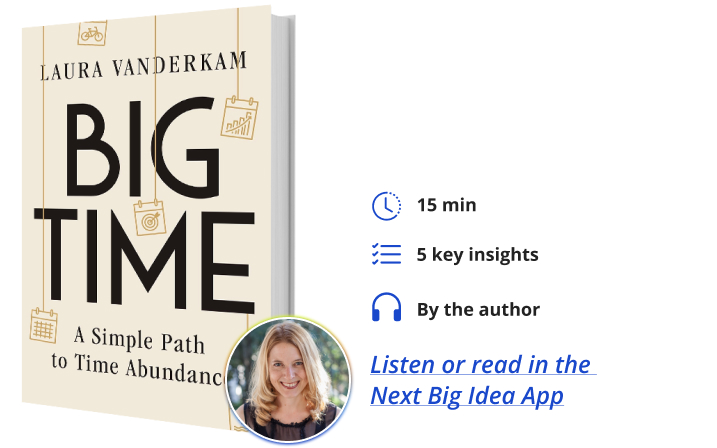
Below, Laura Vanderkam shares five key insights from her new book, Big Time: A Simple Path to Time Abundance.
Laura is the author of several time management books and the host of the Before Breakfast podcast. She is also the host of the Best of Both Worlds podcast, and her work has appeared in The New York Times, The Wall Street Journal, Fast Company, and Fortune.
What’s the big idea?
What if you’re not actually “too busy,” but just missing the secret to making your time work for you? By tracking your hours, embracing small steps, and saying yes to what excites you, you can turn everyday life into something far more intentional and a lot more fun.
Listen to the audio version of this Book Bite—read by Laura herself—in the Next Big Idea App, or buy the book.
1. Tracking your time makes you happier with your time.
I’ve tracked my time on weekly spreadsheets for the last 11 years. Yes, I know that makes me sound like a lot of fun! But I find that knowing where my time goes keeps me accountable and helps me cement memories. I’m a big fan of time tracking, and whenever someone wants to spend their time better, I suggest they try tracking their time for a week.
For Big Time, I decided to look more systematically at time tracking. I had 279 people track their time for a week. I asked them various questions designed to measure time satisfaction before and after the week. I found that people’s satisfaction rose significantly. Indeed, agreement with the statement “Generally I have enough time for the things I want to do” rose 25% in a week.
Partly, this is because time tracking inspires better choices. People didn’t want to document a three-hour YouTube binge in their logs, so they chose more fulfilling leisure-time activities and thus felt better about their time.
But the deeper reason is that seeing where the time really goes helps us rewrite our stories. Even if you work long hours, you don’t work around the clock. If you have a bad night, that doesn’t mean all seven nights of the week were terrible. You probably saw your family. You had some free time. It might not have been as much as you wanted, but it wasn’t zero either. When you see that, you start to see that life is pretty reasonable. Maybe you want to change things, but we’re talking tweaks, not a total lifestyle overhaul. Seeing where the time goes makes us happier with our time.
2. Life should be a circus.
When people say, “My life is a circus,” they mean it is chaotic. But I think this is a slander against circuses. A circus is incredibly well organized. No one gets shot out of a cannon at the wrong time. All the acts happen when they are supposed to happen. Tricks are executed with split-second precision. And many of those tricks happen over a net, so mistakes don’t turn into disasters. I think we should aspire for life to be a circus!
True time management masters think of themselves as the ringmaster of their lives. Life is a three-ring circus, with the rings representing your career, your relationships, and yourself. A good ringmaster knows what is going on in all three. She has thought through what needs to happen and when, and she has a plan for when things go wrong.
“As we plan our lives, we should ask what we are truly looking forward to.”
And, of course, a circus is managed for delight. No one wants to watch a show where people are just trudging through their acts. Likewise, as we plan our lives, we should ask what we are truly looking forward to. Maybe everyone gets where they need to go, but what sounds genuinely fun? If there’s nothing in the plan, go back and work on it again until this circus is one you’re proud to present to the world.
3. Big things are doable in small steps.
Many of us walk around with a story that we are starved for time. There’s no way we have time to do something like read War and Peace . . . or do we?
It turns out that even big things are doable when you break them down into small enough steps and spread them over a big enough chunk of time. For instance, a few years ago, I decided to tackle War and Peace. It turns out that Tolstoy’s epic is comprised of 361 extremely short chapters. I read one chapter a day for a year. Each day, I was reading for just a few minutes, so this project never felt overwhelming. But time kept passing, and my bookmark kept moving forward until, on December 27, I finished it.
So it goes for many things. If you want to listen to all the works of Bach, just listen for about 30 minutes a day, and you will get there in a year. If you want to read all the works of Shakespeare, pick up a 1,024-page anthology and read three pages a day for a year. Anywhere is walking distance if you’ve got the time, and by breaking things down into small enough steps, you reduce resistance and make big things feel doable.
The upside of that is that when you do big things, it’s hard to tell yourself a story that you have no time. After all, you have time to read War and Peace! It doesn’t matter if it only took a few minutes a day—that sense of time abundance can carry over into everything else.
4. Time satisfaction comes from embracing your golden hours.
People often talk of the golden years, that time after working when retirees can enjoy family and leisure. We get a miniature version of this every weekday evening during what I call our “golden hours”—the time after work and before bed.
“The key is to set one small intention each day for something you want to do during your golden hours.”
This is often the bulk of the leisure time people have during the week, but these hours are incredibly hard to use well. People are tired. We are out of energy and out of sorts. Still, I think it’s possible to make choices that allow us to feel like these hours actually happened.
The key is to set one small intention each day for something you want to do during your golden hours. It should be something that isn’t work, housework, or the physical care of family members. It should also be something you would genuinely look forward to doing.
I like to spend 30 minutes doing a puzzle or reading a book. Some people like to sit outside, go for a walk, make a special treat for dessert, call a friend, or do a hobby. It doesn’t have to be much, but when I had people try this for a week, their sense of time satisfaction rose significantly.
Interestingly enough, when people started setting golden hour intentions, they also started getting more sleep! It turns out a lot of people stay up late to get “me” time. But if you build in 30 minutes of me time somewhere else during the evening, you won’t need to stay up late, and this can make all of time feel better.
5. Opportunities come from saying yes.
A key tenet in a lot of productivity literature is that we should all say no more often. I get it. We feel overscheduled. I don’t want anyone spending time on things that are neither meaningful nor enjoyable for ourselves or the people we care about.
“One way to think about this is to use a rubric to decide whether to say yes or no to things.”
But almost all new opportunities, adventures, and relationships come out of saying yes. After all, if you knew about something great, you’d already be doing it. New things come from talking to someone new, following up, putting in some effort, and seeing where things go.
One way to think about this is to use a rubric to decide whether to say yes or no to things. In general, we want to spend less time doing things that we need to talk ourselves into. If you’re not initially excited, but it won’t be too hard, and it might look good on your résumé . . . that qualifies as a 5 or 6 on a 10-point scale of excitement, and that is how many of us fill our lives.
You want to sit up and pay attention when you start talking yourself out of something. If you’re initially excited but then start telling yourself that the logistics will be complicated, maybe it’s outside your comfort zone, you’d have to call in a favor . . . listen to that initial excitement. You can probably figure everything else out.
This article originally appeared in Next Big Idea Club magazine and is reprinted with permission.
Enjoy our full library of Book Bites—read by the authors!—in the Next Big Idea app.