
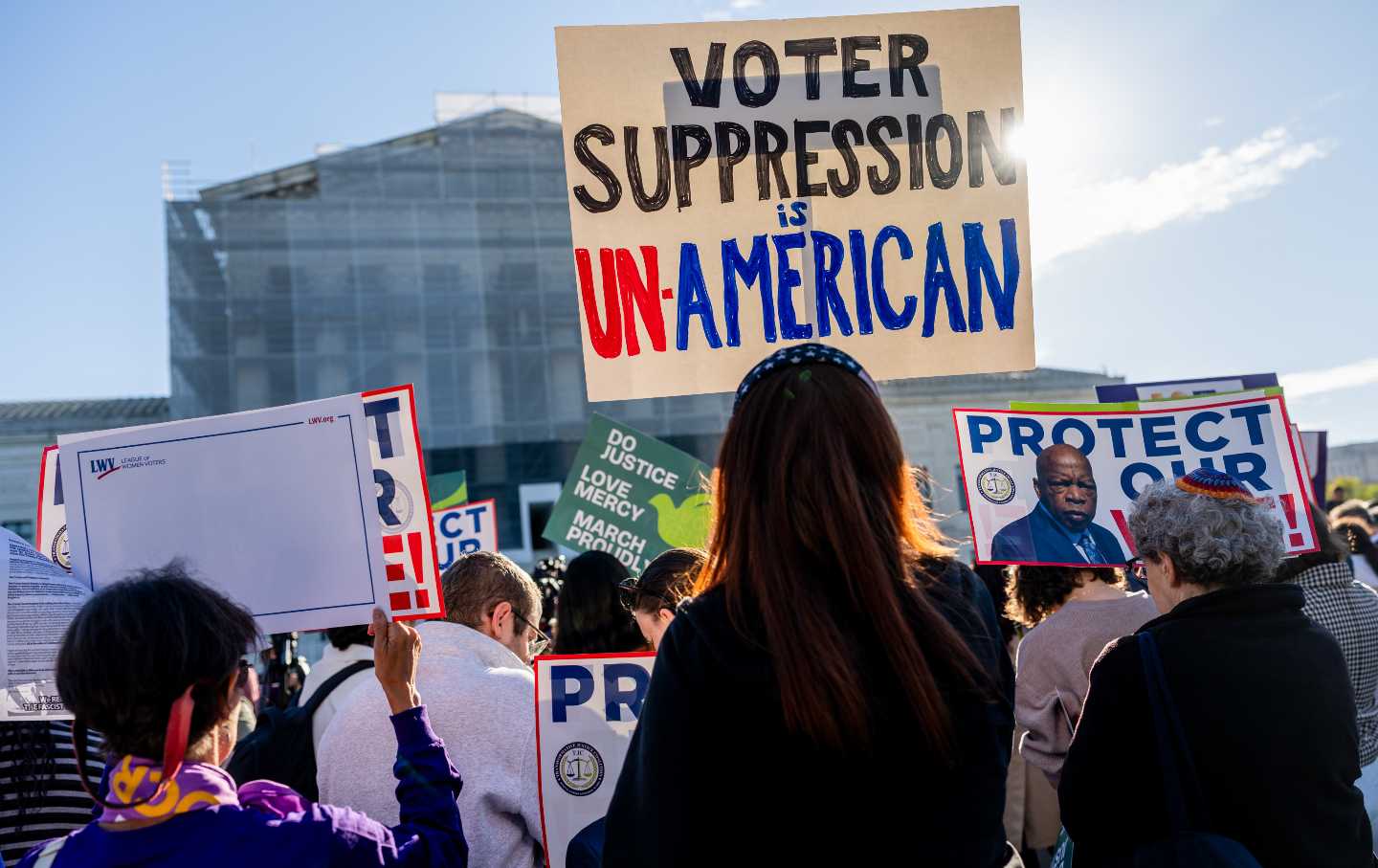
The US Supreme Court is aiding and abetting voter suppression.
America’s Southern sons of perdition and their Northern apologists defended the sin of human bondage with their blood-drenched cry of “states’ rights.” After they lost the Civil War, they defended the sin of Jim Crow and apartheid segregation. And now, rejecting the progress won with the lives of civil-rights martyrs, they are defending the antidemocratic sin of minority disenfranchisement. This is our nation’s unsettling history. Yet just as unsettling is the fact that at too many critical junctures in the 250-year struggle for American progress, the US Supreme Court has aided and abetted the Tories who have refused to accept the premise that all people are created equal.
The Dred Scott decision in 1857.
Plessy v. Ferguson in 1896.
Shelby County v. Holder in 2013.
The Southern Tories repeatedly shamed themselves and their region. But it is the Supreme Court that has repeatedly shamed the nation. This legacy of infamy was carried forward on April 29, with a decision to eviscerate the Voting Rights Act of 1965. The 6–3 decision was the final blow in a decades-long fight by Republicans—now led by President Donald Trump—who have sought political gain by undoing the work of the Rev. Martin Luther King Jr., the labor leader A. Philip Randolph, organizers such as Bayard Rustin and Fannie Hamer, and President Lyndon Johnson and Vice President Hubert Humphrey—work that enabled Americans to finally step out of the shadow of states’ rights and walk forthrightly into the bright sunshine of human rights.
With their decision in Louisiana v. Callais, Chief Justice John Roberts and his cabal confirmed their scorching disregard for the US Constitution and their own illegitimacy as arbiters of justice.
Current Issue

Justice Elena Kagan did not mince words in her dissent. “The Voting Rights Act is—or, now more accurately, was—‘one of the most consequential, efficacious and amply justified exercises of federal legislative power in our Nation’s history.’ It was born of the literal blood of Union soldiers and civil rights marchers,” Kagan wrote, quoting Ruth Bader Ginsburg’s dissent in Shelby County v. Holder. “It ushered in awe-inspiring change, bringing this Nation closer to fulfilling the ideals of democracy and racial equality. And it has been repeatedly and overwhelmingly reauthorized by the people’s representatives in Congress. Only they have the right to say it is no longer needed—not the members of this Court. I dissent, then, from this latest chapter in the majority’s now-completed demolition of the Voting Rights Act.”
The response to this decision must come immediately, as the people choose their representatives in the midterm elections. Democratic primary voters need to nominate congressional candidates who are committed to advancing the agenda proposed by Representative Ayanna Pressley, the Massachusetts Democrat who said, “Congress must immediately pass the John Lewis Voting Rights Advancement Act and take action to restore the integrity and legitimacy of [the] Supreme Court—including expanding the court, imposing term limits on Supreme Court justices, and passing a binding Supreme Court code of ethics. Every option should be on the table.”
But this isn’t just a federal fight. Democrats in states like Georgia and South Carolina have an opportunity to redouble their efforts to elect governors who are prepared to block racist gerrymanders, and national Democrats must not neglect any of this year’s gubernatorial and legislative elections in the South. The Legal Defense Fund reminds us that officials have the power to pass state-based voting-rights acts. And Democrats in blue states can counter President Trump’s scheming to rig the next Congress in his own favor. Trump’s GOP allies have already redrawn the maps for congressional districts in Texas and Florida, and the high court’s decision could inspire more gerrymandering in states like Louisiana. Democrats in California and Virginia have redrawn their own maps and restored a measure of balance. But the fight cannot stop there. The Wisconsin gubernatorial candidate Mandela Barnes has the right idea: If elected with a Democratic legislature, he promises to move immediately in 2027 to redraw the battleground state’s congressional maps, which are currently gerrymandered to give Republicans a 6–2 advantage. “Red states are being given a free pass to rig their maps by disenfranchising Black voters,” Barnes said. “We can’t sit this fight out.”
From illegal war on Iran to an inhumane fuel blockade of Cuba, from AI weapons to crypto corruption, this is a time of staggering chaos, cruelty, and violence.
Unlike other publications that parrot the views of authoritarians, billionaires, and corporations, The Nation publishes stories that hold the powerful to account and center the communities too often denied a voice in the national media—stories like the one you’ve just read.
Each day, our journalism cuts through lies and distortions, contextualizes the developments reshaping politics around the globe, and advances progressive ideas that oxygenate our movements and instigate change in the halls of power.
This independent journalism is only possible with the support of our readers. If you want to see more urgent coverage like this, please donate to The Nation today.