
The state has a tremendously successful pilot in four counties to offer free services to those on pretrial release. But federal budget cuts put the program at risk.
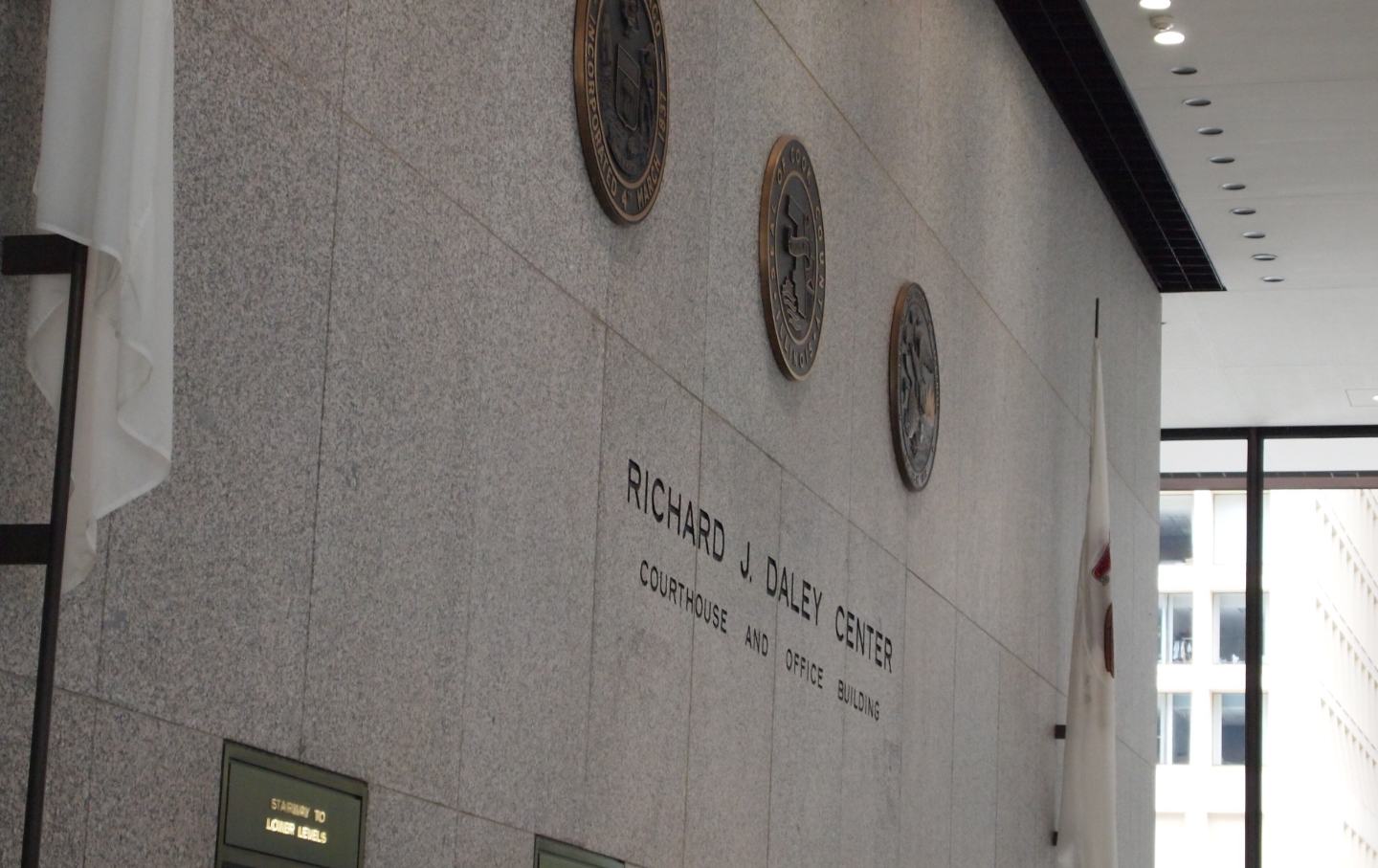
The Richard J. Daley Courthouse and Office Building in Chicago.
(Jaysin Trevino / Creative Commons)
Last year, R.J. Horacek, a 29-year-old Illinois resident, was arrested by police in DuPage County. After the arrest, he didn’t spend any time in jail—Illinois abolished cash bail three years ago—but over the past year, he has been required to regularly appear in court as his case proceeds. In December, Horacek moved to Aurora, a six-hour walk from the court. He doesn’t have a car or any extra funds to pay for rideshares; he’s unemployed and was recently homeless. He has no family or friends nearby. “I pretty much have no one,” he said. If he fails to make it to an in-person hearing, he could have a warrant issued for his arrest for failing to appear.
Then in March, a public defender told Horacek about Radical Hospitality Ministries, a nonprofit that runs one of four pilot sites through state grants to offer a variety of free pretrial services to people like him. Three days before an in-person hearing, as he contemplated making that six-hour walk, the organization told him it could get him to the courthouse for free. He immediately felt “that stress lift off my shoulders,” he said. “I’ve been struggling with everything, and just to have this one part of it [taken care of], that is huge.” The organization has given him rides to and from court ever since. “They make it happen no matter what, because they understand people in my scenario don’t have any other means,” he said. “Without their support, it feels quite impossible.”
That wasn’t the only help Horacek received. The organization offers food to people who have been released pretrial and has given Horacek a snack and tea after stressful court appearances. It put him in touch with a nearby legal aid organization. It connected him to a church that helped him print documents for court for free and covered the cost of legal consultation.
Horacek struggled to express his gratitude for the help Radical Hospitality Ministries has given him. It has “been everything I’ve needed and a huge stress off my shoulders,” he said. “No matter what it is, how it is, I do plan on paying them back in some way, shape, or form.”
In 2021, Illinois lawmakers passed the Pretrial Fairness Act, which, as of September 2023, made the state the first to eliminate cash bail. The effects were immediate: Within a year, the urban jail population fell by 14 percent and the rural population declined by 25 percent. But lawmakers didn’t stop there. Last year, the legislature allocated $3.5 million to pilot sites in four counties throughout the state to offer free services to those on pretrial release to help them return to court and avoid getting tangled up with the legal system in the future. The sites have already helped hundreds of people with things like transportation to courthouses, childcare during their hearings, and connections to mental health and substance abuse programs at no cost. Advocates say they are working remarkably well, helping people avoid arrest for failure to appear and, ultimately, move on with their lives.
But the state legislature is currently debating the budget for next fiscal year, and including funding for this program is not guaranteed. Its future hangs in the balance just months after the programs got off the ground.
Current Issue

The abolition of cash bail in Illinois ended the fundamental injustice of people being thrown in jail because they didn’t have enough money to post bail, not because they posed a threat or were about to flee. Between 2016 and 2019, Illinois residents collectively paid nearly $150 million in bail to secure their freedom. But those charged with crimes are still obligated to return to court; a felony case can take two years of court appearances to resolve. Bail, in its original form, was intended to ensure that people returned to court; advocates wanted the state to provide services that would help people make it to their hearings. “We have so many more people now who are getting to return to the community while awaiting trial,” said Matthew McLoughlin, an organizer for the Illinois Network for Pretrial Justice. “What else could we be doing to help those folks succeed?”
The Pretrial Success Act offers services that might help people return to court, such as transportation, childcare, and case management. It was passed in the spring of 2024 with enough money to fund up to five pilot sites, but grants didn’t flow until this past fiscal year. Four sites were picked as pilots: Champaign County; Cook County, which includes Chicago; DuPage County; and Will County. Anyone who has been released pretrial for a case in one of those courthouses and has a pending case is eligible for these programs. Importantly, the services offered are voluntary; no one is obligated to accept anything they don’t want.
The services are also intended to help people address whatever it might have been that led to their getting arrested in the first place. “Criminal legal system reform addresses the injustices that happen in the court system,” McLoughlin noted. But such reform “can’t fix the reasons that may have brought people into contact with the courts.” For some, that’s mental health or substance abuse struggles; for others it may be poverty-related issues like a lack of housing or a job. Offering treatment or employment assistance can help people “disentangle themselves from the legal system while they do that work to fight their case,” McLoughlin said. That should help keep people from committing crimes while on release and after their cases are closed, preventing them from “having to go through this process in the future,” McLoughlin said.
Earlier this year, Lauren, a mother of four, forgot about a court date. Caught up in her children’s needs, she said, the court appearance had “just slipped my mind.” The DuPage County court issued a warrant for her arrest for failure to appear.
When Lauren, a pseudonym, later went to court, staff from Radical Hospitality Ministries were waiting to ask her if she needed help. She had a ride home that day from her mother, she told them, but she would need help getting back to court: she lives in Chicago, over a half-hour drive away. They sent her reminders for upcoming court dates and gave her bus fares and even paid for an Uber so she could come back to court for monthly hearings. They also covered an order of groceries for her and her children and gave her a coat in the cold winter. When she comes to court, they give her snacks and hot cocoa. She hasn’t missed a single court date since.
“It was a big blessing to me,” she said. “I can’t even stop thanking them.”
Radical Hospitality Ministries, which runs the pilot site in DuPage County, in the northeast of the state, served its first client the first week of August last year. He was a man in his late 70s who uses a walker to get around and had been arrested for failing to appear in court. The man suffered from memory loss caused by a fall years earlier; he forgot about his case. He lived more than an hour away from the courthouse, but when he was released after his arrest, he wasn’t given a walker, didn’t have a phone, and had no way to get home. The organization offered him free transportation back to where he lives. “What would have happened to that person without a program like ours?” asked James Baugh, cofounder of Radical Hospitality Ministries. “Would he have died on the streets? Would he have been reincarcerated because he did something out of desperation?”
By late April, Radical Hospitality Ministries had already served 425 people. “We hit the ground running, we’re doing a lot of work, we’re helping a lot of people,” Baugh said. About 90 percent of the people it’s helped have showed up to all of their court dates and haven’t been incarcerated for a different offense while on release.
Popular
“swipe left below to view more authors”Swipe →
DuPage County has limited public transit, so a lot of clients need help getting home from jail and getting back to court for later appearances. The organization owns a van, which is now mostly dedicated to driving people to and from the courthouse, and staff also drive clients in their own cars. As of late April, it had provided more than 250 trips to the courthouse; that doesn’t include rides home or to other services like doctors’ offices. It also provides clients with public transit fares. While the organization serves anyone who has a case in DuPage, those people live all over the state, some hours away. “We use planes, trains, and automobiles,” Baugh said. The organization has provided people with tickets for Amtrak and charter buses. “It’s always cheaper to help people get to court than it would be to not help them,” he said, and have them get arrested for failure to appear.
The organization takes care of needs great and small. Staff sign up for a client’s court date reminders in case that person gets a new mailing address or otherwise fails to receive updates; they send texts to check in and remind clients of upcoming hearings while also asking about any other needs they might have.
It has a wardrobe at its office across the street from the courthouse for anyone who doesn’t have appropriate clothes “so they’re showing the best version of themselves in court,” McLoughlin said. Some people get arrested in the winter in shorts and a T-shirt, and that’s how they get released from jail; the organization can offer warmer clothing. They also offer people food either because they’re hungry upon release or are going home to an empty refrigerator.
The organization has a contractual relationship with a childcare provider it can use to help people who need coverage for their children while they appear in court. But, Baugh said, most clients have been able to make use of the courthouse’s existing children’s waiting room that’s supervised by adult volunteers with backgrounds in early childhood education. It’s just that no one seemed to know about it until Radical Hospitality Ministries helped them get connected.
For those who need mental health or substance abuse treatment programs, Radical Hospitality Ministries connects clients to providers and then covers the entire cost of the care. It can also connect them with housing providers, educational opportunities, and employers to “help them plan for the long term,” Baugh said. “We want to make sure that when their pretrial release is over, they’re not just back to where they were.”
Although Illinois Governor JB Pritzker’s budget this year included a line item for the Pretrial Success Act, McLoughlin said, it only contained a few thousand dollars left over from the previous year, which isn’t enough to keep the pilot sites going. Radical Hospitality Ministries has enough funding to operate through the end of June, but if the legislature doesn’t pass additional funding, it will close after that.
The Illinois Network for Pretrial Justice estimates that it would take $15 million to fully expand the program statewide next year. If the state legislature funds the program at the same $3.5 million it got last year, it would allow the four pilot sites to continue and add a fifth in Southern Illinois. But it’s “a tough budget year,” McLoughlin said, given the major cuts to safety net programs resulting from Republicans’ One Big Beautiful Bill.
If the legislature does add enough funding to the program for it to fully expand, however, advocates are ready. Radical Hospitality Ministries is prepared to open offices near additional county courthouses. Other counties have seen what’s been done in the four pilot sites and are eager to bring it to their areas; in letters shared with The Nation, the directors for court services in Kane and Kendall Counties wrote about their desire to participate. “Having a community-based agency that is not directly connected to the court system will offer a resource to community members without the apparent stigma of judicial involvement,” Kane County court services director LaTanya Hill wrote. “Services such as court reminders, transportation, child-care resources, food, and healthcare are the basic needs that often pose as barriers to this population.”
The Illinois Network for Pretrial Justice has repeatedly brought its members to talk to state lawmakers about their personal experience with the pilot sites and has “been having lots of positive conversations with legislators,” McLoughlin said. “We’ve heard a lot of enthusiasm for funding the program. I think we are feeling very hopeful right now that, at a minimum, these pilot sites would continue.”
“We’ve taken a huge positive step forward with the Pretrial Fairness Act,” Baugh added. “This is the logical next step in this process.”
From illegal war on Iran to an inhumane fuel blockade of Cuba, from AI weapons to crypto corruption, this is a time of staggering chaos, cruelty, and violence.
Unlike other publications that parrot the views of authoritarians, billionaires, and corporations, The Nation publishes stories that hold the powerful to account and center the communities too often denied a voice in the national media—stories like the one you’ve just read.
Each day, our journalism cuts through lies and distortions, contextualizes the developments reshaping politics around the globe, and advances progressive ideas that oxygenate our movements and instigate change in the halls of power.
This independent journalism is only possible with the support of our readers. If you want to see more urgent coverage like this, please donate to The Nation today.
More from The Nation

The Catholic Church’s power is on the wane—but it now has a pope who is to the left of many US institutions and enrages the president by expressing his convictions.

Across the US, students are missing school, falling behind academically, and carrying the trauma of detention and family separation into school each day.

At the Bezos ball, WNBA stars chose celebrity over solidarity.
Trans people have been going underground to access care for generations. But that doesn’t mean DIY networks are a large-scale strategic answer to transphobia.
The Remedy Project trains students to help incarcerated people file grievances, expose abuse, and, in some cases, secure release.
The stakes are undeniable when voting rights are diminished and abortion access is on the line.