
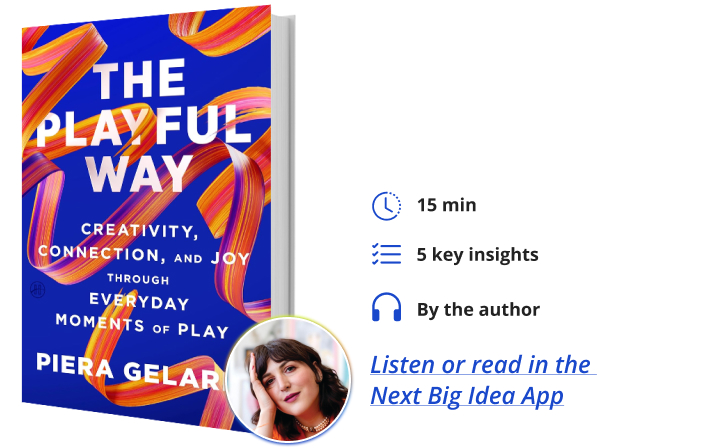
Below, Piera Gelardi shares five key insights from her new book, The Playful Way: Creativity, Connection, and Joy Through Everyday Moments of Play.
Gelardi is a creative entrepreneur. She cofounded the media brand Refinery29 and, more recently, the creative wellness company NoomaLooma.
What’s the big idea?
Playfulness means being curiously, creatively, and courageously engaged with life. Being playful isn’t the easy choice. It requires showing up authentically, risking looking silly, and trying something that might not work. In a world that rewards performance and polish, choosing play is a quiet act of courage that will help you feel alive.
Listen to the audio version of this Book Bite—read by Gelardi herself—in the Next Big Idea app, or buy the book.
1. Pressure narrows. Play opens.
When life throws a curveball, you must choose between taking the Pressured Way or the Playful Way. The Pressured Way is often our default: Tense up, try to get control, force the solution. The Playful Way approaches the same situation with curiosity, levity, and openness. It’s the difference between white-knuckling through life and seeing it as an adventure.
Think about the last time you were really stuck, be that attacking a problem from the same angle, a hard conversation you kept dreading, or a decision that felt impossible. The more pressure you applied, the smaller everything felt. That’s not a personal failure. That’s just what pressure does. It narrows your thinking, tightens your options, and puts you in survival mode.
Play does the opposite. Think about the last time someone cracked a joke in a tense meeting, and suddenly the whole room shifted. Or when someone asked a genuinely unexpected question and new possibilities opened that weren’t visible a moment before. The Playful Way reorients situations to a position of curiosity instead of control, openness instead of force, and fluidity instead of rigidity.
2. Playfulness makes seriousness bearable.
We’ve all absorbed some version of these messages as we grew up: be serious, get focused, act your age. We’ve been taught to think play is for kids, for weekends, or for after you’ve earned it.
When my company, Refinery29, was growing and we began hiring more corporate people, I started hiding my natural playfulness. I thought that to be taken seriously as a leader, I needed to sand down the parts of me that were curious, irreverent, and imaginative, that those qualities had no place in a serious business.
In this mindset, I slowly suffocated. From the outside, it looked like I had reached a splendid career high, but I was spending nights lying on my apartment floor crying and making lists of all the ways I was failing. I was overworked and underplayed—spectacularly, chronically underplayed. Cutting myself off from playfulness hadn’t made me more professional. It had cut me off from my resilience, my perspective, my joy for the work, and my ability to roll with challenges creatively.
When I reconnected with play—brought it back into the office, back into how I led, back into how I thought—I became more resourceful, more connected to my team, and I wanted to show up for work again. That has been true not just in work but across my whole life. I live with depression, anxiety, and ADHD, and play has been one of my most powerful tools for working with them rather than against them. Instead of bracing and fighting, play gives me a way to stay fluid, curious, and connected to myself, even on hard days.
3. Discover your powers of play.
One of the most common things people tell me is, “I’m just not a playful person.” When I ask what they mean, they almost always say that they’re not silly. They’re not performing funny impressions at the dinner table or turning meetings into a comedy set. But silliness is only one tiny corner of play.
Playful people come in many forms:
- The Mundane Alchemist is someone who makes every mundane errand feel like an adventure. They transform daily life with reframes and games.
- The Curious Quester is the person who asks the question in a meeting that suddenly opens everything up. Their form of play is intellectual exploration.
- The Mover and Shaker is someone who can’t sit still when they’re excited and who thinks with their whole body.
- The Joyful Jester is the person who cracks a joke in a tense moment and shifts the entire room.
These are four of the eight Powers of Play. Each one is a distinct mode of creative aliveness. When you’re living in yours, people feel it. You become magnetic. Your authenticity shines.
Some powers will come more naturally to you than others, but they’re each like muscles that you develop with practice. You’ll likely find that you draw on different powers in different situations.
4. Playfulness is a practice, not a vacation.
We tend to think of play as something we do when life slows down—on vacation, on weekends, or after we’ve finished the hard stuff. But it’s in the texture of ordinary days that playfulness has the most power to transform your life.
I’m not talking about big time-outs. I’m talking about small, deliberate moments woven into the fabric of your day. When I’m feeling anxious and wound up, I do a two-minute shake break in which I shake my whole body wildly like a wet dog, and it interrupts the spiral every time. When I’m feeling stuck or low, I go on a Wonder Wander—a slow, sensory walk where I’m not trying to get anywhere, just noticing and delighting in what’s around me. When something goes wrong, I try to find the funny—not to dismiss the difficulty, but to find the pinhole of light in it.
These aren’t frivolous. They’re how I stay connected to myself, find solutions, and tap into joy along the way. The more you layer play into the ordinary moments, the more resilient, creative, and alive you feel.
5. The P.L.A.Y. process.
Knowing you want to be more playful is very different from knowing how to shift states in the middle of a hard moment. So, I developed a four-step process called the P.L.A.Y. Process for moving from a pressured state to a more playful one:
- P — Pause and Accept. Stop. Acknowledge what’s true right now, without judgment.
- L — Lighten. Find one small way to reduce the weight of the moment, be that a laugh, a breath, or a moment of physical movement.
- A — Activate Your Play Powers. Deliberately engage a specific power of play, whatever feels natural to you.
- Y — Yes, and. Work with what’s in front of you instead of fighting it. Say “Yes this is happening AND I can handle it the Playful Way!”
I used this recently while standing in an airport security line. The line was chaos. People were huffing, puffing, and emanating frustration. My flight was in an hour, and the checkpoint felt miles away. I could feel myself getting pulled into collective misery.
I chose to Pause and Accept: I stopped and acknowledged that I’m in a slow line and feeling stressed.
Then I Lightened: I took a big, loud breath and caught my partner’s eye.
Next, I Activated my Play Power: I deliberately chose to lean into levity and raised my hand for a high five. “YES! One turn closer!” I cried. My partner looked confused, then grinned and slapped my palm.
And then I said “Yes, and”: I chose to work with what was happening, the playful way. With each turn, I celebrated our micro progress. By the third zigzag, a family with a toddler was holding up their hands before we could even offer ours. A pocket of genuine laughter had formed in our section of the line.
Nothing changed. We were still late. The line was still long. But the entire experience transformed from stress to humor and from isolation to community. That’s the P.L.A.Y. Process. It’s not about waiting until conditions are perfect. It’s a tool for finding the playful way in the middle of the mess.
Enjoy our full library of Book Bites—read by the authors!—in the Next Big Idea app.
This article originally appeared in Next Big Idea Club magazine and is reprinted with permission.