
While it’s nice that politicians are finally talking about the “affordability crisis,” working folks are wondering: Where have you been?
In my early 20s, I worked in a courthouse. Courthouses aren’t as exciting as you might think; real trials rarely happen and mostly papers are filed, data is entered, callers are put on hold. Courtrooms are a depressing parade of people who have messed something up in some fashion or another and now are having their lives turned upside down by judges, bailiffs, attorneys, and jailers who rarely look up from their desks.
Most of the work isn’t in the courtroom but the adjacent office. This is where dozens of people, nearly all women, stamp documents, clack on keyboards, and stand on their tippy toes to retrieve files. It was the office where I met Carla, a fortysomething grandma who kept stuffed animals in her desk drawer for the children who had to wait by her desk while parents went in court.
Everyone loved Carla. She was generous, gregarious, and good at her job. She’d been a clerk for nearly 20 years, and when I met her, she had just gotten approved for a mortgage for her first house.
It was 2004 and Carla was building a home. On Mondays, she would report to us on the progress. The lot was selected. The cement pad was laid. The framing was up, the driveway poured. The plumbing, the drywall, the bathtub were in.
By the end of that summer, I drove to Carla’s single-wide trailer where she, her two sons, her mother and her grandson were all living and helped load up a U-Haul. We drove out of the dingy city, up the highway, to where her new, suburban life was waiting.
Two years later, I was helping load up another U-Haul. Unable to keep up with the high payments, Carla, her mom, her sons, and her grandchildren had been served with a foreclosure notice. We packed all day, and that evening, as I drove out of the neighborhood, I noticed waist-high grass in several yards and another foreclosure notice on the door of what was once the neighborhood’s model home.
Current Issue

The following Monday, Carla was quiet at her desk with the drawer full of stuffies. I overheard another clerk, when she offered Carla a hug, whisper: “I just lost mine, too.”
A year later, the nightly news started carrying stories about the foreclosure crisis. It was yet another year before politicians used the term “subprime” and longer still before anyone added the descriptor “predatory.” But that’s the way it is for working people: Our skin is the skin that’s exposed so we always feel the wind first.
We are, I suppose, the canaries in the coal mine.
I thought about Carla last fall while shopping in my neighborhood Food Lion. I was comparing prices on shredded coconut when an older woman driving a motorized cart came towards me, smiling. I smiled back. Once she had maneuvered up next to me she said, quietly, “Excuse me, Miss, can you help me buy some food?” I declined and wished her luck.
As I drove home, I wondered to myself why I hadn’t offered at least some help. I’m making decent money; the really hard-knock days of being a single mom with a little kid are behind me. I have no reason to think the woman wasn’t in need; the way she lowered her voice to almost a whisper let me know she was uncomfortable and, sadly, ashamed. But the truth is, I was thinking about the canaries all around me.
I live in a neighborhood of work trucks, double shifts, and roofs that need repair. I’ve lived here for a long time. I know poverty personally and I see it every day, all the time—the man living in an RV in front of my neighbor’s house, the families queued up at the food distribution. People here know how to navigate the ups and downs of an economy not made for us.
But right now, the feeling is different. It is as if we can feel something coming toward us, like the way you can feel the pressure change before a thunderstorm. We can feel some hardship rolling our way, something more than the usual, a blow that will be harder than the last, more than we are used to.
Poor and working-class places like this are always where you see the shadows move first; we know things long before other people do.
It’s been a long time since things were “affordable” here. A lot of us have never really been able to afford much; rent has been eating up more than half my neighbor’s paychecks for a decade now. Half the washing machines at the local laundromat don’t work and no one is in a rush to repair them. Healthy food is mostly out of reach; my ability to buy things like blueberries and raspberries for my family is still a novelty. The utter shock of our Duke Power bills this month set off dozens of comments in our neighborhood Facebook group, but as the dad up the road said to me: “I guess it doesn’t matter if it’s a $400 light bill or a $100 light bill. I can’t pay either and it will get cut off the same.”
So, while it’s nice that politicians are finally talking about the “affordability crisis,” working folks are wondering: Where have you been?
In my work, I talk to working-class people all over the country, every day. We see things—not just prices—as they begin to bubble. We feel things as they begin to blow. We have both the intellect and vantage point to see where we are fraying as a nation, and to understand, long before Congress or the president, what is coming our way.
Popular
“swipe left below to view more authors”Swipe →
Yet still the president talks about the Dow, like he’s taking our blood pressure while we are bleeding out. It’s the mysterious language of the wealthy, this talk of stocks and percentages, when our power is shut off at home. And his opposition meekly counters with “affordability” like it’s a state of being with no cause, like there isn’t someone going to the bank laughing, like we haven’t always been left counting out our change.
Working people see what’s coming: Prices will keep going up, programs that could ease the pain keep being shut down, opportunities continue to dry up, and the number of grandmas needing help with their groceries continue to climb. It will happen here first, then everywhere. I’m not proud to say it, but that’s why I think I didn’t help the woman in the grocery store: I’m a single mom trying to support my kid going to college and I’m retreating inwards, protecting my own, because it’s clear that people in power don’t—can’t—see what we see. But as long as they hold the power and they make the decisions, then the rest of us—the most of us—are their canaries in the coal mine.
More from The Nation

Viktor Orbán’s defeat is just the latest example of the administration’s European ambitions’ being stymied.

The Canadian security company GardaWorld is manning detention facilities like Alligator Alcatraz. It is far from the only Canadian-based firm in bed with ICE
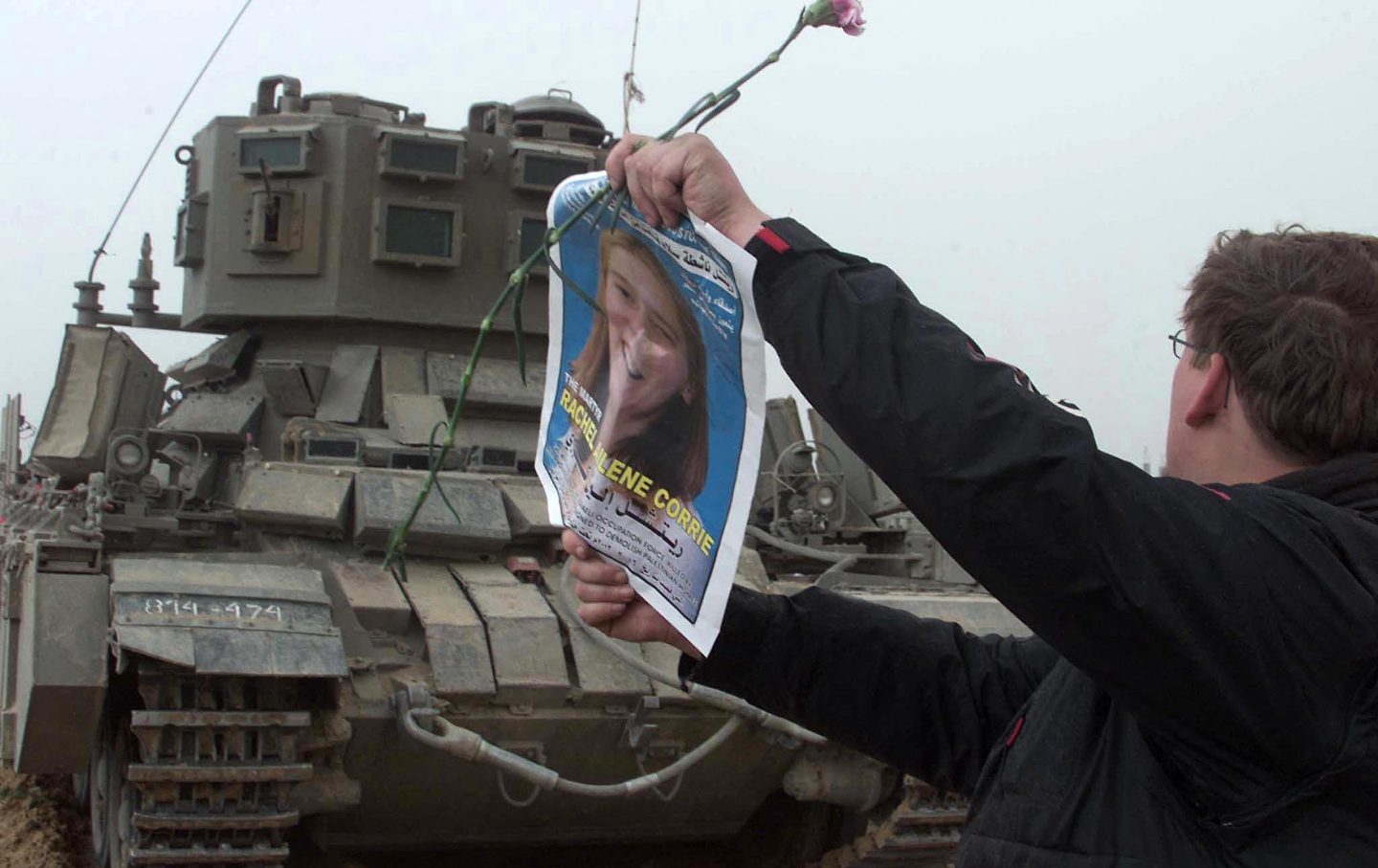
Bernie Sanders is trying to end the shipment of US bulldozers to Israel—like the one that crushed my daughter, Rachel Corrie, to death 23 years ago.

Five years after they began organizing for it, deliveristas have a space to rest and charge their e-bikes.