
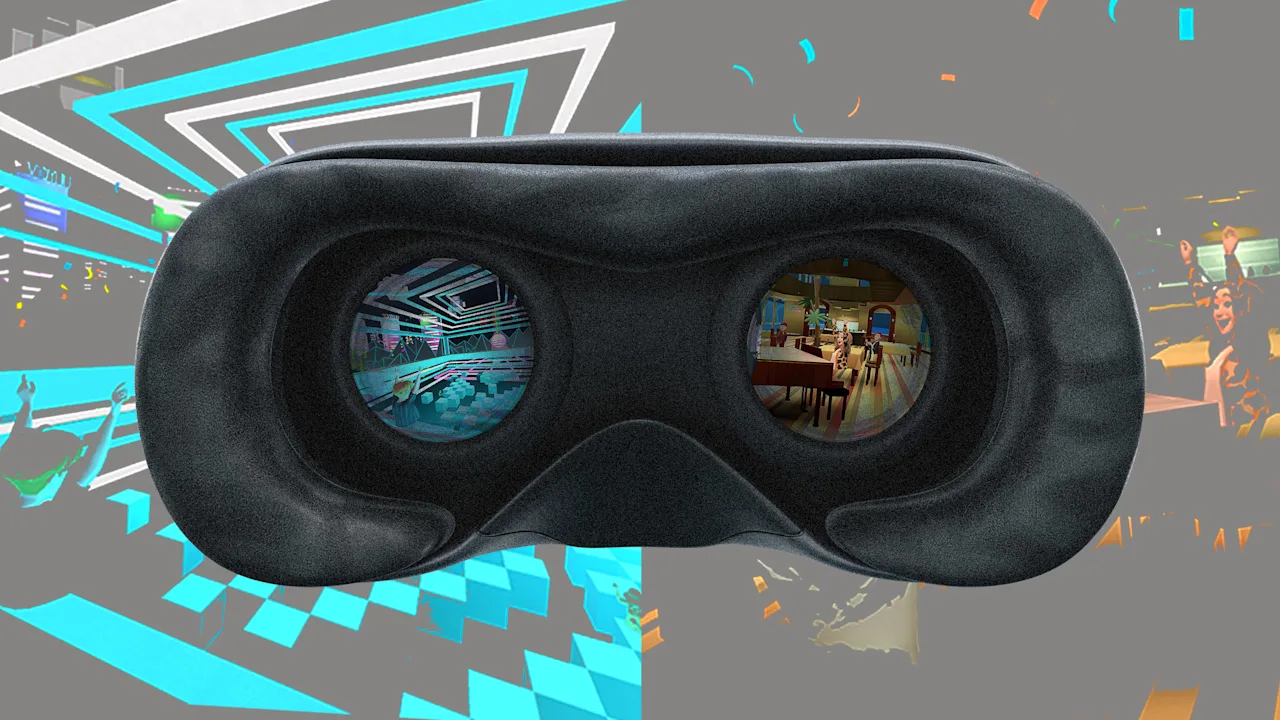
Five years ago, tech angel investor Chris Adamo and a few friends jumped on a burgeoning trend in the digital asset world: they used a virtual real estate broker to buy 23 parcels of property in a metaverse called The Sandbox. He doesn’t remember exactly how much he spent, but it was around $200,000 for the whole group. The real estate, to be clear, consisted of pixelated parcels in “hip,” “trendy” virtual “neighborhoods,” an asset that crypto bros and Web3 enthusiasts like Adamo saw as the future of tech and digital investment. At one point, it ballooned tenfold in value. Adamo was far from alone. Across the four major metaverse platforms, property sales topped $500 million in 2021.
It wasn’t just niche investors making that call. Perhaps most famously, Mark Zuckerberg bet big on the metaverse. He called it “the successor to the mobile internet.” Convinced that one billion people would eventually use it, he poured $80 billion into the effort and, in one of the most visible signals of that bet, renamed Facebook as Meta.
Adamo and his cohort bought into that vision. “When metaverse worlds and NFTs started, our friend group wanted to begin learning and playing in the proverbial sandbox,” Adamo says. “Since we all had already owned so many NFTs, as an experience to learn that realm, land ownership seemed like the next logical trial by fire.”
But big promises to investors gave way to weak financial performance and low user counts, and many metaverse companies have struggled in recent years. The Verge reported in 2023 that Decentraland’s billion-dollar metaverse had as few as 38 active users on a given day. Animoca Brands, which owns The Sandbox, cut 50% of its staff and closed all offices worldwide last year. Perhaps most damningly, Mark Zuckerberg announced last month that Meta would effectively shut down Horizon Worlds in June. All of its employees were laid off and the metaverse budget cut by 30% as the company pivoted toward wearables like its viral AI and AR glasses.
As for Adamo, he tells Fast Company that the money his group put into Sandbox real estate has effectively been written off as a sunk cost, one he has accepted won’t yield returns anytime soon. They tried to sell and take the loss, but there was “no one to buy them,” he says. For now, they’re holding on, partly in the hope that the assets might rebound, partly, as Adamo jokes, as a kind of historical artifact.
“Going into it, we knew that it was going to either be a complete wash (too early) or a big outcome if it took off,” he says via Instagram direct message. “Sadly, the tech and adoption was just too slow and lost steam as COVID ended and people got back to real-world activities.”
How the metaverse real estate economy works
The metaverse house-hunting process largely mirrors the real-world one. Land can be bought at auction or at a fixed price. Once a buyer secures a parcel, they pay in crypto and receive the keys as a non-fungible token (NFT). Owners can then build whatever they want, a mansion, a bungalow, even a to-scale replica of Epcot Center. They can settle into their pixelated Experimental Prototype Community of Tomorrow, or, more realistically, try to flip it to the next buyer. Entire firms sprang up to support this ecosystem, including brokerages like Metaverse Property and designers who offered to digitally stage virtual homes.
The parcels Adamo purchased were in a coveted area of The Sandbox, near the buzzy NFT Bored Ape Yacht Club compound and a plot owned by Adidas. He declined to share exactly how much his group, which called itself the MetaCollective DAO, ultimately lost, but prices offer a sense of the stakes. At the time, Sandbox properties started at around 1 ETH, roughly $3,000. One parcel near Adamo’s sold for about 42 ETH, or nearly $130,000, in 2022.
This wasn’t just a passive investment; Adamo and his group had ambitions for the land. “We tried to create a virtual college, the first metaversity, but sadly it never quite had time to take off,” Adamo says. He envisioned a full syllabus, with courses on cryptocurrency, chain building, partnerships, fundraising, communications, and more.
They weren’t the only ones spending big in the virtual world. Snoop Dogg famously sold a parcel in The Sandbox for $450,000. At the start of 2022, MetaMetric Solutions reported that metaverse real estate sales topped $85 million in January alone. Matt Upham, a TikTok creator who makes content about AI, tech, and coding, also bought land for $15,000 in 2021 and later lost money on the investment. Five years on, he told followers he regretted it.
“I was, like, 25, and that was the dumbest financial decision of my life,” he said in a video posted in March after the shutdown announcement. “Metaverse as a concept is completely done. Meta is shutting down Horizon Worlds—their Metaverse—and I bet the rest are going to follow.”
Hrish Lotlikar, CEO of the virtual real estate platform SuperWorld, still sees a future. His company sells 64.8 billion plots of land across the globe as NFTs, effectively turning the real world into a layered digital marketplace where users can advertise products and services tied to specific locations, something like Groupon built on crypto rails. Today, he says, a parcel is valued at about $20, or 0.01 ETH on Base.
Lotlikar argues that the cooling of the metaverse was always part of the cycle. “I think the key point here is, you know, this isn’t the end of the metaverse, it’s the end of a specific approach to it,” he tells Fast Company. “We’re seeing a shift now towards real-world utility, like Meta’s AR and AI glasses, and real-world integration. ”
Lotlikar believes the core issue with the metaverse was in adoption. “I think Meta took this big bet on a fully immersive virtual world,” he says. “Like a video game with avatars. And that required massive behavior change. That’s hard, right? Especially after COVID, people are like, ‘Hey, I wanna meet people in the real world.’”
He sees integrated AR wearables, like Meta’s Ray-Ban glasses, as a bridge between the physical world and a more widely adopted Web3 future. In his view, the core premise still holds: that every inch of the planet can be for sale ten times over, in digital economic layers wrapped like cling film around the world.
“If you think of Airbnb, they revealed a secret that maybe before Airbnb, a lot of people didn’t think of, which is, the room in your apartment or house could be a hotel room,” he says. “Most people couldn’t put that together before Airbnb. You know, the idea that Uber brought out is, your car could be a taxi. That’s the secret that we’re revealing at SuperWorld, is that everything you see around you, there’s trillions of dollars of commerce that’s happening in real-world locations—you can actually become a stakeholder in those locations.”
But Lotlikar is one optimist in a sea of people ready to leave this chapter behind. Many other players have decided to move on. When, for example, Fast Company reached out to virtual real estate firm Metaverse Property for comment, the email was inactive, and every single executive of the group named on the website has listed a new job title on their LinkedIn.