
April 16, 2026
In an election year under an administration that has wreaked record-setting havoc, journalism is more important than ever—and we need to act like it.
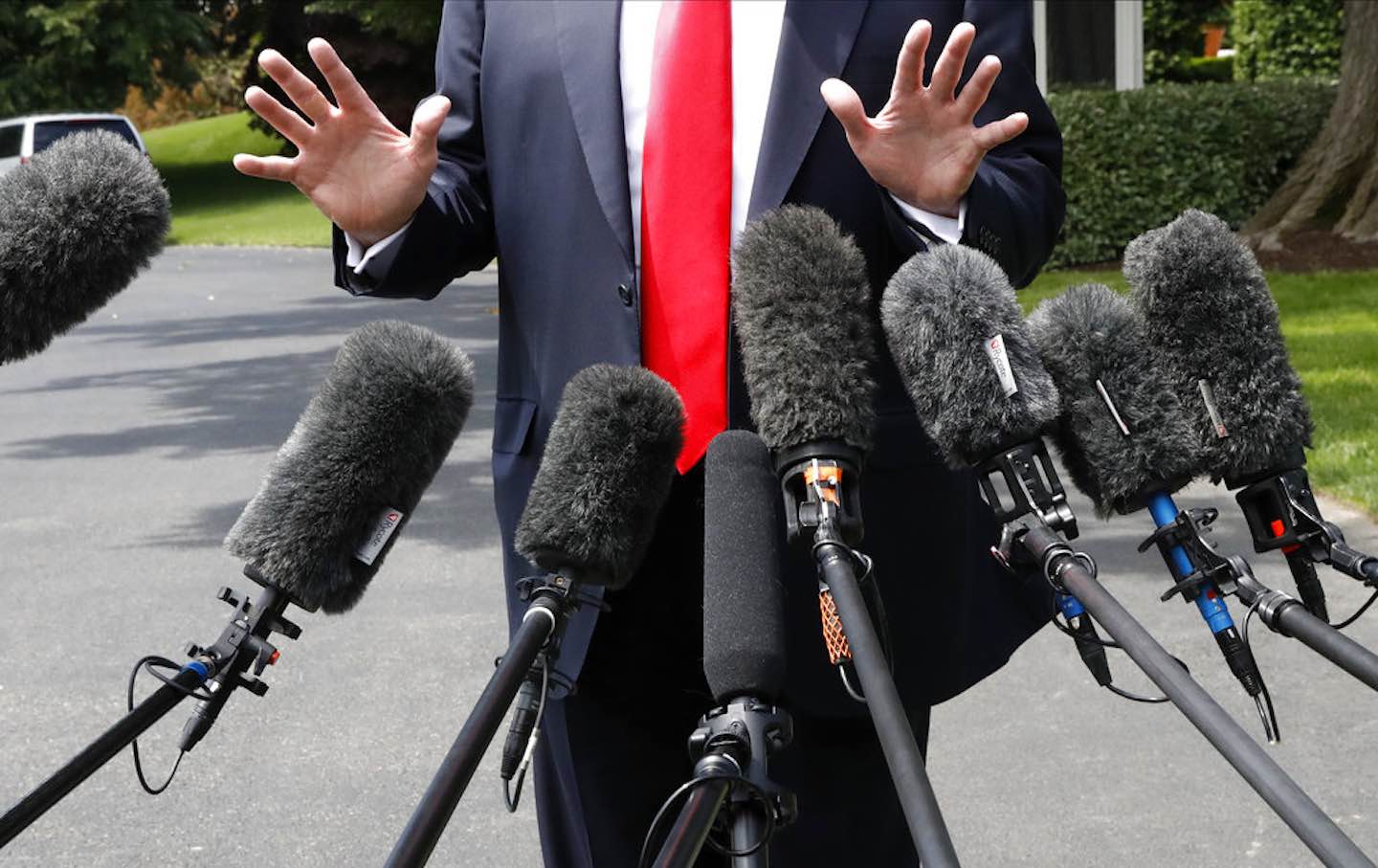
President Donald Trump speaks to the press on the South Lawn of the White House in 2018.
(Jacquelyn Martin / AP Photo)
This article originally appeared at TomDispatch.com. To stay on top of important articles like these, sign up to receive the latest updates from TomDispatch.com.
A few weeks before the 2020 presidential election, I wrote “An Open Letter to My Old Tribe,” urging “every reporter who is covering this election at any level” to focus on a crucial question—whether the public would trust the election procedure and the losing candidate would accept the result as legitimate. “It does not seem an exaggeration,” I wrote then, “to say that the future of American democracy, perhaps its very survival, depends on the answer.”
More than five years later, with less than seven months to go before the midterm elections, that question is before us again, but in far starker terms than I could have imagined in 2020. So, here’s an updated letter to the media tribe I once belonged to, with suggestions broadly similar to those I made five years ago, but with a far sharper sense of urgency, even fear.
Here’s my first suggestion: Reporters in 2026 need to pay more attention to and offer more forceful coverage of President Trump’s continuing insistence that Joe Biden’s victory in 2020 was fraudulent and that year’s election illegitimate. (As recently as March 15th, he tweeted this completely false allegation: “With time, it [the 2020 election] has been conclusively proven to be stolen.”)
While Trump keeps repeating that long-discredited claim, journalists should not treat his falsehoods as “old news” that no longer requires detailed coverage anymore. They should instead consider it an important and newsworthy story right now. Instead of briefly repeating a shorthand conclusion (“false” or “without evidence”) after a quote from the president, they should take a few more lines of type or minutes of air time to remind readers or listeners of the facts that show irrefutably why they should never believe his words. After all, Trump’s “rigged election” claims haven’t been validated in a single one of 64 court cases—that’s right, 64!—challenging the election results, or in any official investigation or recount.
On that point, reporters can cite an authoritative 2022 report, “Lost, Not Stolen: The Conservative Case That Trump Lost and Biden Won the 2020 Election,” written by a panel of authors including two former Republican senators, a lawyer who served as solicitor-general under President George W. Bush, and five other prominent conservatives. After exhaustively reviewing every judicial proceeding and postelection probe in six states where election fraud was alleged, the authors concluded that “Donald Trump and his supporters had their day in court and failed to produce substantive evidence to make their case.” Their definitive verdict on the overall issue was: “There is absolutely no evidence of fraud in the 2020 Presidential Election on the magnitude necessary to shift the result in any state, let alone the nation as a whole. In fact, there was no fraud that changed the outcome in even a single precinct.”
(Journalists might also pass on this thought from David Becker, executive director of the Center for Election Innovation & Research, who, in a recent podcast, suggested that all 2020 election conspiracy theories rest on this dubious premise: “Democrats, being out of power, somehow managed a conspiracy against a sitting president, who controlled the entire government, to steal an election from him…and that four years later when those same Democrats held every lever of federal power, they forgot to do it again.”)
Current Issue
Reporters should also remind their audience of another important fact: Trump’s claims of fraud in the 2020 election were emphatically refuted by Mike Pence, his vice president, and Bill Barr, his attorney general, both of whom publicly broke with the president, strongly denied his allegations, and unequivocally recognized that Joe Biden had been legitimately elected.
In that connection, here’s a related suggestion for reporters: Ask every Republican candidate on your state’s ballot to answer this question: Do you really believe that Donald Trump won the 2020 election, and lost only because of massive vote fraud? Press as hard as you can for an on-the-record, yes-or-no answer, and if you don’t get one, keep pushing. If a candidate says yes or evades the question, follow up with questions like: “What evidence do you have? How do you explain that those charges were not verified in a vote recount or in a single one of more than 60 judicial proceedings? Were judges in 64 courtrooms across six states all part of a nefarious conspiracy against Donald Trump, or do you have any other explanation?”
Report on the Process, Not Just the Arguments
Journalists in 2026 also have a much broader task: to keep their audiences informed on the details of the election process and the ongoing efforts to undermine its legitimacy. Covering those themes systematically and proactively will not be easy at a time when the headlines are bound to be filled with other explosive issues: a major war in the Middle East (and possibly beyond); the ongoing bitter controversy about the Trump administration’s chaotic immigration enforcement campaign that led to the violent deaths of two US citizens; the continuing effects of drastic staff reductions in federal agencies that have eliminated or significantly reduced government services and benefits for millions of Americans; and a long list of other divisive subjects. But the threat to public trust in the election process poses a clear and present danger to the principles, traditions, and values of the American political system, and news organizations need to adapt their campaign coverage accordingly.
So, here’s a suggestion (one I made in that earlier letter years ago) to reporters, editors, and news directors across the country:
Starting now, treat the election process in your state as a significant running news story. Make it a separate beat, alongside the traditional coverage of the reactions of candidates and voters. Touch base regularly with local and state election administrators. Learn (and then tell your readers or listeners) the details: how voters are registered, how and where the voting will be conducted, and exactly how their votes will be counted. Cultivate sources and regularly report what local officials are doing (or not doing) to ensure a credible election. Meanwhile, before any votes are cast or counted, press candidates and their minions to state exactly what they would define as evidence of miscounting or fraud, what they would consider grounds for contesting the outcomes of local or other races, and how they envisage conducting those contests—standards for which they can then be held accountable if they do end up disputing the official results.
Don’t cover such subjects only when they arise in a partisan debate where the traditional role of journalists is to report both sides (candidate A says the ballot count will be falsified or ineligible voters will be allowed to vote, candidate B or election administrator C says the voting will be legally conducted and the count will be accurate). Instead, monitor and regularly update your audience on what’s actually happening. Track problems as they appear and solutions as they are proposed, discussed, and adopted.
For example, on the controversy about voting by mail—an issue now before the Supreme Court—don’t just report the opposing arguments and leave it to readers and listeners to choose which side to believe. Give them the knowledge to decide for themselves. Don’t wait for partisans on one side or the other to bring up the subject. Take the initiative with a story detailing the rules in your state that define who can vote by mail and how to do so. When the time comes, report how many mail-in ballots have been distributed and track how many have been returned. Explain in detail how those ballots are stored and protected and when and how they will be opened and counted—facts that will let news consumers reach their own conclusion about the practice and whether it’s risky or not.
Reliable Sources
A useful resource for journalists covering such issues is the nonprofit news organization Votebeat, which focuses exclusively on covering how elections are conducted and distributes its articles at no cost to readers or local and national news outlets. Founded in 2020, Votebeat has reporters based in five states (Arizona, Michigan, Pennsylvania, Texas, and Wisconsin) that were centers of controversy in that year’s election. On the national level, in 2024 it operated an “Expert Desk” where journalists could ask voting-related questions and get knowledgeable answers from a panel of nearly 100 election administrators, cybersecurity experts, attorneys specializing in election law, and other professionals. It plans a similar program to assist journalists covering this year’s election. Reporters or anyone else concerned about election issues can sign up here to regularly receive its reports.
Popular
“swipe left below to view more authors”Swipe →
A variety of other organizations across the political spectrum can answer media queries on election procedures and management. Here are a few more groups whose work reporters should follow and contact if needed:
- Voting Rights Lab, “a campaign hub designed to supercharge the fight against voter suppression.” It operates the Election Policy Tracker, which “analyzes voting and election laws across all 50 states and the District of Columbia and provides near-real time analysis of election-related legislation pending across the country.” The tracker is designed to support “policy experts, advocates, researchers, legislators, and anyone on the front lines of the pro-democracy movement with critical information about the laws and legislation shaping our elections.”
- Protect Democracy, a nonpartisan group bringing together “conservatives, moderates, and progressives” who share a common goal: “preventing American democracy from declining into a more authoritarian form of government.”
- The Center for Election Innovation & Research, whose stated goal is “to restore trust in the American election system and promote election procedures that encourage participation and ensure election integrity and security.” (David Becker, the group’s executive director, is quoted earlier in this article.)
- Defending Democracy Together, an organization created by “lifelong conservatives and Republicans” to defend “democratic norms, values, and institutions” and oppose “abuses of power that threaten to undermine the integrity of U.S. elections, federal agencies, and the Republican Party as a whole.” Its list of directors includes William Kristol, founder of the right-wing magazine The Weekly Standard, and Mona Charen, a staff member and speechwriter in Ronald Reagan’s White House.
- Republicans for Voting Rights, committed to defending “the accessibility, integrity, and competitiveness of American elections” and to oppose Republicans “pushing for more restrictive voting laws designed to support unfounded accusations that the [2020] election was stolen and the results were illegitimate.”
And one last suggestion for journalists covering this year’s election: go down the ballot in your state and ask every candidate running for the Senate or House of Representatives or any significant state or local office for an unequivocal on-the-record commitment to respect the voters’ decision, whatever it might be. If any candidates waffle or decline to answer, don’t just leave it at that and go on to the next story. Instead, keep asking them (and their political allies, campaign organizers, and spokespeople) the same question and press them to explain exactly why they are dodging the issue.
I ended my 2020 letter with this closing paragraph:
Journalists alone will not win the fight to protect the legitimacy of this election, but they can make an important contribution—perhaps the most important since reporters covering the civil rights movement in the 1950s and 1960s helped make the country confront the realities and the profound injustice of the segregation era. In the coming weeks, it will be absolutely vital for journalists everywhere, in every medium, to recognize the challenge and greatly intensify their efforts in rising to it. The stakes could not be higher.
Sadly enough, in 2026, those words ring even more pertinently than when I wrote them.
More from The Nation
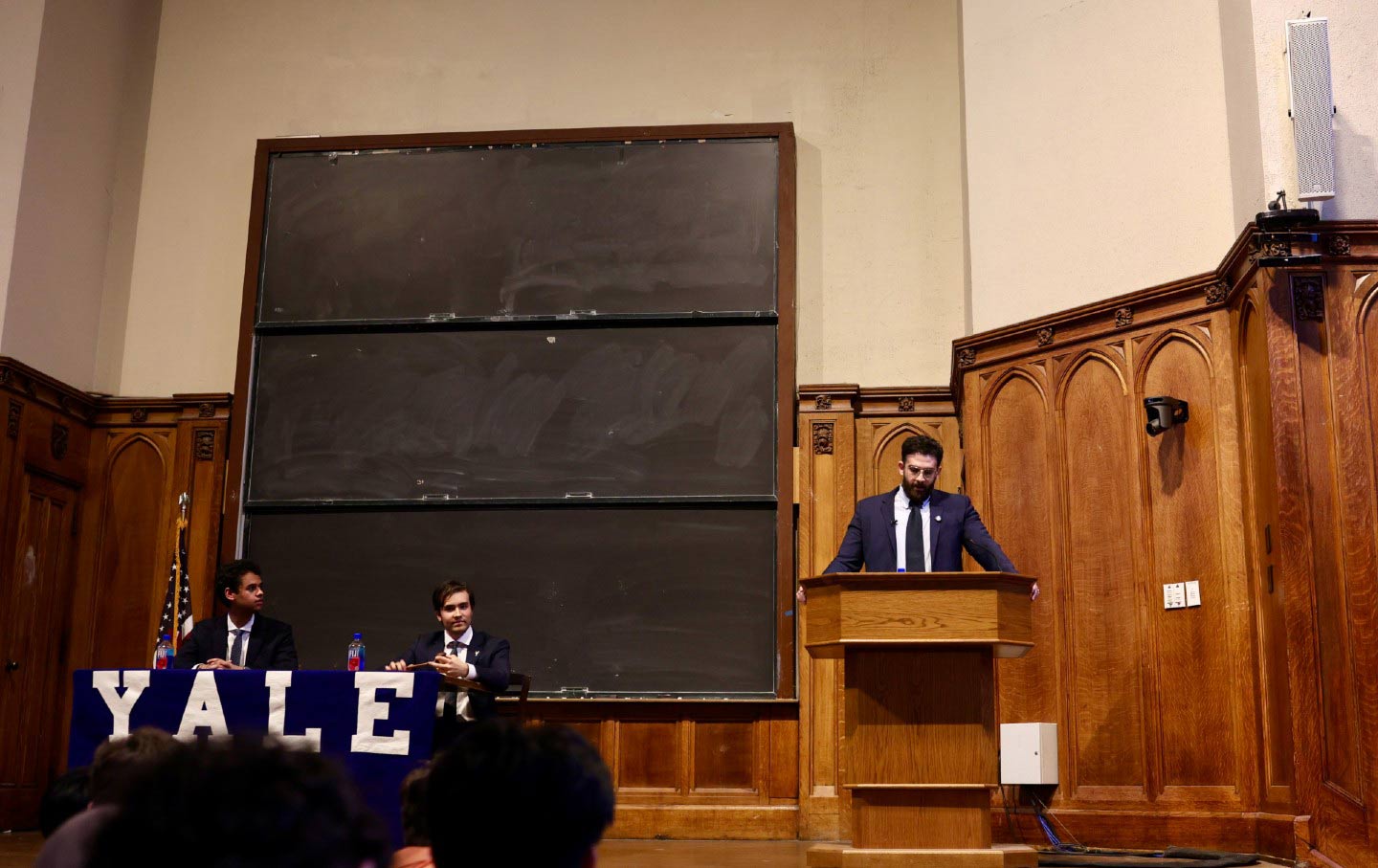
The Twitch streamer’s invitation to debate at the Yale Political Union drew the ire of Laura Loomer, Rick Scott, and Turning Point USA.

It’s not the kitschy White House ballroom—it’s logistics warehouses converted to ICE detention centers.

The New York Times columnist is being touted as the latest conservative even liberals can love. But his actual work doesn’t live up to the fanfare.
Tech elites are enriching themselves by plundering STEM institutions—and offering researchers scraps.
Recent decisions mean the agency will no longer process claims regarding harassment, the denial of bathroom use, or discrimination in hiring, firing, or promotion on the basis of …

A profile of an AI healthcare start-up overlooked the creaky business model behind it, as well as the tech sector’s worship of “high agency.”