
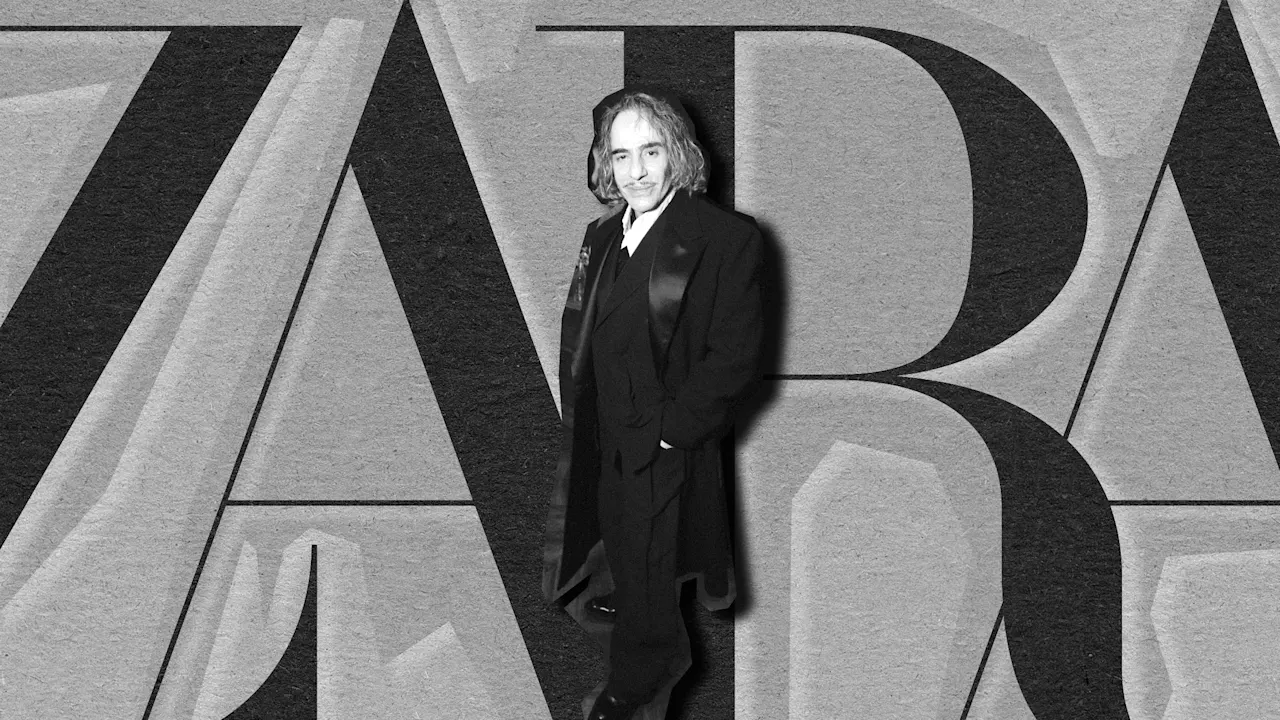
Fashion, it turns out, is a leading indicator. Long before mainstream business commentary catches up to a structural shift in the economy, the runway has usually already staged it. The announcement that John Galliano—arguably the greatest couturier alive—has signed a two-year creative partnership with Zara is one of those moments. It looks like fashion news. It is actually a signal about the future of value creation itself.
The most surprising move in fashion in years
To understand the shock value, a little context. Galliano’s career has been defined by the haute maison—Givenchy, his own label, Dior, and then a celebrated decade at Maison Margiela, where he orchestrated some of the most critically lauded runway shows of his generation. These institutions were the frame through which his genius was legitimated, distributed, and priced. The assumption was that a designer of his stature would always find his home inside another of fashion’s storied houses.
Instead, he is going to Zara. Not as creative director. Not to relaunch a diffusion line. But as a “creative partner” who will deconstruct and “re-author” pieces from Zara’s own vast archive—taking the ephemera of fast fashion and subjecting it to a couture process. The first collection drops in September 2026.
The fashion world’s reaction ranged from confusion to awe. But strategists should recognize it immediately: this is what the end of competitive advantage looks like in real time.
Seasons are dead. So are categories.
For most of its modern history, fashion has operated on a set of assumptions so stable they felt like laws of nature. There were four seasons. There was a clear hierarchy: haute couture at the apex, then ready-to-wear, then high street. There were coherent “looks”—a house had an aesthetic DNA, a consumer had a tribe, and the two found each other through ritual (the show, the magazine, the boutique).
All of that is dissolving. Seasons have become continuous flows. TikTok-native consumers don’t cycle through trends on a quarterly basis—they layer them, mix them, reject the premise that a wardrobe needs a coherent sensibility at all. Streetwear bleeds into suiting. Archive Margiela sits alongside H&M finds. The “look” is now personal curation, not institutional affiliation.
When taken as a gestalt, across countries and genres, we can see that this is a structural change in how value is created and captured in any industry organized around taste, knowledge, and creative authority. Fashion just got there first.
The Carlota Perez lens: We are at a turning point
Economic historian Carlota Perez describes how major technological revolutions move through two phases: an installation period of turbulence and speculation, followed by a deployment period in which the new technology’s possibilities are embedded into social and institutional life. First, a period of financialization and destruction of old social arrangements, giving way (hopefully) to a golden age of productivity and a broader distribution of gains. We are, right now, in the painful transition between those two phases and fashion, as a great cultural messenger, is reflecting the dislocations.
What makes the current moment distinctive is how traditional advantages in fashion are eroding. For most of industrial history, scale was the primary source of competitive advantage. You built large factories, large distribution networks, large marketing operations—and that scale gave you a moat. The maison was a version of this logic applied to culture: you built a storied institution, a deep archive, a global distribution of prestige, and that infrastructure was the moat.
Digital technologies are allowing us to go under, over, and around those moats. The capabilities that once required massive institutional infrastructure—design iteration, content production, trend analysis, personalized marketing—can increasingly be performed by small teams, or even individuals, armed with the right tools. The institutional premium is evaporating.
Individual creative IP beats institutional legacy
This is the second-order-effects story of Galliano partnering with Zara. What Zara is acquiring is not a house, not a team, not an archive. It is a sensibility—a singular, irreducible creative intelligence that cannot be replicated at scale, cannot be automated, and does not require a Grand Avenue address to be legitimate.
We see this pattern everywhere, once you know to look for it. Solo founders building companies with AI leverage that previously required hundreds of employees. Independent consultants outcompeting large firms because their judgment and relationships are the product, not their headcount. Journalists, researchers, designers, and strategists detaching from legacy institutions and finding direct routes to audiences and clients.
The unit of value creation is shrinking. What remains scarce—genuinely, durably scarce—is individual creative authority and trusted judgment. Galliano has that. The Zara deal is a stunningly vivid illustration of what happens when that kind of scarcity meets a platform with global reach.
For Zara: A masterclass in transient advantage
From Zara’s side, this is equally instructive. Under Inditex chair Marta Ortega Pérez, the brand has been on a deliberate campaign to escape the gravitational pull of the “fast fashion” label—a label that increasingly carries reputational, regulatory, and commercial risk. The strategy has involved a series of collaborations: Narciso Rodriguez, Samuel Ross, Stefano Pilati, Ludovic de Saint Sernin. Galliano is the clearest signal yet that Zara is not trying to occupy a lane. It is trying to make lanes irrelevant.
This is a textbook execution of what I have called the transient competitive advantage: rather than trying to build and defend a durable position, Zara is stringing together a sequence of shorter-term advantages, each one redefining the competitive landscape before competitors can respond. Each collaboration is an arena entry—it resets the terms of competition before rivals have time to replicate the previous move.
What executives should take from this
The Galliano-Zara story is exotic enough to feel safely distant from the strategic challenges facing most organizations. It is not.
Every industry has its version of the haute maison—institutions that assumed their prestige, their infrastructure, and their accumulated authority would insulate them from disruption. Law firms. Consultancies. Universities. Media organizations. Even hospitals and banks. These institutions are discovering that the individuals who carried their value—the partner with the client relationships, the professor whose ideas drive enrollment, the journalist whose byline drives subscriptions—are increasingly capable of detaching and finding direct routes to the markets they serve.
The question for leaders is not whether this dynamic will reach their industry. It already has, or it will soon. The question is whether their organization can become a platform that talented individuals want to work through—rather than an institution that talented individuals feel the need to escape from.
Galliano did not go to Zara because Zara is prestigious. He went because Zara offered him something the heritage houses could not: a direct, unmediated route to a global audience, on his own creative terms, without the burden of institutional expectation.
That is the positioning smart organizations will have the courage to pursue.