
Close Menu
    Facebook X (Twitter) Instagram
    TRENDING :
    • 10 Key Factors Influencing Equipment Loan Rates Today
    • 5 Simple Steps to Form Your Sole Proprietorship
    • Your Essential How-To Manual for Incorporating a Business
    • The case for saying no to new gadgets
    • This 3D model captures a rare tropical glacier before it’s gone
    • Kevin O’Leary believes his 10,000-acre data center can be ‘beautiful’
    • America’s HOAs are broken. This startup is trying to fix them
    • 10 Best Open Source Bookkeeping Software Options
    Populist Bulletin
    • Home
    • US Politics
    • World Politics
    • Economy
    • Business
    • Headline News
    Populist Bulletin
    Home»Business»Pakistan’s solar boom is helping it save billions during the ongoing energy crisis
    Business 3 Mins Read

    Pakistan’s solar boom is helping it save billions during the ongoing energy crisis

    Business 3 Mins Read
    Share Facebook Twitter Pinterest LinkedIn Tumblr Telegram Email Copy Link
    Follow Us
    Google News Flipboard
    Share
    Facebook Twitter LinkedIn Pinterest Email


    Pakistan gets almost all its oil and gas from the Middle East, where U.S. and Israeli bombing of Iran have caused crude prices to blow past $150 a barrel and tankers can’t get through the Strait of Hormuz. But it has one edge in the crisis: a rapid, recent shift to solar power.

    The country’s solar boom started in the wake of the Ukraine war, when Pakistan couldn’t afford to buy liquefied natural gas and that led to power outages. “It also led to soaring electricity bills,” says Rabia Babar, an energy market analyst at the Pakistan-based nonprofit Renewables First.

    Some power bills were as much as 30-40% of people’s income, sometimes more than they were spending on rent. At the same time, the price of solar panels had steeply fallen, with an oversupply from Chinese manufacturers that was easily accessible in Pakistan. And so people started buying and installing solar—often to avoid using grid power.

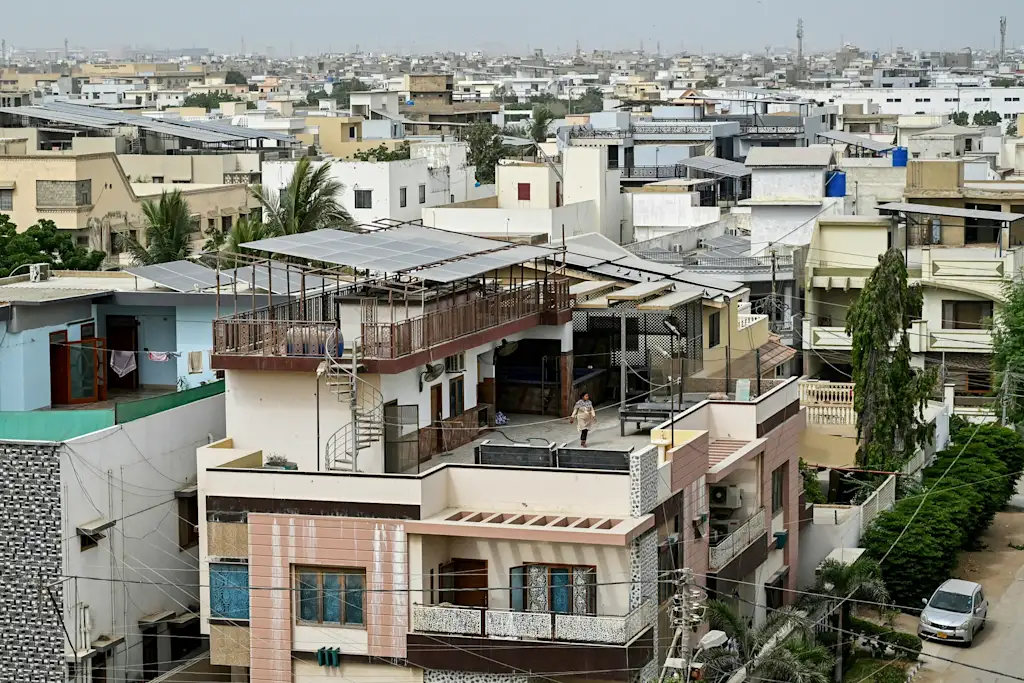
    Rooftops in Karachi, 2025. [Photo: Asif Hassan/AFP/Getty Images]

    “You could go to your local bodega, buy a solar panel and charge controller and a battery, and install it yourself,” says Jigar Shah, an energy entrepreneur and investor who previously led the Loans Program Office at the U.S. Department of Energy. “It was so cheap that people were able to do it with discretionary funds, $50 that they had.”

    A grassroots DIY movement quickly grew. Self-taught solar entrepreneurs learned about installation and repair on YouTube and in local WhatsApp groups. As people installed solar on their roofs, their neighbors followed. Businesses added solar and batteries on factory buildings. Farmers started using solar pumps, rather than diesel, for irrigation. Cheap solar panels also helped bring power to rural homes that had always been off the grid. Last year, the country was the second-largest importer of Chinese solar panels in the world. Ten percent of the grid shifted to solar in just a few years, driven largely by these small installations.

    “When you think about the sheer volume and the population of Pakistan, it certainly is the largest deployment of solar and battery storage to solve energy poverty in the world,” Shah says.
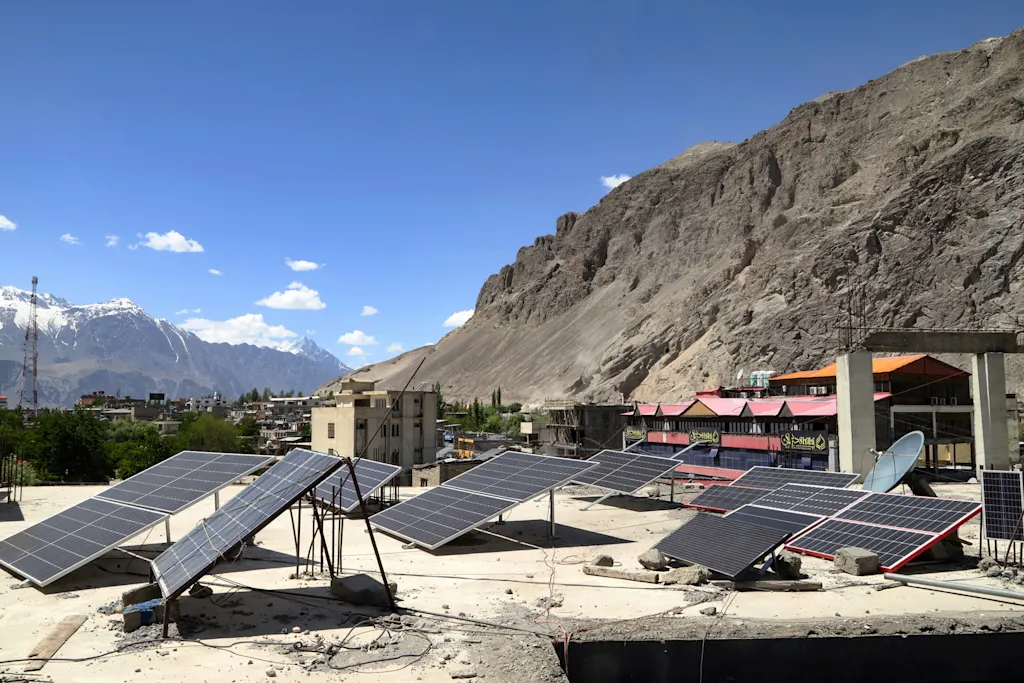
    Solar panels installed on the roof of a building at Skardu in Pakistan’s Gilgit-Baltistan region, 2024. [Photo: Manzoor Balti/AFP/Getty Images]

    Over the last nine years, the country has imported a massive 51 gigawatts of solar power. (For comparison, that’s more than the entire capacity of power plants on the country’s electric grid.) That’s helped Pakistan avoid spending more than $12 billion on fossil fuel imports, according to a report from Renewables First. This year, as crude prices have surged, the country could save another $6.3 billion. (Pakistan still relies almost entirely on fossil fuels for transportation, as EV adoption in the country is at an earlier stage. )

    The transition hasn’t gone perfectly. Because solar grew organically without top-down planning, utilities suddenly lost so much business that they’ve faced financial challenges keeping older infrastructure afloat. The lesson for other developing countries, Shah says, is that utilities should help customers install cheap solar so that the whole system can be coordinated.

    But the current crisis is likely to speed up the solar transition. “Consumers who are running on diesel in Pakistan—but not just Pakistan, but Kenya, Tanzania, etcetera—their price of diesel just doubled,” says Shah. “If you’re the guy in Pakistan who still hasn’t switched to solar, you’re probably switching to solar this year.”


    Source link

    Share. Facebook Twitter Pinterest LinkedIn Tumblr Email

    Related Posts

    10 Key Factors Influencing Equipment Loan Rates Today

    May 31, 2026

    5 Simple Steps to Form Your Sole Proprietorship

    May 31, 2026

    Your Essential How-To Manual for Incorporating a Business

    May 31, 2026
    Top News
    Business 2 Mins Read

    You can soon lie flat in economy on United—but it’ll cost you

    Business 2 Mins Read

    Plane comfort is important yet notoriously hard to achieve. But now one airline is set…

    Fed likely to lower rate but may pause follow-up cuts

    December 10, 2025

    JUST IN: Charlie Kirk’s Funeral Scheduled for Sunday, September 21 at State Farm Stadium in Phoenix, Arizona – President Trump Has Promised to Attend | The Gateway Pundit

    September 13, 2025

    ‘Don’t worry, I’ve got you’: 3 artists channel the outrage of Minneapolis

    January 28, 2026
    Top Trending
    Business 14 Mins Read

    10 Key Factors Influencing Equipment Loan Rates Today

    Business 14 Mins Read

    When considering equipment loans, it’s crucial to understand the various factors that…

    Business 7 Mins Read

    5 Simple Steps to Form Your Sole Proprietorship

    Business 7 Mins Read

    Starting a sole proprietorship can seem intimidating, but it doesn’t have to…

    Business 16 Mins Read

    Your Essential How-To Manual for Incorporating a Business

    Business 16 Mins Read

    Incorporating a business is an important step that can greatly influence your…

    Categories
    • Business
    • Economy
    • Headline News
    • Top News
    • US Politics
    • World Politics
    About us

    The Populist Bulletin was founded with a fervent commitment to inform, inspire, empower and spark meaningful conversations about the economy, business, politics, government accountability, globalization, and the preservation of American cultural heritage.

    We are devoted to delivering straightforward, unfiltered, compelling, relatable stories that resonate with the majority of the American public, while boldly challenging false mainstream narratives that seem to only serve entrenched elitists, and foreign interests.

    Top Picks

    10 Key Factors Influencing Equipment Loan Rates Today

    May 31, 2026

    5 Simple Steps to Form Your Sole Proprietorship

    May 31, 2026

    Your Essential How-To Manual for Incorporating a Business

    May 31, 2026
    Categories
    • Business
    • Economy
    • Headline News
    • Top News
    • US Politics
    • World Politics
    Copyright © 2025 Populist Bulletin. All Rights Reserved.

    Type above and press Enter to search. Press Esc to cancel.