
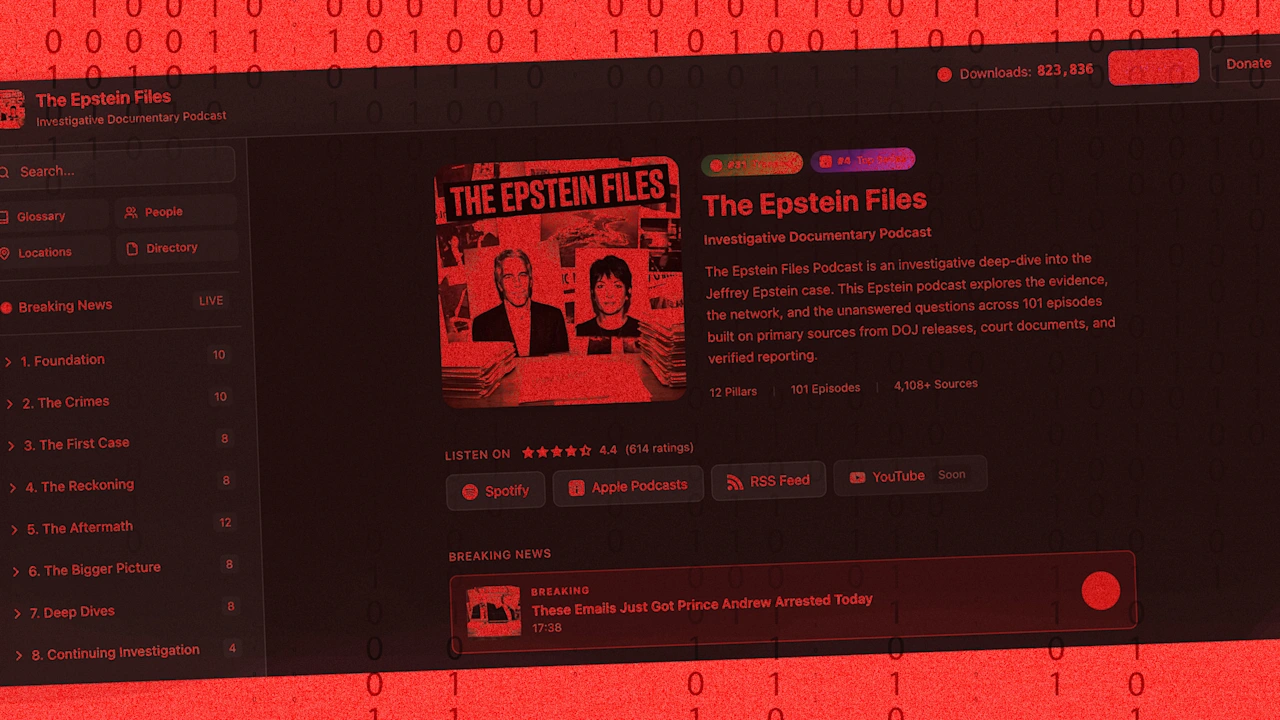
The Epstein Files are dominating nightly news broadcasts and newspaper front pages. But in the media ecosystem there’s another format that’s proving a massive draw to news consumers: a podcast run by a non-journalist and entirely generated by AI.
The Epstein Files is an investigative documentary podcast that, at the time of writing, has published 97 episodes—new episodes get uploaded twice daily—and notched up more than 700,000 downloads in a matter of days. That puts it in the top 10 rankings of podcast series on Apple Podcasts, and in the top 30 on Spotify. But it’s created by Adam Levy, an entrepreneur with a background in building data products and content creation, who has no experience in journalism.
Levy launched the Epstein Files podcast in early February after the trove of documents relating to the late financier and convicted sex offender Jeffrey Epstein was released to the public. After 48 hours of hacking—working 14- to 16-hour days—Levy built an automated pipeline that ingests the raw files, extracts text from emails and images, cross-references sources, and produces scripted podcast episodes narrated entirely by AI-generated voices.
“People just want no bullshit,” says Levy. “Strip the emotion, strip the bullshit, strip everything away—just tell me things for what they are and when you tell it to me, help me understand the facts.”
The technical architecture behind the project stitches together multiple large language models—from Anthropic’s Claude to Google and OpenAI’s offerings—to connect names, places, themes, and timelines across the 3.5 million files that were released, with connections requiring a confidence score of veracity to be included in the podcast. Levy supplements the raw dump with material from the Internet Archive and Google Pinpoint, a tool that other investigators have used to index portions of the files, as well as other bottoms-up projects like Jmail, which turns the Epstein Files emails into a navigable inbox like any other.
Using and citing those sources was vital, Levy says, to counteract fears of hallucinations. “Everybody’s quite skeptical of AI,” he says. “It was really important to reference all the sources that were used to basically construct the episode.”
“Like Clawdbot or a lot of the current AI simulation exercises, it piques curiosity, then rapidly becomes tedious,” says Emily Bell, founding director of the Tow Center for Digital Journalism at Columbia University, explaining why the podcast has had such popularity in its early days. “I thought the first episode was pretty listenable but also very obviously AI to anyone who has fed data or a script to NotebookLM.”
Yet Bell found that the more episodes she listened to, the harder it was to sustain interest and engagement. “It provided a helpful forensic audit of data, but it’s not something I am going to sign up to and listen to—unless I am doing other work on the files,” she says. “For that, it’s pretty useful, and an interesting use of the tools.”
Those tools are something Levy has thought about. “I’ve been able to out execute any other outlet that tried to document the episode,” he explains. “They just won’t be able to [produce episodes at such speed.” That has additional benefits—including being able to ride podcast app algorithms. “That also helps with discovery, and the people who like getting into rabbit holes, this gave them a really big hole to dive into.” Levy tells Fast Company he is already building a second series on an undisclosed subject, applying the same AI pipeline to a different story.
Whether you appreciate the quality of the finished podcast or not, the fact that such an AI-heavy podcast could garner such a large audience is significant, and the consequences for journalists—particularly those covering complex, document-heavy stories—are hard to ignore.
“I could easily be in the camp of: these tools are going to replace me, I’m screwed,” says Levy. “Or I can figure out how to embrace them and find a new pocket for myself. Maybe I’m no longer the voice. Maybe I just become the curator.”
Not everyone is convinced that speed and sourcing are sufficient substitutes for editorial judgment. “Just because something like the Epstein Files can be produced doesn’t mean that this will work with most audiences,” says Nic Newman, a journalist and digital strategist who contributes to research at the Reuters Institute for the Study of Journalism at the University of Oxford. He has conducted recent research suggesting publishers are likely to produce more audio content as a defense against AI. “The idea being that AI struggles with empathy and human connection compared with human hosts and it is harder to summarize things in audio in a way that feels authentic and intimate,” he says.
As Bell’s experience shows, what was first seen as a novelty doesn’t necessarily translate into a regular audience. “If I didn’t already know a significant amount about the files, the investigations, the background—I would have found many of the episodes very hard to follow,” she says. “And boring.”
However, people seem to be sticking around and rating it relatively highly: The podcast currently has a 4.4 rating on Apple Podcasts. “The goal was to just build something that I was personally curious about and I would enjoy listening to,” says Levy, “and maybe other people would reciprocate the same value.”