
Close Menu
    Facebook X (Twitter) Instagram
    TRENDING :
    • A Fintech Founder Shares the 5 Numbers That Reveal Whether Your Business Can Survive a Downturn
    • Anthony Williams Fires 4 TDs in St. Bernard’s Big Win
    • Why Smart Leaders Make Bad Decisions Under Pressure — and It Isn’t a Lack of Discipline
    • 14 Hollywood Stars Who Built Families Through Surrogacy
    • Her Time-Saving Product Hit $10,000 in Sales in 36 Hours
    • Fat Bear Week Contestants Announced – See the Competing Bears
    • Your Online Presence Is Your First Impression — So Make It Good
    • Harmonic Inc. Presents Analyst and Investor Day Insights
    Populist Bulletin
    • Home
    • US Politics
    • World Politics
    • Economy
    • Business
    • Headline News
    Populist Bulletin
    Home»Business»The housing markets with the most exposure as Trump sets 100-home cutoff for proposed institutional ‘ban’
    Business 3 Mins Read

    The housing markets with the most exposure as Trump sets 100-home cutoff for proposed institutional ‘ban’

    Business 3 Mins Read
    Share Facebook Twitter Pinterest LinkedIn Tumblr Telegram Email Copy Link
    Follow Us
    Google News Flipboard
    Share
    Facebook Twitter LinkedIn Pinterest Email


    Want more housing market stories from Lance Lambert’s ResiClub in your inbox? Subscribe to the ResiClub newsletter.

    Back on January 7, President Donald Trump announced: “I am immediately taking steps to ban large institutional investors from buying more single-family homes, and I will be calling on Congress to codify it.” On January 20, Trump went further, outlining elements of the proposed “ban.”

    The order directed multiple federal agencies—including HUD, the Department of Agriculture, the VA, the GSA, and the Federal Housing Finance Agency—to issue guidance within 60 days limiting the federal government’s role in facilitating institutional purchases of single-family homes that could otherwise be bought by owner-occupants.

    Specifically, within 60 days, the government-sponsored enterprises (Fannie Mae and Freddie Mac) would no longer be permitted to approve, insure, guarantee, or securitize single-family home purchases by “large institutional investors.” The order also stated that, within 30 days, the administration would define “large institutional investors” and that build-to-rent transactions would be exempt.

    On Thursday (February 19), the Wall Street Journal reported that the White House has settled on a key detail of its proposed ban—one it plans to send to Congress—prohibiting large investors, defined as entities owning 100 or more homes, from purchasing additional single-family houses.

    Because the threshold is set at 100 homes, the policy would affect not just major institutional landlords, but also some larger individual investors. The plan still includes the build-to-rent exemption and adds another carveout: large investors can continue to purchase homes in need of “significant repair.”

    Those two proposed exemptions are notable given that most institutional activity right now is in build-to-rent, and when purchasing scattered-site homes, institutional investors—at least when they are actively buying—tend to target properties that require sizable renovation spending.

    Notably, this proposal would not mandate large investors to liquidate existing holdings.

    The measure announced on Thursday would need congressional approval, and its prospects are uncertain. According to reporting from the Wall Street Journal, passage is still far from guaranteed.

    At the height of the Pandemic Housing Boom, large investors—those owning at least 100 single-family homes—made up an all-time high of 3.1% of home purchases in Q2 2022, according to John Burns Research and Consulting.

    That period, at the tail end of the boom, was when yields were particularly attractive as borrowing costs were ultra-low, home prices were soaring, and rents were climbing rapidly. However, since mortgage rates spiked and capital markets shifted, their share has fallen to around 1.0% of transactions over the past three years. The math isn’t as favorable right now.

    ResiClub members (paid tiers) can find an interactive version of the map below here
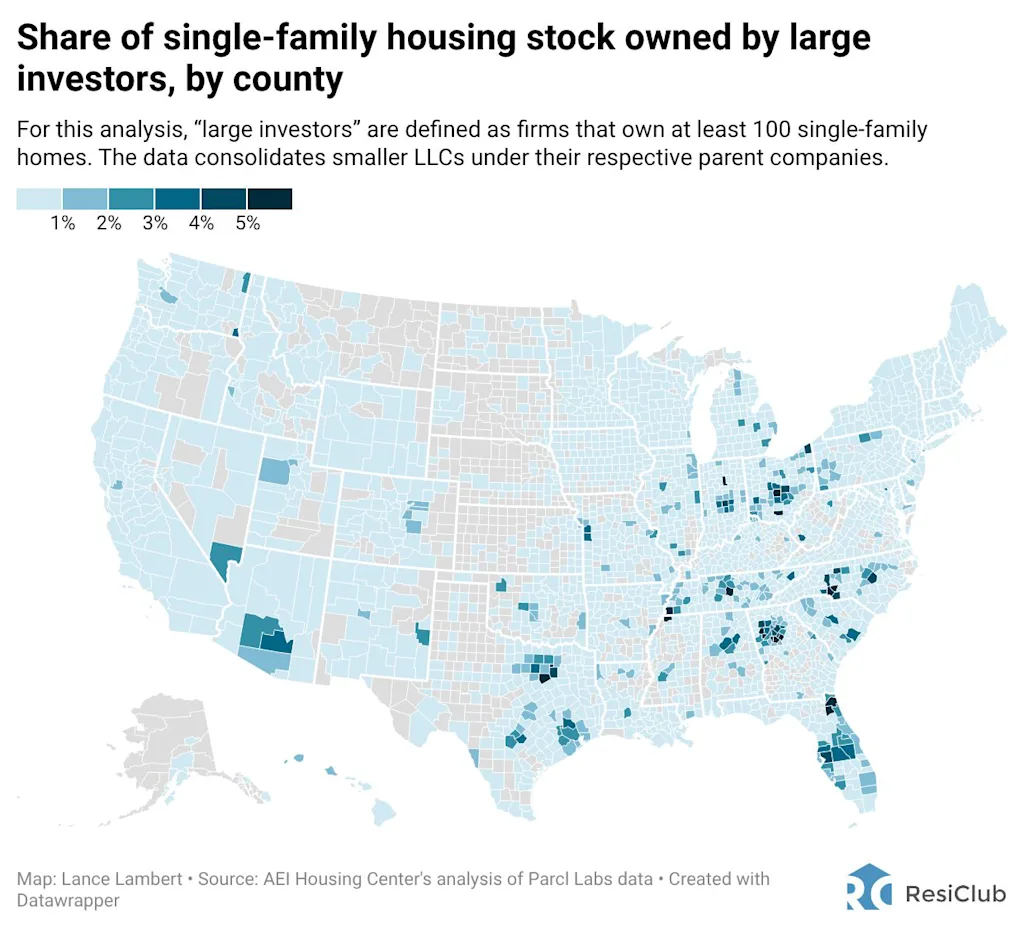
    On a national level, “large investors”—those owning at least 100 single-family homes—only own around 1% of total single-family housing stock.

    That said, in a handful of regional housing markets, institutional and large single-family landlords have a much larger presence. Markets like Phoenix and Atlanta became major hubs for institutional single-family rental investment following the 2008 housing crash as the asset class started to institutionalize.

    Firms such as Invitation Homes, Progress Residential, and AMH built sizable portfolios in these metros by acquiring distressed homes. That early activity helped establish a reliable local SFR ecosystem—including property management firms, leasing infrastructure, and contractor networks—that makes it easier to scale and expand single-family rental and build-to-rent operations today.


    Source link

    Share. Facebook Twitter Pinterest LinkedIn Tumblr Email

    Related Posts

    A Fintech Founder Shares the 5 Numbers That Reveal Whether Your Business Can Survive a Downturn

    September 19, 2026

    Why Smart Leaders Make Bad Decisions Under Pressure — and It Isn’t a Lack of Discipline

    September 19, 2026

    Her Time-Saving Product Hit $10,000 in Sales in 36 Hours

    September 19, 2026
    Top News
    Business 3 Mins Read

    Even more pasta salads recalled over Listeria fears: Here’s the latest list of products to avoid

    Business 3 Mins Read

    Yet another food retailer has joined the growing list of companies that have recalled pasta-related…

    The ‘zombie internet’ has arrived—and it has devastating consequences for advertising, social media, and the human web

    February 14, 2026

    Texas House Passes Congressional Redistricting Bill After Absconding Dems Return

    August 21, 2025

    Threatening Vulnerable People Is No Way to Mourn Someone Who Was Murdered

    September 19, 2025
    Top Trending
    Business 6 Mins Read

    A Fintech Founder Shares the 5 Numbers That Reveal Whether Your Business Can Survive a Downturn

    Business 6 Mins Read

    Opinions expressed by Entrepreneur contributors are their own. Key Takeaways A fintech…

    World Politics 1 Min Read

    Anthony Williams Fires 4 TDs in St. Bernard’s Big Win

    World Politics 1 Min Read

    St. Bernard’s football team exploded offensively Friday night behind the arm of…

    Business 7 Mins Read

    Why Smart Leaders Make Bad Decisions Under Pressure — and It Isn’t a Lack of Discipline

    Business 7 Mins Read

    Opinions expressed by Entrepreneur contributors are their own. Key Takeaways Under pressure,…

    Categories
    • Business
    • Economy
    • Headline News
    • Top News
    • US Politics
    • World Politics
    About us

    The Populist Bulletin was founded with a fervent commitment to inform, inspire, empower and spark meaningful conversations about the economy, business, politics, government accountability, globalization, and the preservation of American cultural heritage.

    We are devoted to delivering straightforward, unfiltered, compelling, relatable stories that resonate with the majority of the American public, while boldly challenging false mainstream narratives that seem to only serve entrenched elitists, and foreign interests.

    Top Picks

    A Fintech Founder Shares the 5 Numbers That Reveal Whether Your Business Can Survive a Downturn

    September 19, 2026

    Anthony Williams Fires 4 TDs in St. Bernard’s Big Win

    September 19, 2026

    Why Smart Leaders Make Bad Decisions Under Pressure — and It Isn’t a Lack of Discipline

    September 19, 2026
    Categories
    • Business
    • Economy
    • Headline News
    • Top News
    • US Politics
    • World Politics
    Copyright © 2025 Populist Bulletin. All Rights Reserved.

    Type above and press Enter to search. Press Esc to cancel.