
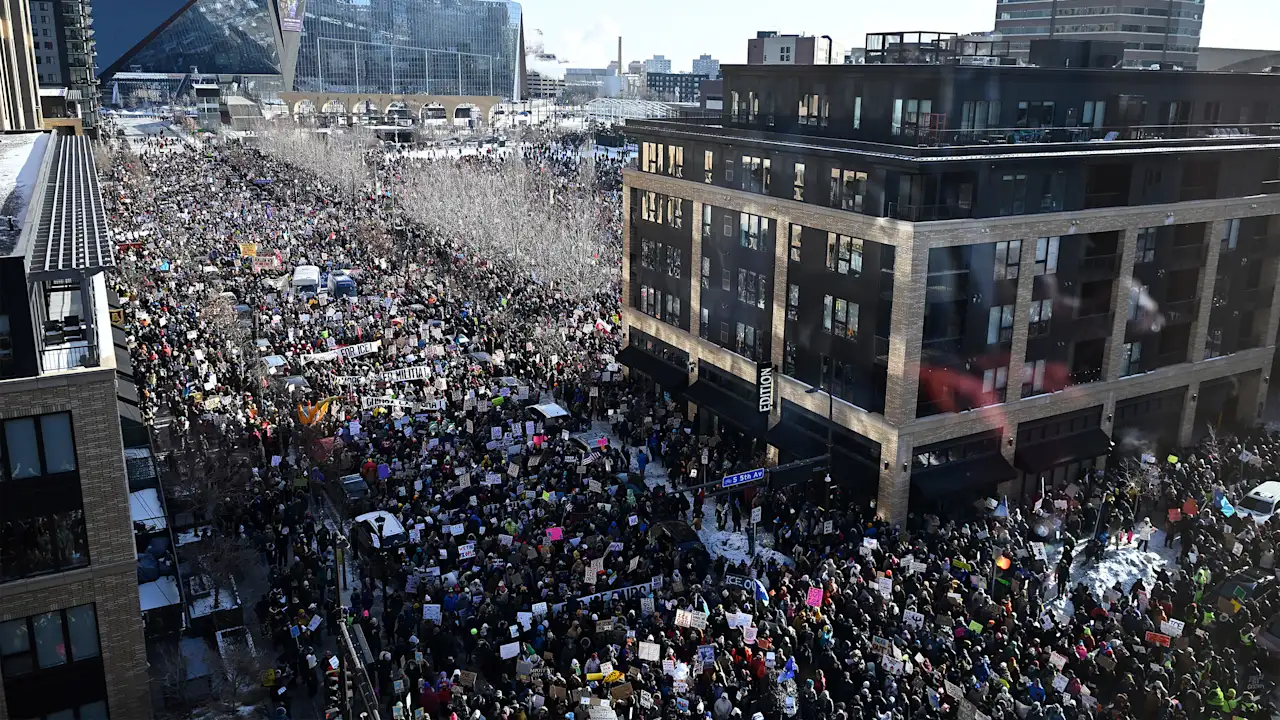
ICE’s occupation in Minnesota has lasted weeks, and until a couple of days ago, the state’s major corporations, quick to issue statements in the wake of George Floyd’s killing by a Minneapolis police officer in 2020, had been largely silent. When Fast Company reached out to several heavy hitters in mid-January, including Target and Best Buy, there was no response.
Finally, on January 25, more than 60 of the state’s major business leaders put out a response calling for “de-escalation.” But the statement has been criticized on social media and beyond, with some calling it “spineless.” It came over two weeks since federal agents fatally shot U.S. citizen Renee Good, and a day after federal agents also fatally shot U.S. citizen Alex Pretti.
For weeks, the Twin Cities have been awash in chaos and fear as ICE raids streets, shops, and schools, profoundly disrupting daily life, as well as economic activity. Roughly 80% of immigrant-owned businesses along main streets have closed, while restaurants and health care centers in some of the surrounding suburbs have had to cut hours because employees are afraid to come to work. Last Friday, there was an economic blackout as hundreds of businesses closed and over 75,000 protesters marched.
Given the loss of life and constant turmoil, it’s puzzling why Minnesota’s business leaders were quiet for so long. For insight, Fast Company talked to Bill George, Executive Education Fellow at Harvard Business School and former CEO of Medtronic, one of the world’s biggest medical tech companies, whose operations are based in Minneapolis.
This interview was conducted over two days and has been edited for length and clarity.
What do you think of the statement that businesses finally released?
Well, I think the statement itself is very significant. If you worked in a large company, you can’t believe how difficult it is to get not just one but 60 CEOs from a wide range of businesses to [do the same thing]. These people are very cautious about signing on anyone else’s statements. There are those that thought it didn’t go far enough.
But as Marshall McLuhan once said “the medium is the message.” I don’t see CEOs or companies that were left off. So I think having all of them sign on may have taken a while, but it’s significant.
And I’d go further. Let me just say: I hope this will be the tipping point, and the businesses are sending a powerful signal to the White House that they are being harmed by this. No doubt it’s causing a loss of productivity and lots of issues. I hope this will be the turning point that will cause the White House to move on.
We did hear a huge outpouring of support after George Floyd’s death. What was different this time around?
They want to stay out of the news, and many of them feel they can work behind the scenes to get what they want. You see some of the deals that have been cut with Nvidia and Intel and Apple and others. But I think most companies don’t have that kind of access.
It’s a different time than it was with George Floyd. And I think there is a very strong point of view that we should work behind the scenes and not do anything to provoke anyone in the government—not just the president, but any of the members of [Trump’s] administrative team. The companies have to let ICE do their job, whether they like it or not—but I think that their employees need to know they have their support.
The public letter from the business leaders has gotten criticism on social media for not going far enough.
Well, the governor and the attorney general, who I’ve spoken with, are being investigated. So I don’t think any of these CEOs want to get between their interests and ICE or the federal government.
These CEOs are not very political. None of them are extreme left or extreme right. You might say that they’re slightly to the right center, but they’re quite independent in how they vote. Their primary concern is to run their business and stay out of politics.
How did Alex Pretti’s death trigger the timing of the statement?
This didn’t just get thrown together. These things don’t happen easily, sure; particularly when a lot of other companies are involved. It’s hard enough to get a statement out of one company, much less 60. But I think these things are all having an impact: the protests in Minneapolis, [Pretti’s] death, the concern to people’s business, the fact that Minnesota companies are highly dependent upon being able to recruit people from all around the United States and all around the world.
What if the statement is not enough to get the administration to move on?
I’m not sure. I think it’s continuing discussions behind the scenes.
And what kind of leverage do the companies have behind the scenes?
I don’t think a lot. These are not companies that are making big promises that you’ve seen very publicly for the last year that I’m aware of, but people care about these businesses. The president himself is a businessman, and will recognize that.
One other thought is: what is the goal here? We have very few illegal immigrants in Minnesota. I can assure you, the companies on that list do not hire illegal immigrants. They hire immigrants. For example, at the Mayo Clinic, several of the physicians, including a CEO, were born outside the U.S. That’s great. It’s great for the Mayo Clinic. It’s great for Minnesota. If you were really looking for illegal immigrants, why wouldn’t you go to Florida, Arizona, or Texas?
What do the companies want?
They want to restore calm, and I’m sure they would like to see this all get settled. They’re hoping to get a peaceful situation and not provoke greater confrontation. They certainly don’t want to have the United States military sent in. They certainly don’t want to see martial law declared for Minnesota.
What’s the long-term impact of this corporate silence going to be on employees?
Employees are going to feel very disappointed, and they may feel a lack of loyalty to the company.
As a CEO, you have to keep innovation going. And to do that, you’ve got to attract people from all over the country and all over the world to come to Minnesota. From a longer term perspective, this could scare off people from coming. As a CEO, I’d want to make sure people know we’ve got their backs, and we will provide the support they need.