
For decades, people with disabilities have relied on service dogs to help them perform daily tasks like opening doors, turning on lights, or alerting caregivers to emergencies. By some estimates, there are 500,000 service dogs in the U.S., but little attention has been paid to the fact that these dogs have been trained to interact with interfaces that are made for humans. A team of researchers from the United Kingdom wants to change that by designing accessible products for, and with dogs.
The Open University’s Animal-Computer Interaction Laboratory in the UK was founded in 2011 to help promote the art and science of designing animal-centered systems. Led by Clara Mancini, a professor of animal-computer interaction, the lab studies how animals interact with technology and develops interactive systems designed to improve their wellbeing and support their relationships with humans.
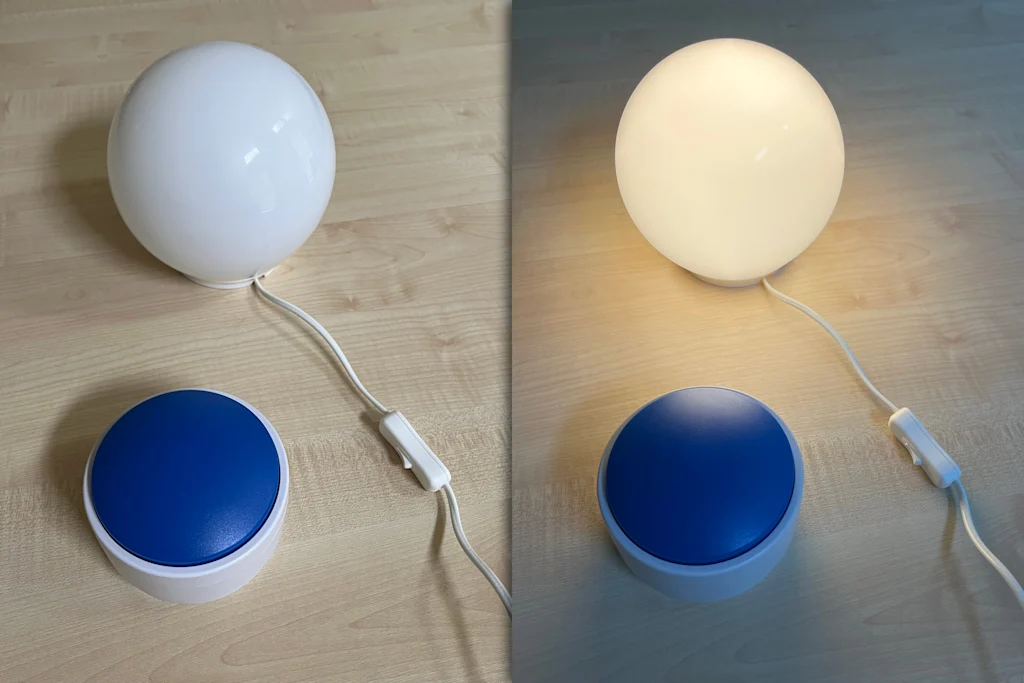
The team’s first commercially available product is a specifically-designed button that service dogs can press to help turn on corresponding appliances at home, like a lamp, a kettle, or a fan. The Dogosophy Button took more than ten years to develop and was tested with about 20 dogs from UK charity Dogs for Good.
It gives dogs more control over certain aspects of their home, which can make training them easier and further strengthen the bond between a human and their dog. It’s also taught the team a few lessons about how to design for humans. “I am now a better human designer,” says Luisa Ruge, an industrial designer who worked with Mancini and led the design of the button.
For now, the Dogosophy Button is only available for purchase in the UK (for about $130).
The challenges of designing for animals
Anyone who’s ever designed a product for a human client knows the process relies on a perfect storm of variables like gender, age, background, and personal preferences. But these designers also have one advantage they likely take for granted: they can ask their client what they think at every step of the way.
Getting feedback from a dog is much harder and requires an understanding of animal behavior. “There’s a lot of iteration,” says Ruge, “and a huge ethical and reflective component because I can’t be a dog, I don’t [feel] what they feel.”
Ruge began her career as an industrial designer, but as she moved up the corporate ladder, she realized she was fascinated with animals. Her interest led her to train as a service dog trainer at Bergin College of Canine Studies in California. “One of the ways to bond is we had to be tied to our dog with a carabiner and leash for 8 days, 24/7,” she recalls.
Later, she attended a conference on human behavior change for animal welfare, where she met Mancini and became interested in her lab. Ruge immediately enrolled in a PhD at The Open University, and spent the next three years writing a thesis on designing for the animal user experience and proving out her dog-centered methodology.
Ruge followed the five human factors model, a method that helps designers understand the end user’s behavior by breaking down the UX into five factors. The typical list includes physical, cognitive, social, cultural, and emotional factors, but Ruge added a sixth—sensory—and then later, a seventh: consent.
To understand the exact characteristics and abilities she had to design for, she focused on Labrador Retrievers, Golden Retrievers, as these are the most common breeds for service dogs. Her research led to various correlations that informed the design of the button. For example: since both breeds have long tails, the button should not feature sensors that might accidentaly be activated by it. Since both breeds are predisposed to hip dysplasia and joint problems, the button should also not be designed in a way that requires jumping to activate. And since all dogs see the world in hues of yellow, blue, and brown, the button should be made in one of these colors so it is easy to perceive.
When Ruge first got involved, the prototype Mancini had developed was square in shape, and looked a bit like the standard metallic button that people with wheelchairs can press to open a door. Now—after about 20 iterations and five prototypes—the button is round, convex, and blue. It is textured to prevent a dog’s wet snout from sliding on it, and its push depth is such that a more timid dog shouldn’t have to press hard to activate it.
Ruge had to test some of her designs the hard way. The first prototype she ever made took days to develop and the dogs destroyed it “in two seconds,” she recalls with a laugh. But dogs don’t know that a prototype should be handled with care. To them, a work-in-progress product looks no different than a finished product.
Animal design as a discipline
Designing for dogs humbled Ruge’s assumptions. “It lets you know you’re never 100% right,” she says, adding that the only way to confirm her theories was through extensive testing and observation.
It also made her a better designer for humans, because she learned to better spot her biases and assumptions. “Sometimes, I’m assuming you feel a handle like I do, and you don’t,” she says.
In the end, though, animal design is where Ruge’s passion lies. Since earning her PhD, she has moved back to her native Colombia and started a design consultancy called Ph-auna (pronounced “fauna”) where she focuses on animal centered innovation. She hosts a podcast called Pomodogo, guiding humans to better connect with their dogs, and is now working on an app that gamifies dog training and inspires humans to be better caretakers. “There’s an immense opportunity for animal design to be its own design discipline,” she says.
Meanwhile, in the UK, the Dogosophy Button is available to individual customers willing to buy it, but the team is hoping to broaden its scope beyond the home. Mancini, who spearheaded the button project, says they first installed an earlier version of the button to operate the motorized door of a restaurant’s accessible toilet, but the restaurant ended up shuttering. Then, they tried installing it at a local shopping mall, but the plan fell through due to budget constraints.
Still, she plans to continue developing new versions and adapt them for the characteristics of other species too. “It is my interest to try and install the buttons in public buildings,” she says. “I would love for whole cities to be more accessible for dogs and other urban animals.”