
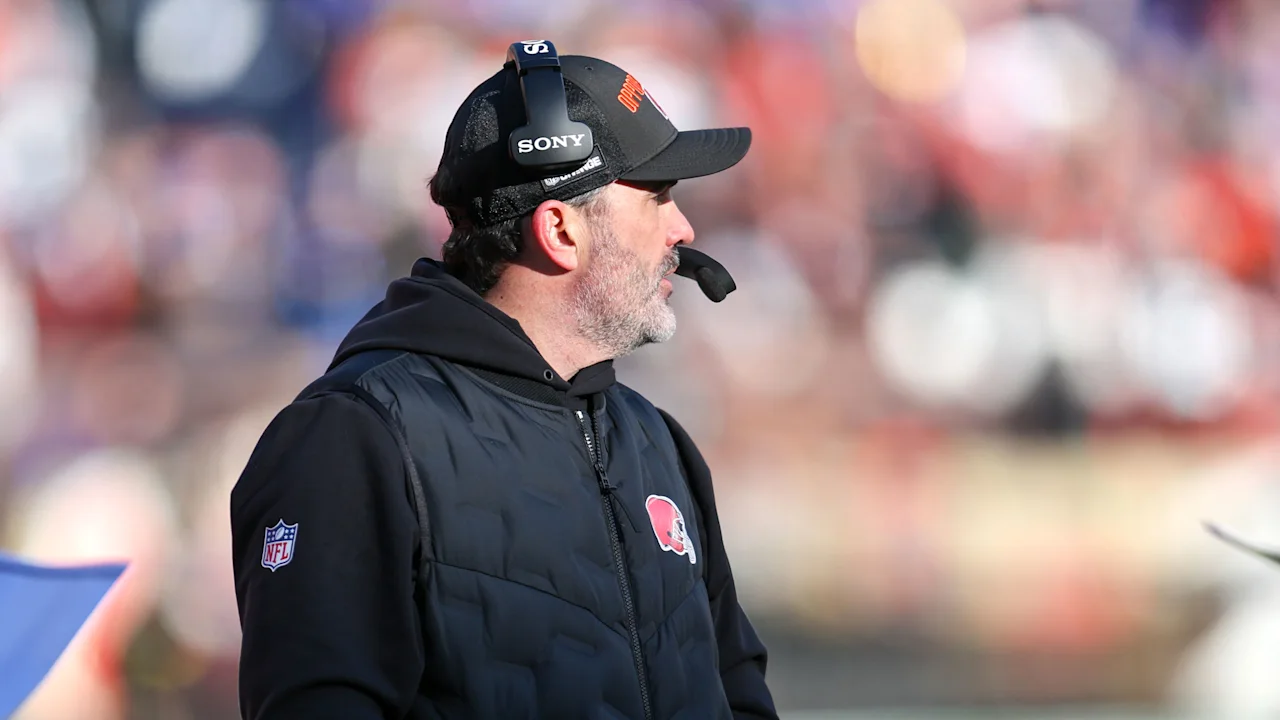
The beginning of a new year ushers in an ominous day in the NFL: Black Monday, the day when coaches are (typically) most at risk of losing their jobs. Black Monday happens the day after the regular season ends, a time when an especially harsh backward review is cast over the wins, losses, and total misses.
The casualty list includes Raheem Morris, who lost his job with the Atlanta Falcons on January 4; Kevin Stefanski, Pete Carroll, and Jonathan Gannon (Arizona Cardinals), who were each fired on Black Friday by the Cleveland Browns, Las Vegas Raiders, and Arizona Cardinals, respectively; John Harbaugh, who was fired by the Baltimore Ravens on January 6; and Mike McDaniel, whose dismissal from the Miami Dolphins was announced January 9.
In the NFL and other sports leagues, performance metrics could not be more clear cut and public. So if coaches aren’t wracking up enough Ws, isn’t it just radical accountability to let those who aren’t performing go? And could the business world learn anything from this?
‘High-visibility performance management’
That kind of slice ‘em and dice ‘em mentality doesn’t offer a model of accountability to the traditional work environment outside the sports world, Mario Avila, Assistant Professor of the Practice of Management at Vanderbilt University, tells Fast Company.But it does offer a “model of high-visibility performance management” that may well serve the upper echelons of corporate America.
Conceptualizing performance in the NFL in this way is possible because all eyes are on the field as the game unfolds. And “while these KPIs are powerful, and having clear performance indicators are powerful and important, the difference between the NFL and a traditional business is in the corporate sector,” Avila also said, where accountability functions differently. A football coach has to consider injuries, rosters, and the patience of owners—factors that don’t cross the mind of a CEO. Therefore, Avila added, “accountability is very different.”
But that doesn’t mean corporate leaders can’t take from the NFL and Black Monday. The top of the list includes clarity and feedback loops, he explains.
“There’s a significant amount of clarity of what the KPIs are” in a game, and they provide “instant feedback loops: are you winning or losing? Are you hitting the right numbers or are the expectations being met? It’s highly visible, you’re in front of millions of viewers, on display every weekend.”
A manager at a desk job may not be conducting on-field warfare against 53 opponents, but those same loops persist; after all, most work is about hitting goals and, ultimately, winning.
More teamwork lessons than accountability ones
Football also offers a lot of lessons about leadership and teamwork, something that’s baked into the backbone of the sport, Stephen Master, Adjunct Assistant Professor of Marketing at New York University’s Stern School of Business tells Fast Company.
Sports are “about teamwork: it’s about everyone contributing what they can, and it’s about culture.” Just like in a traditional office environment, “if there’s someone who is giving off a negative vibe and is a cancer in the locker room, and they’re just not a good teammate … that’s the same thing you can risk in corporate America, where someone is really only interested in their own achievements and their own personal growth goals.”
If leadership has incentivized the work experience—football players get trophies, corporate workers get bonuses, perhaps—those incentives should “be also tied to
company performance or division performance, and that’s the same thing in any sport, but especially in football,” he added. As Master put it, a quarterback on any given team can be the best in the world, but if his offensive line isn’t doing their job, the team isn’t going to win.
The real takeaway
If there is one thing corporate leaders should avoid emulating, it’s the NFL’s culture of disposable leadership, which is “detrimental to the long-term success of a business,” Avila says. Bringing people into an environment where easy firings and mass layoffs run rampant—where a bad start can cost you your job after barely two seasons on the field—isn’t something businesses should mimic if there are concerns about company morale.
Conversations that intersect the NFL and corporate America also raise questions of long-term results vs. short-term gains, Dae Hee Kwak, Graduate Program Director and Associate of Sport Management at the University of Michigan explains to Fast Company. The NFL is “built for a 17-week sprint, while a healthy business is built for a 50-year marathon. If you apply NFL logic to a marathon, you’ll never have enough runners left to finish the race.”
An environment steeped in fear will do little to encourage those marathon runners—or, perhaps, football coaches—to approach their jobs fearlessly, Avila agrees. “Incentives about winning now reduce long-term capability building,” he said. “But when we look at some of our organizations across the country that are the most successful … short-term incentives and winning now [mentalities] really distort the behavior.”
“Fear crowds out learning,” he continued. “Because people are going to start to protect themselves instead of experimenting.” Success is built on risk, and “you want your people in business to take risk. If you make the environment safe, people will take more risks. If they fear that they’re going to get fired, they will be less willing to take risks, which leads to a decrease in innovation, and a decrease in growth.”
As endless newspaper and website pages are filled with stories of mass layoffs, perhaps one of the more salient lessons from the NFL is exactly Avila’s point: to succeed, workers—all workers—need to be encouraged to try something new, and maybe even fail, before they can rise.
Radical accountability might be a mainstay in the NFL, but that doesn’t mean it truly can be applied to other work environments—or that it should even be considered. If long-term success is the objective, it likely behooves corporate leaders to let the football coaches do their thing…while they do their own.