
In cities across North America, the best and most exciting public spaces can increasingly be found near the water. Park spaces on and along seashores and riverfronts are in a kind of renaissance right now, with large and small cities alike opening major waterfront parks over the past few years.
2025 was especially active. Cities brought big, ambitious park designs to the water’s edge, adding valuable recreation space, ecological services, and engines for urban regeneration.
Here are four of the best waterfront parks that opened in 2025.
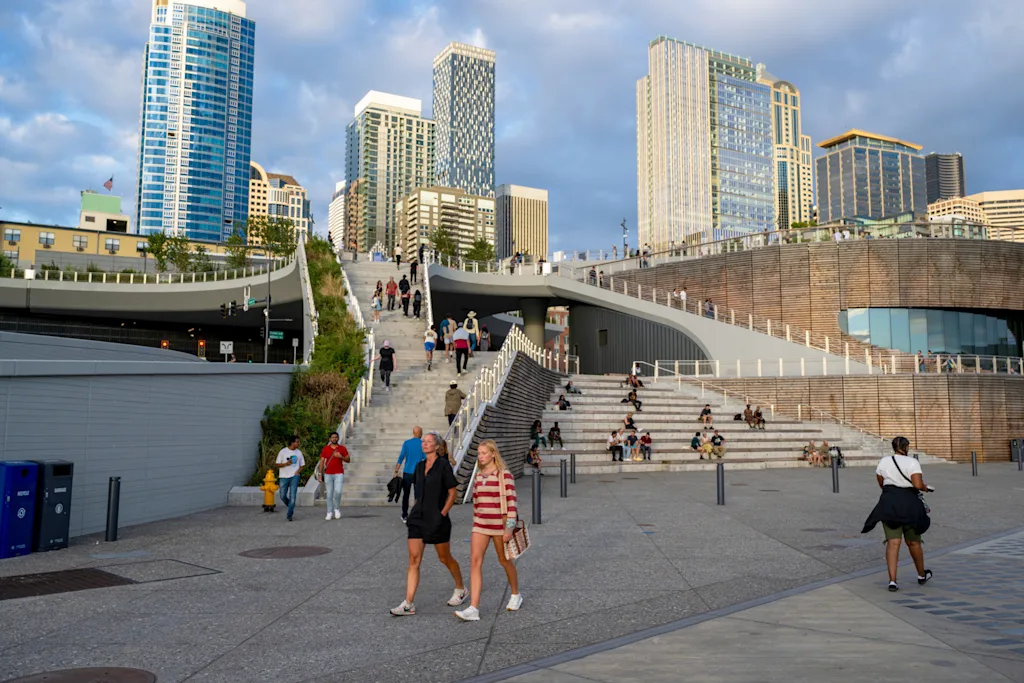
Seattle’s Waterfront Park
More than 15 years in the works, Seattle’s new park is a true reconnection of the city with its water. Once separated from downtown Seattle by the double-decker Alaskan Way Viaduct highway, the waterfront has been painfully and expensively restitched into the city after traffic was rerouted into a $3.35 billion tunnel and the surface level reconfigured as a boulevard.
The park is a 1.2-mile long linear space along Elliott Bay with tendrils that spread perpendicularly into the city grid. It also connects tourist attractions like Pike Place Market, the Seattle Aquarium, and Pioneer Square with historic docks, new playgrounds, and a bicycle and pedestrian lane that wraps around the bay.
After being officially open for just over a month, the park won one of the most prestigious prizes in urban parks. It stands to rewrite how the city interacts with and embraces its scenic shore.
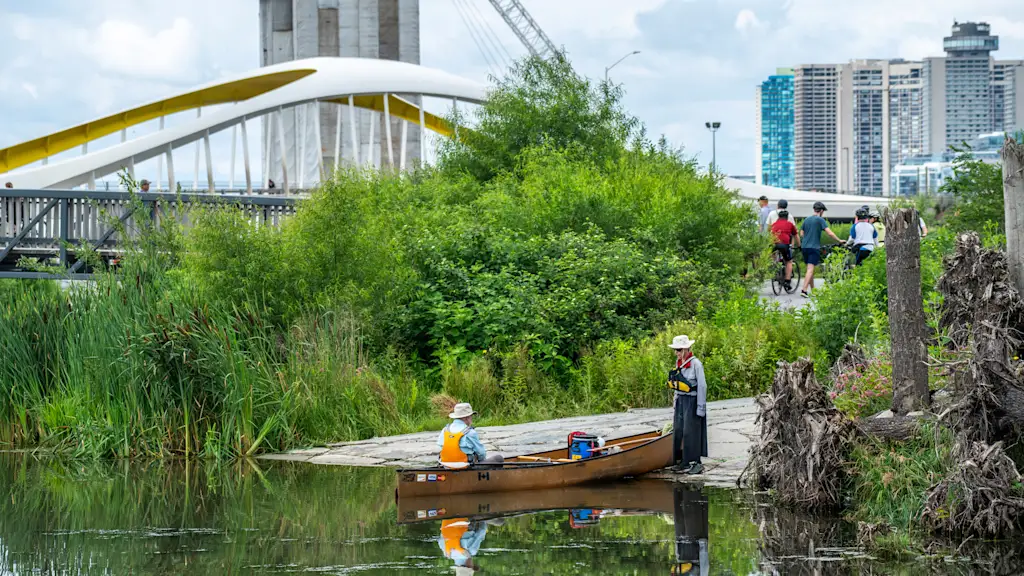
Toronto’s Biidaasige Park
What was once an industrial wasteland immediately adjacent to downtown Toronto has been carefully transformed into a re-naturalized waterfront park that’s laying the foundation for a dramatic urban redevelopment.
The first phase of the nearly 100-acre Biidaasige Park opened in 2025 and has undone more than a century of environmental damage. Industrial development in the area led to a large-scale filling project, turning the mouth of the adjacent Don River and its surrounding wetlands into a channelized outpouring surrounded by concrete.
A design by the landscape architecture firm Michael Van Valkenburgh Associates tore out much of that concrete and allowed the river to reclaim its historic course, while building a new island where much of the park’s recreation amenities now stand. The team designed the park and the re-naturalized wetland to prevent flooding that has increasingly affected the area.
The $1.4 billion project persevered through several delays since its origins in 2007, but is now becoming one of the city’s most used public spaces. Next, the city will build out more park space, as will an urban element of the project. Soon there will be upwards of 15,000 people living on the island, adding to the park’s already substantial user base.
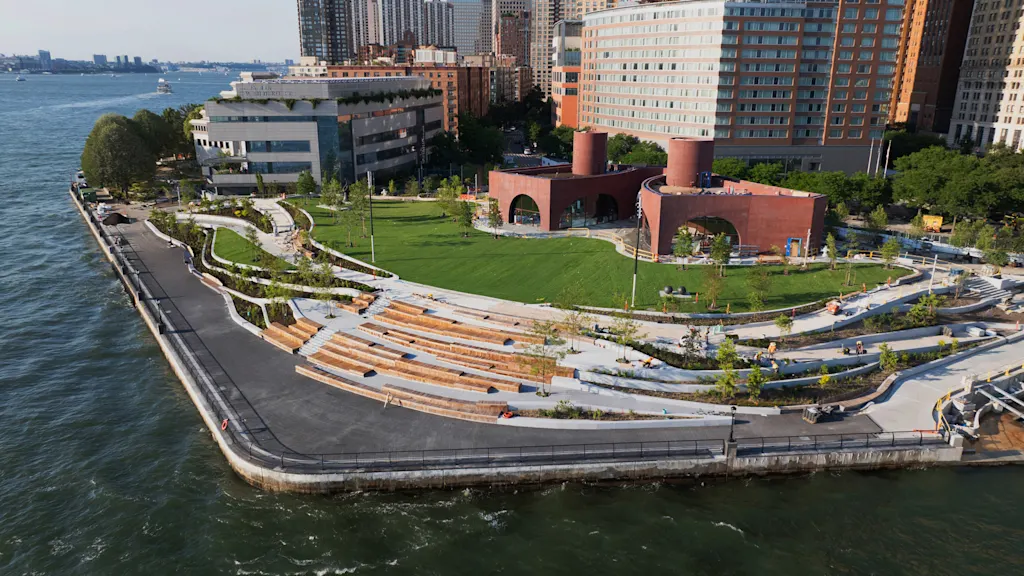
New York’s Wagner Park
The terraced walkways and broad grassy field on the recently rebuilt Wagner Park at the tip of Lower Manhattan are low-key feats of urban flood protection.
The park’s site has been engineered by AECOM to double as an 18-foot-tall flood wall, protecting the edge of New York City from storm surges and rising sea levels. Most people probably won’t realize that the park now sits 10 feet higher than it once did, thanks to elegantly sloping walkways that climb up from the water to a grassy peak.
Hiding beneath that grass is another part of the park’s flood protection: a 63,000-gallon stormwater cistern that can hold the onrush of rainwater during a big storm before slowly releasing it into the city’s system once the heaviest rains have passed.
While the park’s flood protection elements are what make it a model to follow, it’s also a space designed for people to use. A new community space and pavilion make room for events, and a native garden brings additional green space to a dense part of the city. With front row views of the Statue of Liberty, the site’s natural attraction can now outweigh its natural risk.
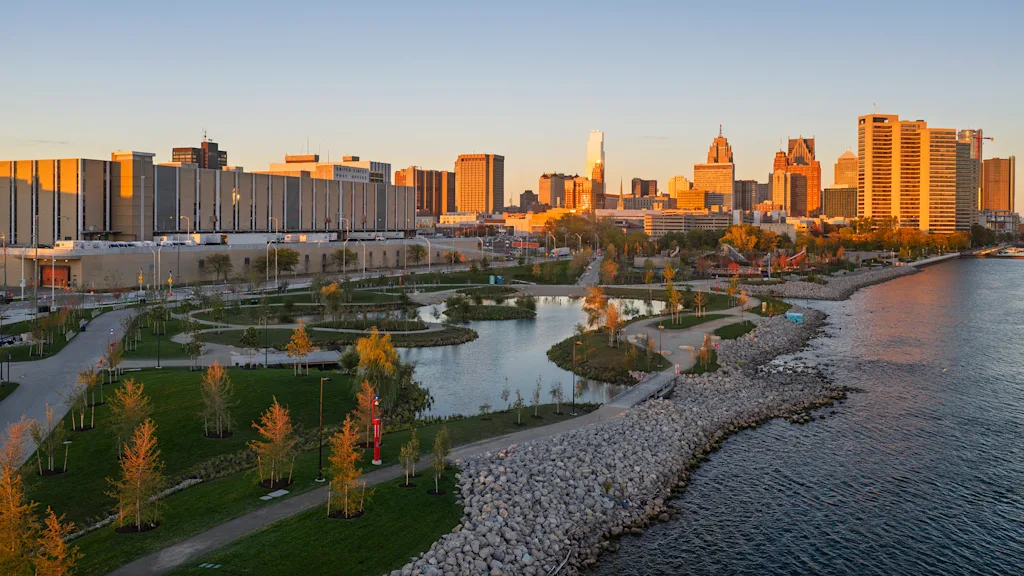
Detroit’s Ralph C. Wilson, Jr. Centennial Park
Covering 22 acres and connecting a key stretch of a 5.5-mile continuous walkway along the Detroit River, the new $80 million Ralph C. Wilson, Jr. Centennial Park fills several important gaps in Detroit.
Running along a downtown-adjacent stretch of the river that has seen increased investment in its once contaminated edges, the park adds more space to a growing riverfront walk, while also adding to a 27-mile trail loop that runs through the city. The park also brings recreational space to a part of the city where quality public open space is lacking.
Also designed by landscape architecture firm Michael Van Valkenburgh Associates, the park turned a lackluster industrial-site-turned-grass-field into a regional destination, with world-class playgrounds and recreational facilities, and a unique natural water element that redirects flows from the river to create a rare water habitat that urban visitors can experience up close.
Filling a crucial missing piece of Detroit’s Riverwalk, the park is situated with sparkling views of the city’s downtown and its two international bridges, and was designed for both active and passive uses, and intended to draw crowds from across the region and across the age spectrum.
“We wanted the park to have things in it that the range of members of a family would need to have to go to the park and spend some serious time there,” Van Valkenburgh told Fast Company ahead of the park’s opening. Luring crowds and solving urban problems, this space will serve as a precedent other waterfront parks look to follow.