
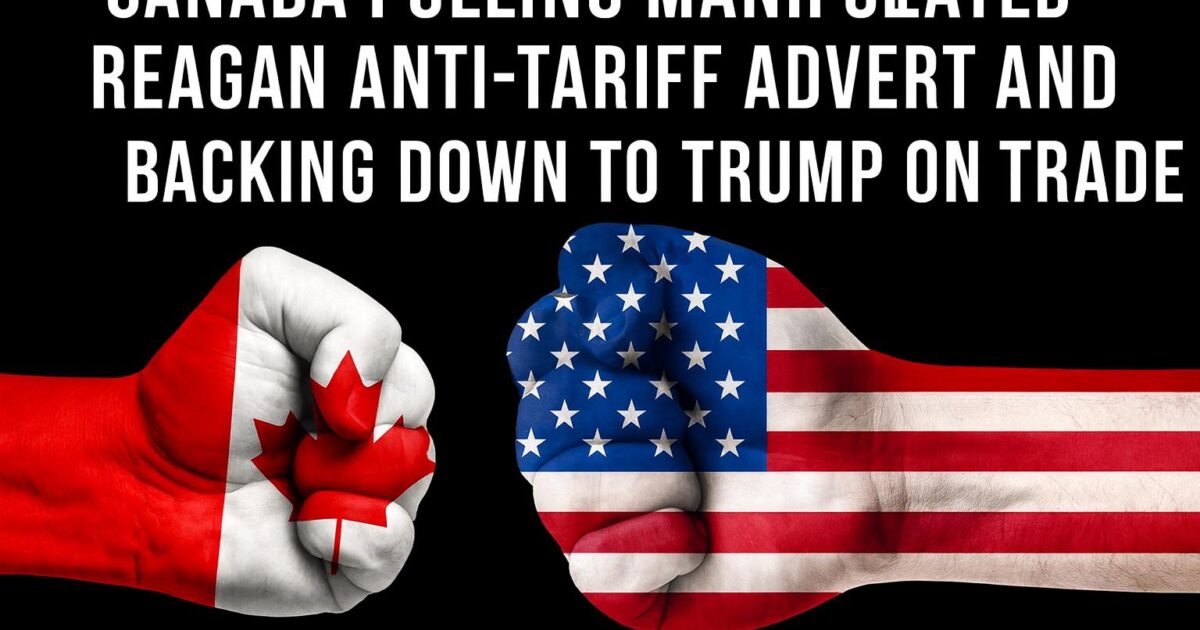
Ontario Premier Doug Ford announced he would suspend the controversial anti-tariff ad campaign that triggered President Trump to halt trade talks with Canada.
The advertisement, created by the Ontario government and costing about 75 million Canadian dollars, used edited clips from a 1987 Ronald Reagan speech warning that high tariffs lead to retaliation and harm workers and consumers.
It aired widely in the United States during the World Series and quickly drew backlash.
President Trump called the ad “fake,” because Canada had selectively clipped, manipulating Reagan’s words, in an attempt to influence an upcoming Supreme Court ruling on his global tariff regime.
The Ronald Reagan Presidential Foundation and Institute also condemned the ad, saying it misrepresented Reagan’s views and that it was considering legal action.
Trump’s administration suspended trade negotiations pending review of the controversy, with both Trump and the foundation insisting the advertisement distorted Reagan’s original message.
White House spokesman Kush Desai denounced Ontario’s taxpayer-funded anti-tariff ad as “misleadingly edited,” saying it showed Canadian officials “would rather play games than engage.”
While provincial leaders such as Manitoba Premier Wab Kinew and British Columbia Premier David Eby defended Doug Ford’s messaging as bold and effective, however, the move backfired by provoking Washington.
Trump’s decision to end trade negotiations with Canada further escalated already tense relations between the two allies.
Prime Minister Mark Carney said Canada remains open to discussions but is also prioritizing efforts to expand exports beyond the U.S., as tariffs continue to strain Canada’s steel, aluminum, auto, and lumber sectors.
Carney has pledged to double Canada’s non-U.S. exports within the next decade, declaring that “the decades-long process of an ever-closer economic relationship between the Canadian and U.S. economies is now over.”
He said Canada is “re-engaging with the global giants India and China” in an effort to reduce dependence on its southern neighbor.
While Canada may talk tough, it is all bluster. Canada is highly dependent on the US, and there is no way to establish or reshuffle relationships with other countries to replace the US as a market.
Canada is already trading with most of the world’s countries, and ostensibly, they are already buying the quantity of Canadian goods that they want and can afford.
Currently, about three-quarters of Canada’s merchandise exports go to the United States, representing nearly one-quarter of national GDP, while imports from the U.S. make up about 16.7 percent of GDP.
In 2023, exports to the U.S. accounted for 16.8% of Canadian GDP and supported more than 2.6 million Canadian jobs.
Furthermore, most of Canada’s foreign direct investment comes from companies attempting to bypass US tariffs by manufacturing in Canada and exporting to the US. Now, because of the tariffs, Canada’s received foreign direct investment is declining.
Canada’s concession on the Reagan television advert underscores a recurring pattern of tough talk followed by retreat under U.S. pressure.
Earlier in the year, Ford had threatened to cut electricity exports to Michigan, New York, and Wisconsin, vowing to “fight right to the death.” Yet by March 4, 2025, he softened the stance, proposing a 25 percent surcharge on exports only if Washington escalated further.
When Trump countered with a threat of 50 percent tariffs on steel and aluminum, Ontario quickly suspended the surcharge. Ford framed the move as a goodwill gesture after Commerce Secretary Lutnick offered an “olive branch” meeting.
Federal officials in Ottawa followed the same pattern. In mid-2025, Canada scrapped its planned Digital Services Tax on major tech companies after Trump threatened to halt negotiations, with the White House declaring that Canada had “caved.”
Earlier, the government pledged about $950 million (USD) to strengthen border security and appointed a “fentanyl czar,” despite Canada accounting for less than one percent of fentanyl seized by U.S. authorities.
By August, Ottawa dropped most of its retaliatory tariffs by aligning with U.S.-Mexico-Canada Agreement (USMCA) exemptions in an effort to restart trade talks. By September 1, counter-tariffs on most U.S. imports were removed, leaving only steel, aluminum, and automobiles subject to duties.
When Trump later doubled tariffs on steel and aluminum, Prime Minister Carney offered angry words but no retaliatory tariffs, underscoring Canada’s limited leverage and ongoing tendency to back down when confronted by U.S. economic pressure.
Prime Minister Mark Carney’s plan to double Canada’s non-U.S. exports faces steep structural and economic obstacles.
Canada’s geography makes diversification difficult, as its vast land border with the United States enables far cheaper overland transport than shipping goods across oceans to Asia or Europe.
Global demand for Canadian products is relatively fixed, so any loss of U.S. market share cannot be replaced.
Even in the most optimistic scenario, doubling non-U.S. exports over the next decade would reduce reliance on the U.S. only from about 75 to 60 percent of total exports.
In short, Canada’s strategy to counter U.S. tariffs is aspirational rather than practical. Geography, trade patterns, and deep interdependence continue to bind Ottawa to the economic gravity of its southern neighbor.
Consequently, having no other option, Canada will capitulate to U.S. demands. Hopefully, a Republican is elected in 2028 so the U.S. can continue to enjoy the lucrative trade deals resulting from this full-scale rebalancing of global trade under President Trump.