
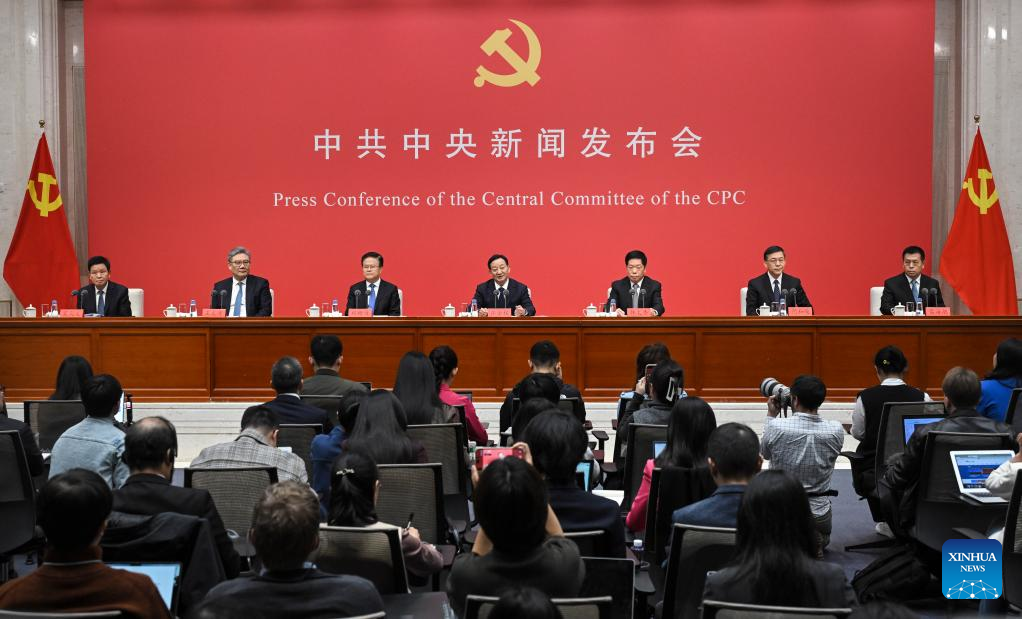
China approved the draft of its 15th Five-Year Plan at the Communist Party’s Fourth Plenum, which concluded on October 23, 2025. Although the plan doesn’t mention “Trump,” it clearly reflects Xi Jinping’s urgency to make China more self-sufficient and less dependent on the United States. The Chinese economy has been slowing since the first Trump administration, and Xi has yet to find a quick fix. The final version of the plan is expected to be released during the Two Sessions in March 2026.
Five-Year Plans serve as comprehensive blueprints for China’s economic and social development, outlining national goals, strategies, and priorities for each cycle. They clarify the country’s strategic intentions, define government focus, and shape the behavior of market entities. In practice, this means the Chinese Communist Party issues directives to private companies, telling them how to operate in line with Party objectives. The CCP also embeds Party cells within enterprises to relay official instructions, hold study sessions on Xi Jinping Thought, and ensure that both management and employees follow Party guidance.
If you live, work, or study in China, you quickly learn how proud the Chinese people and government are of their 5,000-year history, which they believe enables them to plan farther into the future than other nations—especially the United States, which they regard as having a much shorter past. This belief in long-term strategy underpins their conviction that China’s ability to “win the waiting game” will eventually allow it to surpass the United States militarily, economically, and diplomatically. They pursue this goal one Five-Year Plan at a time.
China has implemented these plans since 1953, evolving from an early focus on heavy industry and industrialization to improving living standards, achieving moderate prosperity, and pursuing high-quality development. Each plan functions as a phased deployment of China’s long-term development strategy, maintaining policy continuity while adapting to new challenges. Major projects have always been central to implementation. From 156 Soviet-assisted projects in the first plan to 102 projects in the 14th, more than a thousand major initiatives have been completed.
The process begins with drafting by the Communist Party Central Committee, followed by public consultation and industry input. It is then approved at Party plenums, formally adopted during the annual Two Sessions, and implemented over the five-year period. China is now completing its 14th Five-Year Plan (2021–2025) and has approved the draft of the 15th Plan (2026–2030). So far, only high-level priorities and recommendations have been released, with the final document expected to be adopted and published in March 2026 following the fall 2025 plenum.
Several major policy initiatives embedded in China’s Five-Year Plans have far-reaching implications for the United States and the rest of the world, each contributing to Beijing’s long-term goal of achieving global dominance. Among the most significant are the Belt and Road Initiative, Made in China 2025, China Standards 2035, the PLA modernization program, and the Two Centenary Goals.
The Belt and Road Initiative, launched by Xi Jinping in 2013 and included in the 13th and 14th Five-Year Plans, seeks to expand China’s global influence through massive infrastructure projects across Asia, Africa, and Europe. As of 2025, roughly 150 countries, representing around 40 percent of global GDP, have signed agreements under the initiative, with total Chinese engagement exceeding one trillion dollars. The goal is to build physical and digital trade networks that anchor China at the center of global commerce.
Twelve years in, the Belt and Road Initiative has failed to deliver the influence and prosperity Beijing promised. Mounting debt, stalled infrastructure projects, and growing international backlash have turned what was meant to be a symbol of China’s rise into a source of financial and diplomatic strain. Once envisioned as Xi Jinping’s pathway to global dominance, the BRI now stands as a costly reminder of the limits of China’s economic reach.
Like the Belt and Road Initiative, Made in China 2025 has fallen short of its ambitious goals. Despite massive state subsidies, China remains heavily dependent on foreign technology, particularly in advanced semiconductors and precision manufacturing. International pushback, combined with inefficiency and limited innovation in state-owned enterprises, has prevented the world from adopting Chinese-made technology and kept China from achieving true technological self-reliance.
China Standards 2035, officially launched in 2018 and integrated into the 14th Five-Year Plan and Vision 2035, extends this strategy by seeking global control over technical standards in emerging technologies. Through active participation in international bodies such as the International Organization for Standardization and the International Telecommunication Union, Beijing aims to shape the rules governing the next generation of global technology.
China Standards 2035 has failed egregiously. Beijing has achieved limited adoption of its standards in developing countries, mainly through Belt and Road projects tied to Chinese financing. However, this success was the result of economic coercion rather than innovation. In developed markets, Chinese technology has been almost entirely excluded, leaving Beijing with increased participation in global standards bodies but little real influence or control.
Military modernization forms the fourth pillar of China’s long-term planning. The 14th Five-Year Plan incorporates the 2027 goal of transforming the People’s Liberation Army (PLA) into a force capable of confronting the U.S. in the Indo-Pacific and compelling Taiwan to negotiate on Beijing’s terms. By 2035, the PLA is expected to complete its modernization, and by 2049, the centennial of the People’s Republic, China intends to possess a fully “world-class” military.
China’s 2027 military modernization goal is falling behind schedule. Despite rapid shipbuilding and weapons development, the People’s Liberation Army still lacks the combat experience, joint coordination, and logistical reach needed to match U.S. power in the Indo-Pacific. With just over a year remaining, Beijing is not on pace to achieve technological or operational parity, making its 2027 target more symbolic than attainable.
Finally, the Two Centenary Goals provide the overarching political vision guiding all of these efforts. The first, achieved in 2021, was to build a “moderately prosperous society” marking the hundredth anniversary of the Chinese Communist Party. The second aims to create a “great modern socialist country” by 2049.
Despite Beijing’s claims of achieving a “moderately prosperous society,” China’s reality falls far short of the propaganda. The average income in China is about $1,000 a month, while more than half the population lives on less than $300, with limited access to affordable education, healthcare, or retirement benefits—leaving them poorer than many U.S. welfare recipients. . Instead of prosperity, the result has been a struggling middle class burdened by debt, inequality, and the high cost of living.
Together, these initiatives form an integrated national strategy which has th aim of surpassing the US but is falling behind.
China’s new 15th Five-Year Plan focuses on technological self-reliance and expanding domestic consumption as trade tensions with the U.S. strain the economy. It aims to reduce dependence on foreign technology, boost advanced manufacturing in sectors like AI, quantum computing, and clean energy, and increase consumer spending to offset slowing exports, essentially the same goals Xi has been pursuing since coming to power more than a decade ago.
However, persistent overcapacity, weak consumer confidence, and heavy state control make it uncertain whether Beijing can achieve sustainable growth or reduce its economic vulnerability to global pressures, particularly with President Trump back in the White House imposing tariffs on China and threatening secondary sanctions for Beijing’s support of Russia in Ukraine.