
Close Menu
    Facebook X (Twitter) Instagram
    TRENDING :
    • Who gets to decide what ‘bad things’ we should accept about AI?
    • Super Bowl LXI Heads to IMAX Screens in 2027
    • The Government Now Considers A Happy Housewife Dangerous
    • Everything that led to Jensen Huang being reinstated as Nvidia’s CEO
    • Calvin Bassey Talks新 Contract Amid Man Utd Interest
    • The Climate Agenda Collapses As The World Confronts An Energy Crisis
    • 3 Tests This Founder Uses to Know If a Business Idea Is Strong
    • Trevor Rogers Heads to Chicago Cubs in Fresh Start
    Populist Bulletin
    • Home
    • US Politics
    • World Politics
    • Economy
    • Business
    • Headline News
    Populist Bulletin
    Home»Business»Meta just made it harder to scam older users. Here’s how
    Business 3 Mins Read

    Meta just made it harder to scam older users. Here’s how

    Business 3 Mins Read
    Share Facebook Twitter Pinterest LinkedIn Tumblr Telegram Email Copy Link
    Follow Us
    Google News Flipboard
    Share
    Facebook Twitter LinkedIn Pinterest Email


    Meta is working to make its apps better for boomers. This week the company announced new UX features designed to deter scammers and make Meta’s apps safer for older adults.

    Scammers today use all kinds of tricks to part people from their money, like soliciting personal information under the guise of fake government benefits, brazenly pretending to be customer service support, and chatting up unwitting people in the comments section of a real business’s social media page to lure them to another page.

    [Image: Meta]

    New features for older users

    Meta says its new in-app warnings are meant to combat that type of behavior, and will be triggered by suspicious activity.

    On the chat app WhatsApp, users who attempt to share their screen with an unknown contact during a video call will get a warning that says “Only share your screen with people you trust.” The pop-up notes that sharing your screen lets those you share it with “see anything you display on your screen, including sensitive details like your banking info.”

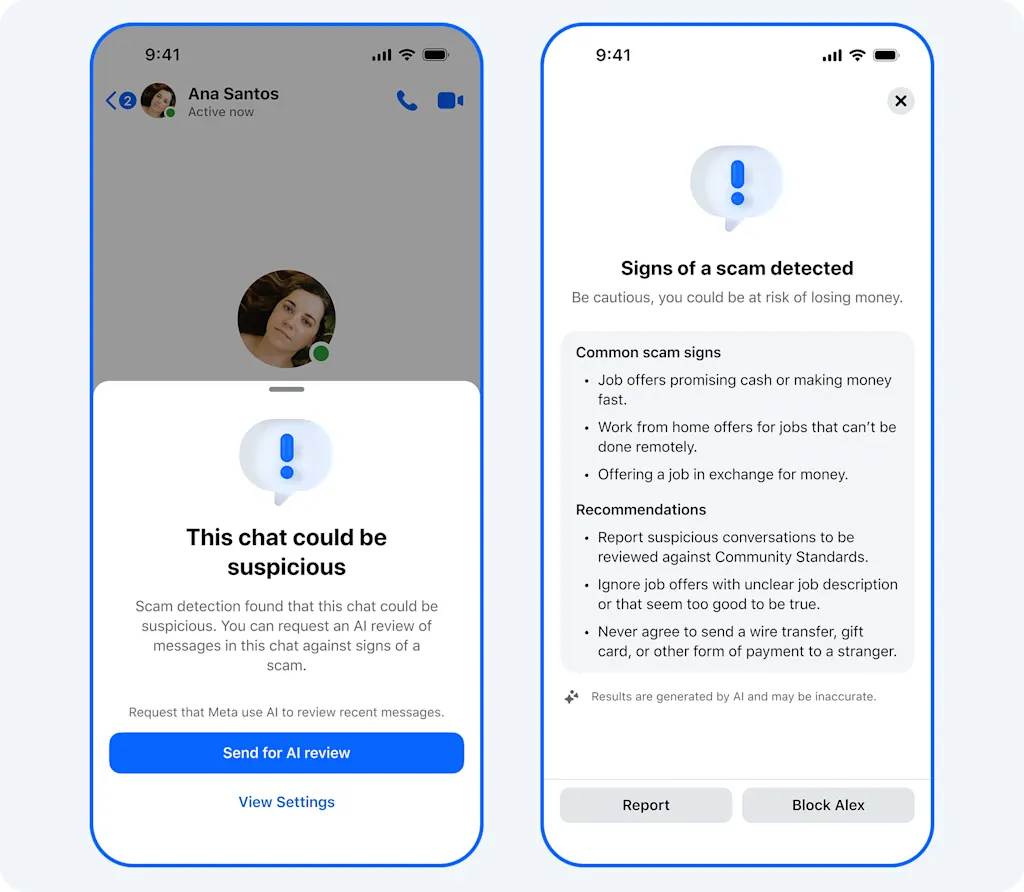
    On Messenger, Meta says it’s testing more advanced scam detection in chats. The company says that when scam detection is enabled, suspicious chats will trigger a warning that prompts users to request an AI review, which will explain why the message was flagged, plus provide tips for staying safe online. The feature can be toggled off or on by going to privacy and safety settings and tapping scam detection.
    [Image: Meta]

    An example AI review Meta shared of a flagged suspicious message notes “common scam signs” such as job offers promising fast cash or the ability to work from home for a job that can’t be done remotely. The AI review goes on to suggest the recipient of the message ignore job offers that seem too good to be true and never agree to send gift cards, a wire transfer, or other forms of payment to a stranger. That includes strangers who are famous.

    Scamming is on the rise

    Scammers have faked the likenesses of public figures such as Taylor Swift to make it appear as if the pop star is promoting a cookware set giveaway, and actors like Helen Mirren and Jamie Lee Curtis have in recent months warned fans about scammers using their likeness on Instagram.

    Meta, which was hit this month with a class-action lawsuit that alleges it profits off of impersonation scam ads, announced it’s investing in cracking down on celebrity scams in the EU, U.K., and South Korea by using facial ID technology and AI.
    [Image: Meta]

    Online scams are a real problem for Meta and other companies. Meta says since the start of year, it’s disrupted nearly 8 million Facebook and Instagram accounts associated with criminal scam centers, and these and other scams have proven costly for victims.

    According to the FBI’s Internet Crime Report, in 2024 people ages 60 and older lost a total of $4.8 billion to fraud—more than any other group. That’s up from more than $3 billion in 2023.

    Best practice for designing digital products for an aging population often calls for features like bigger fonts and intuitive design, but it also means making it safe from scammers and fraudsters who target older individuals.

    As Meta attempts to shore up online safety for young people by launching teen accounts with heightened parental controls, it’s clear the company also has work to do for its users at the other end of the age spectrum.


    Source link

    Share. Facebook Twitter Pinterest LinkedIn Tumblr Email

    Related Posts

    Who gets to decide what ‘bad things’ we should accept about AI?

    November 24, 2026

    Everything that led to Jensen Huang being reinstated as Nvidia’s CEO

    November 24, 2026

    3 Tests This Founder Uses to Know If a Business Idea Is Strong

    November 24, 2026
    Top News
    Business 5 Mins Read

    How leaders must upgrade their talents for the AI Age

    Business 5 Mins Read

    The emergence of AI in corporate life has made almost every professional question what their…

    The Defense Department’s end-of-year spending spree included over $60k on Herman Miller chairs

    March 13, 2026

    Bitcoin Tries to Claw Back Ground Inside Its Bearish Trend

    November 2, 2026

    Your Employees Are Already Using AI. Here Are the 6 Questions Every Business Owner Should Be Asking Now.

    October 14, 2026
    Top Trending
    Business 5 Mins Read

    Who gets to decide what ‘bad things’ we should accept about AI?

    Business 5 Mins Read

    There has been intense debate about the threat AI poses to humanity…

    World Politics 1 Min Read

    Super Bowl LXI Heads to IMAX Screens in 2027

    World Politics 1 Min Read

    ESPN and the NFL are bringing Super Bowl LXI to IMAX theaters…

    Economy 6 Mins Read

    The Government Now Considers A Happy Housewife Dangerous

    Economy 6 Mins Read

    We have reached the point where a woman baking a cake for…

    Categories
    • Business
    • Economy
    • Headline News
    • Top News
    • US Politics
    • World Politics
    About us

    The Populist Bulletin was founded with a fervent commitment to inform, inspire, empower and spark meaningful conversations about the economy, business, politics, government accountability, globalization, and the preservation of American cultural heritage.

    We are devoted to delivering straightforward, unfiltered, compelling, relatable stories that resonate with the majority of the American public, while boldly challenging false mainstream narratives that seem to only serve entrenched elitists, and foreign interests.

    Top Picks

    Who gets to decide what ‘bad things’ we should accept about AI?

    November 24, 2026

    Super Bowl LXI Heads to IMAX Screens in 2027

    November 24, 2026

    The Government Now Considers A Happy Housewife Dangerous

    November 24, 2026
    Categories
    • Business
    • Economy
    • Headline News
    • Top News
    • US Politics
    • World Politics
    Copyright © 2025 Populist Bulletin. All Rights Reserved.

    Type above and press Enter to search. Press Esc to cancel.