
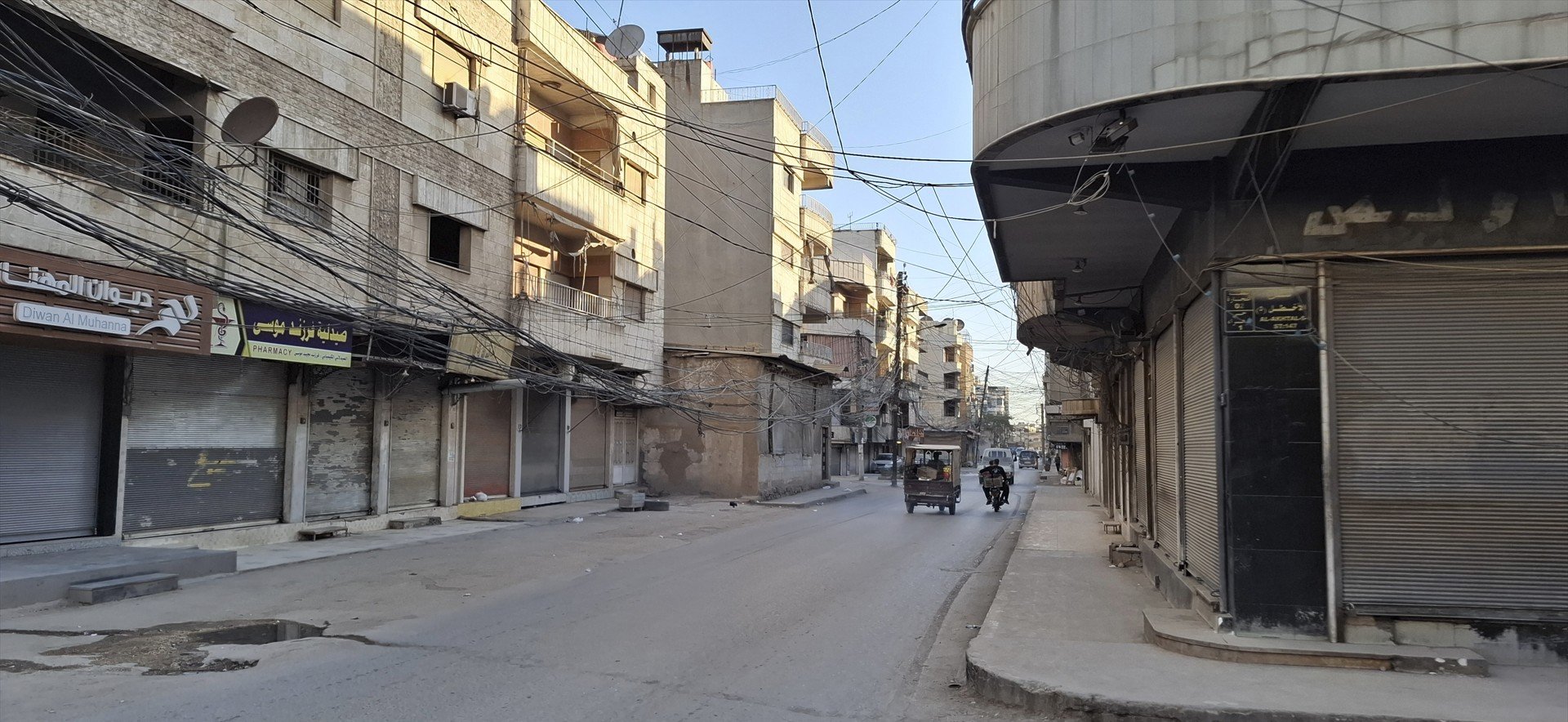
When you cross the border from Iraqi Kurdistan into the Kurdish autonomous region of Syria, called Rojava, formally the Autonomous Administration of North and East Syria (AANES), the decline in economic development is immediately noticeable. Iraqi Kurdistan has statutory autonomy, supported by the United States, and today it has its own government and military forces.
The last few years of stability and peace, particularly since the defeat of ISIS, have created a stronger investment climate, and residents have seen their quality of life increase dramatically. On the Syrian side of the border, however, the people of Rojava, including Kurds, Christians, Arabs, and other minorities, continue to struggle with ongoing violence from multiple fronts: the Damascus government, Turkey, ISIS, and other extremist cells that still launch attacks on a regular basis.
Of all the problems faced by Rojava, the main issue is the conflict with the central government in Damascus. If that conflict were settled, Damascus would likely reject Turkish interference, and the two governments could potentially cooperate to stamp out extremism. However, the Damascus government excludes Kurdish representation, actively works against Kurdish interests, and sponsors attacks on people in the Kurdish region.
The country’s new leader, Ahmad al-Sharaa, also known as Abu Mohammad al-Julani or Abu Mohammad al-Golani, who seized power in a coup in December, rose to prominence through his ties to extremist movements. He had previously broken away from ISIS and founded the al-Nusra Front (Jabhat al-Nusra), which pledged allegiance directly to Ayman al-Zawahiri, the leader of al-Qaeda Central.
His government now includes members of various extremist factions, many of which formed a coalition under Hayat Tahrir al-Sham (HTS) to overthrow Bashar al-Assad, whose family had ruled Syria for more than five decades.
Since seizing power, the al-Sharaa government has been implicated in two large-scale massacres targeting religious minorities. The first, in early 2025, occurred in Alawite villages along Syria’s western coast, where Islamist militias aligned with the new regime reportedly killed more than a thousand civilians in a campaign of retribution.
Months later, in July 2025, security forces and HTS-affiliated fighters carried out another massacre in the southern Druze province of Suwayda. Amnesty International and other human rights organizations reported that dozens of Druze civilians, including women, were executed in their homes, schools, and hospitals, while other reports placed the death toll in the hundreds.
“We are living a temporary life,” says Rokken Hussein, a Kurdish woman weary after 12 years of continuous war. First came the Syrian civil war, then ISIS, and now the HTS government. “Under Assad we had political problems, but we were safe,” she recalls. Under every evolution that followed, including the current one, their physical safety has steadily deteriorated.
Turkey also plays a significant role in the suffering of the people of Rojava. Ankara, the Turkish capital, does not want to see Syrian Kurds gain too much autonomy or economic development, viewing such progress as a threat that could inspire greater resistance among Kurds inside Turkey.
In addition to Kurds, Christians and other minorities in Rojava face attacks from extremist groups and ongoing clashes with the Damascus government’s army, while also being periodically bombed by Turkish forces.
Apart from the threats to their physical safety, residents of the region also suffer severe economic hardship. For the first forty-five minutes after crossing the border, one sees miles of unfinished apartment blocks and abandoned construction sites. According to Rokken Hussein, the reason is that commodity prices have risen so sharply that completing the projects is no longer profitable. Combined with a strong U.S. dollar and a plummeting Syrian lira, these conditions have disrupted every aspect of life in Rojava.

Rokken tells me, “Before the revolution, it was 45 lira to the dollar.” Now it is eleven hundred. Before the war, her father earned a salary of 20,000 lira per month, enough to support the family and even send three daughters to university. “He sent each of us 3,000 lira, and we were able to survive. Today, two cups of coffee cost 3,000.”
During this period of extreme inflation, wages have not kept pace. Most citizens now earn the equivalent of $100 or less per month. “It’s enough for one week,” she said, “and then what will you do the other three weeks?”
In local culture, it is customary for adult children to continue living with their parents, so a family may have four or five wage earners until the parents retire. Even so, with apartments renting for $50 to $300 a month, the cost of living remains high compared to wages. Products are expensive because almost nothing is produced in Rojava. Most goods are made in Turkey and imported through Iraq. Meanwhile, salaries in Iraqi Kurdistan are three to four times higher than in Syria.
The air quality is also terrible in the border area and in the de facto capital city of Qamishli. According to locals, this is because although Rojava has large oil reserves, it lacks the technology to refine the oil into standard-grade gasoline. As a result, cars run on low-quality fuel filled with impurities.

Rokken Hussein told me that she usually buys gasoline and lets it sit for several days before using it, allowing the sediment to settle at the bottom of the container. “One time, I just bought gas and used it. The next day, the car broke down,” she said. Using the dirty fuel that one time cost her $700 in repairs.
Electricity and water are also in short supply. In late 2024, Turkey launched airstrikes on infrastructure in northern Syria, damaging dams, power plants, and irrigation networks and leaving large areas without municipal electricity or water.
According to locals, Rojava once relied on hydroelectric plants, but those have been disabled. “When they destroyed one plant, the planes came back and blew up a second one shortly after,” says Rokken Hussein. Now there is no municipal electricity; neighborhoods and homes depend on generators, which require fuel, cost money, and worsen air pollution.
Water shortages stem largely from Turkish upstream control of the Euphrates and other rivers. Turkey has been accused of deliberately reducing water flows by dam operations, limiting how much water reaches northeastern Syria, and undermining local water access and agriculture.
Despite being rich in resources and producing a large surplus of grain that the country depends on, the Damascus government has blocked investment and neglected to develop Rojava. In addition to lacking other government services, the region has no state-run universities. Several institutes have been created by the local administration, but none are officially recognized. Consequently, students must travel to other parts of Syria to continue their education.
During the ISIS period, the government in Damascus required students from Rojava to attend universities located in ISIS-controlled areas. Students who graduated from high school and applied for university placements were sometimes assigned to study in Hasakah, then under ISIS control. “Many Arabs, Christians, Kurds, and Yazidis were afraid to go there because it was 2013 and ISIS was starting its recruiting,” explained one resident.
“Now people are still afraid to go, not only because of ISIS but because of the government. The government isn’t disciplined, some areas are controlled by groups outside its authority. If you go there and disappear, who will come asking for you?”
She added, “We do not have close relations with this new government. Even if you tried to ask about someone, you wouldn’t be speaking to the government, but to one of these groups. So people disappear, and no one knows where they’ve gone. The situation is unstable, but people here are tired of it. During the time of ISIS, it was the same. Even I didn’t go to Damascus, because they could accuse me of supporting journalists who were against them. Now it’s the same. We cannot go to Damascus, even though it’s the capital of Syria and a beautiful city. It’s such a shame that we cannot go there.”
“I think the only friend we have is the Americans,” said Rokken Hussein. “Even during the time of ISIS, if we saw the Americans, we knew we were safe.” She explained that when people in Rojava saw American trucks driving through, they felt secure because they knew Turkey wouldn’t bomb them.
“The war against ISIS was our people dying on the ground and America supporting from the air,” she recalled. Speaking about the Americans’ role today, she added, “They are the middlemen between the U.S. and this new government.”
