
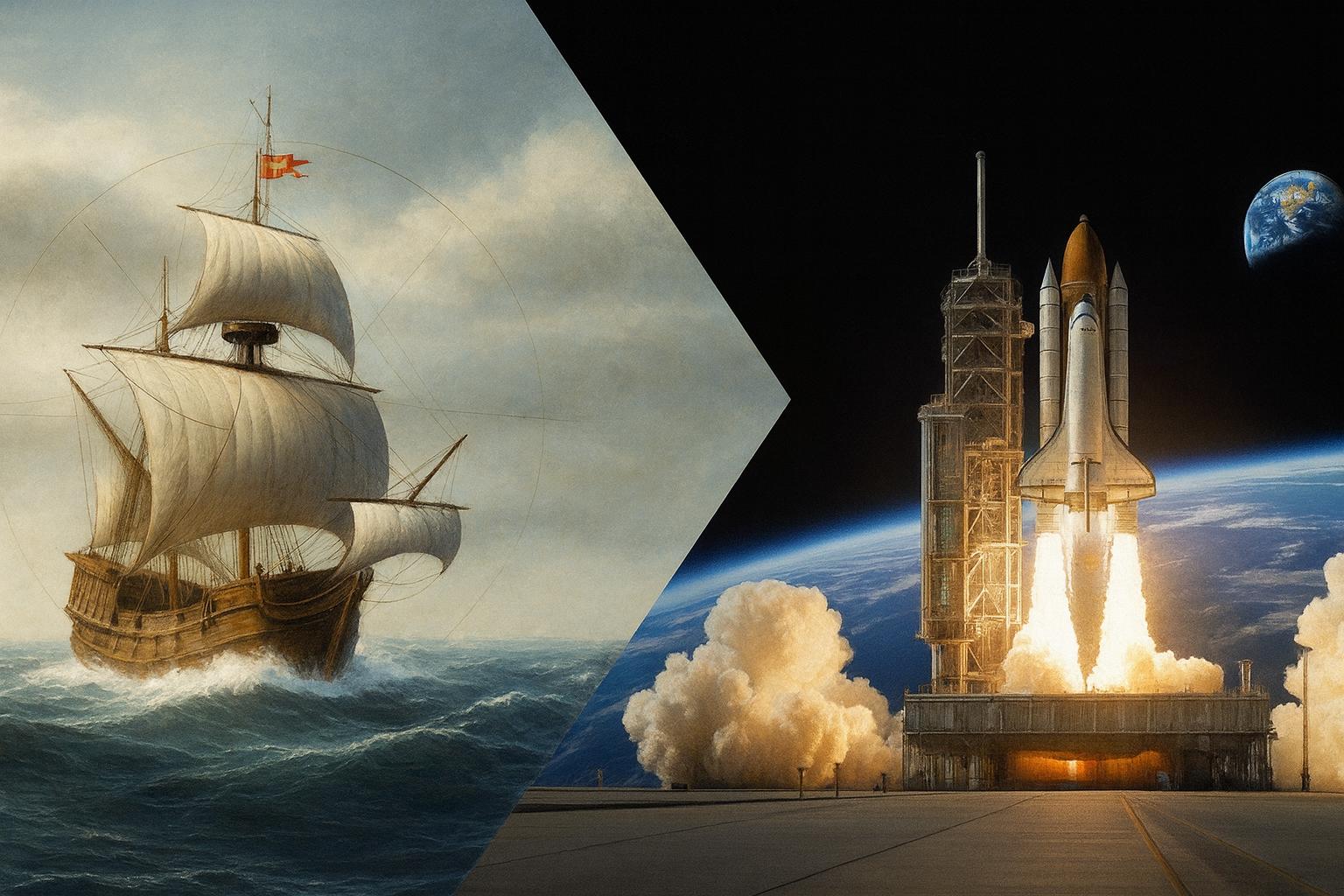
Critics argue that Columbus did not accomplish anything extraordinary, claiming he didn’t truly “discover” the New World since Indigenous peoples already lived there. But, while they knew their own lands, they did not realize they were part of a larger, connected world. Columbus’s voyage marked the beginning of that global connection, uniting continents and cultures in ways that changed history.
Unlike Vasco da Gama, who merely found a new route to already-known lands, Columbus expanded the known world itself. His discovery laid the foundation for the interconnected global civilization we now inhabit. He stands as a symbol for Western civilization and Christianity, and he can be credited for the many positive developments that followed his voyage.
Apart from Indigenous peoples, the two other groups sometimes claimed to have discovered America before Columbus are the Vikings and the Chinese.
The Vikings established short-lived settlements around the year 1000 CE but showed no interest in large-scale colonization. Their Greenland colony was still small, they lacked population pressure, and they faced resistance from native inhabitants. These settlements were eventually abandoned in the 14th or 15th centuries as the Little Ice Age set in, cutting contact with Europe after 1410. Most importantly, the Norse voyages had no lasting influence on the Americas, no maps, trade routes, or enduring exchanges resulted.
The Chinese claim centers on the theory that Admiral Zheng He reached America in 1421, but this idea is widely rejected by scholars. Historians have described Gavin Menzies’s book promoting the theory as “spurious” and “without substance,” relying on circular reasoning and lacking concrete evidence. The accepted historical record shows Zheng He’s expeditions reached East Africa and the Indian Ocean but never crossed the Pacific.
Even if the theory of a Chinese discovery of America were true, it fails the impact test, just like the Viking expeditions. There is no record that such a discovery influenced human history in any meaningful way. The Chinese made no maps, built no settlements, and launched no return voyages that would have connected their world with the Americas or altered the course of global civilization.
In sharp contrast to the Viking and Chinese claims of discovery, Neil deGrasse Tyson has called Columbus’s landing in America “the most significant event in human history.” He explained that it reunited two branches of humanity that had been separated for roughly 10,000 years since the Bering land bridge disappeared, a reunion that prevented human speciation and created one interconnected global population.
Columbus’s voyage launched what became known as the Columbian Exchange, the vast transfer of plants, animals, people, diseases, technology, and culture between the Old and New Worlds. This exchange permanently altered world history.
American crops such as corn, potatoes, and cassava revolutionized agriculture in Europe, Asia, and Africa, fueling population growth and famine resistance, especially after 1700. By reconnecting biologically distinct continents that had evolved separately since the Ice Age, the Columbian Exchange reshaped ecosystems and societies across the globe.
The European colonization that followed led to settlements like Jamestown (1607) and Plymouth (1620), which became the roots of the United States. Early colonial governance, from the Mayflower Compact to Virginia’s House of Burgesses in 1619, introduced forms of democracy and civic participation that influenced the nation’s future political culture. And in 1
George Washington was sworn in as the first president of the United States on April 30, 1789, in New York City, which was the nation’s capital at the time. He was not only America’s first president but also the first democratically elected head of state in world history. That event marked a turning point that eventually helped bring an end to the feudal systems across Europe, Asia, and Africa, which had kept most of the population poor and uneducated.
The combination of American capitalism and property rights, together with the Industrial Revolution, created a middle class and improved living standards for people around the world, and Columbus was the catalyst that set it all in motion.
Other common criticisms used to diminish Columbus’s accomplishments are easily refuted. It is often claimed that Columbus proved the Earth was round, but educated people had known this for centuries. According to historian Jeffrey Burton Russell, “no educated person in the history of Western civilization from the third century B.C. onward believed that the Earth was flat.” Greek scholars such as Pythagoras and Aristotle had demonstrated Earth’s sphericity as early as 600 B.C. through astronomical observations.
Stephen Jay Gould noted, “there never was a period of ‘flat Earth darkness’ among scholars,” since medieval thinkers universally accepted a spherical Earth. The myth that people in Columbus’s time believed the world was flat was actually invented in 1828 by writer Washington Irving in The Life and Voyages of Christopher Columbus, who added fictional flourishes to make the story more dramatic.
Columbus never set out to prove the Earth was round. His goal was practical, to find a westward route from Spain to Asia’s trade centers. While scholars already understood Earth’s shape and that Asia could theoretically be reached by sailing west, no one had ever attempted it. Columbus’s achievement was to make the idea a reality. Though he misjudged Earth’s circumference and believed Asia was much closer than it was, his voyage proved that transoceanic westward navigation was possible, a feat no one before him had accomplished.
Columbus also underestimated the size of Earth by about 25 percent and overestimated the width of Asia, believing Japan was just 8,000 miles from Spain. His calculations were wrong, but that error led to one of history’s greatest discoveries: the existence of the American continents, unknown to Europe at the time. Had the Americas not been there, Columbus might have reached Asia eventually.
Despite insisting he had reached Asia, Columbus’s voyages transformed the world. They proved that crossing the Atlantic was possible and opened the path to global exploration. The final link, a complete westward route to Asia, was achieved in 1521 when Magellan’s expedition crossed the Pacific and completed the first circumnavigation of the Earth. Columbus’s courage and vision set that chain of events in motion, forever altering human history.