
In The Singularity is Nearer: When We Merge with AI, the futurist Ray Kurzweil imagines the point in 2045 when rapid technological progress crosses a threshold as humans merge with machines, an event he calls “the singularity.”
Although Kurzweil’s predictions may sound more like science fiction than fact-based forecasting, his brand of thinking goes well beyond the usual sci-fi crowd. It has provided inspiration for American technology industry elites for some time, chief among them Elon Musk.
With Neuralink, his company that is developing computer interfaces implanted in people’s brains, Musk says he intends to “unlock new dimensions of human potential.” This fusion of human and machine echoes Kurzweil’s singularity. Musk also cites apocalyptic scenarios and points to transformative technologies that can save humanity.
Ideas like those of Kurzweil and Musk, among others, can seem as if they are charting paths into a brave new world. But as a humanities scholar who studies utopianism and dystopianism, I’ve encountered this type of thinking in the futurist and techno-utopian art and writings of the early 20th century.
Techno-utopianism’s origins
Techno-utopianism emerged in its modern form in the 1800s, when the Industrial Revolution ushered in a set of popular ideas that combined technological progress with social reform or transformation.
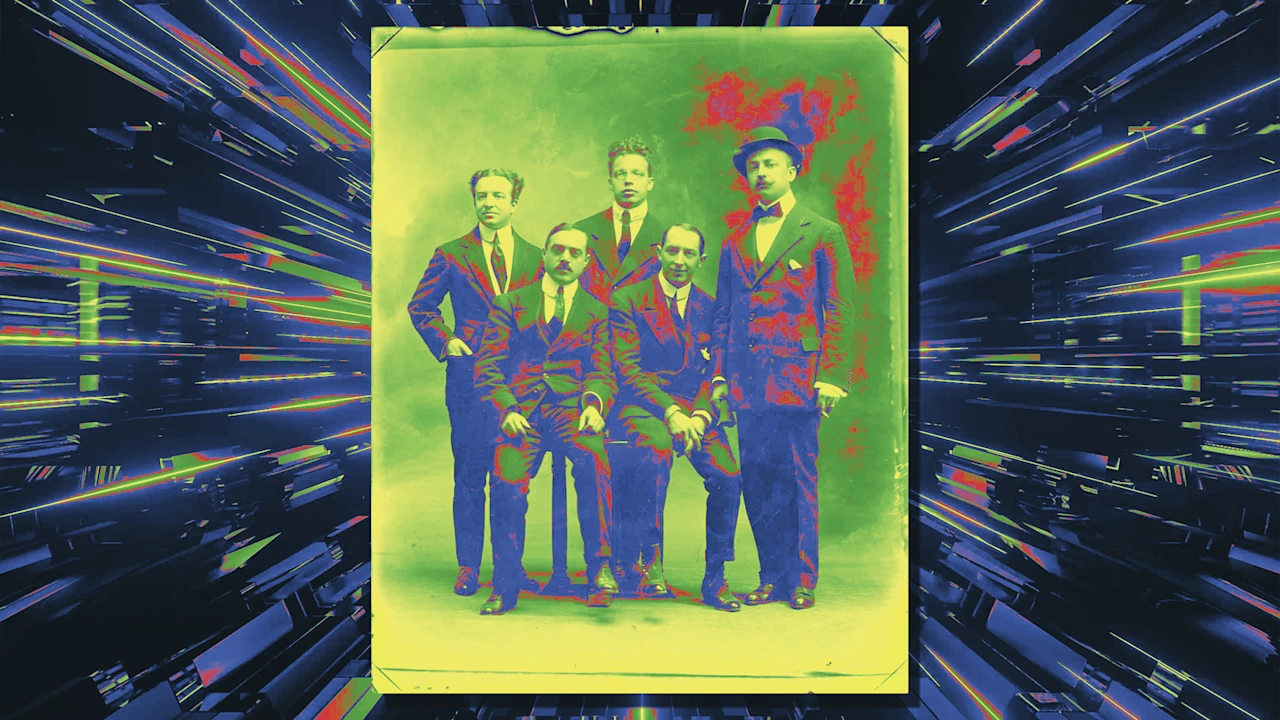
Kurzweil’s singularity parallels ideas from Italian and Russian futurists amid the electrical and mechanical revolutions that took place at the turn of the 20th century. Enthralled by inventions like the telephone, automobile, airplane, and rocket, those futurists found inspiration in the concept of a “New Human,” a being who they imagined would be transformed by speed, power, and energy.
A century ahead of Musk, Italian futurists imagined the destruction of one world, so that it might be replaced by a new one, reflecting a common Western techno-utopian belief in a coming apocalypse that would be followed by the rebirth of a changed society.
One especially influential figure of the time was Filippo Marinetti, whose 1909 “Founding and Manifesto of Futurism” offered a nationalistic vision of a modern, urban Italy. It glorified the tumultuous transformation caused by the Industrial Revolution. The document describes workers becoming one with their fiery machines. It encourages “aggressive action” coupled with an “eternal” speed designed to break things and bring about a new world order.
The overtly patriarchal text glorifies war as “hygiene” and promotes “scorn for woman.” The manifesto also calls for the destruction of museums, libraries, and universities and supports the power of the rioting crowd.
Marinetti’s vision later drove him to support and even influence the early fascism of Italian dictator Benito Mussolini. However, the relationship between the futurism movement and Mussolini’s increasingly anti-modern regime was an uneasy one, as Italian studies scholar Katia Pizzi wrote in Italian Futurism and the Machine.
Further east, the Russian revolutionaries of 1917 adopted a utopian faith in material progress and science. They combined a “belief in the ease with which culture could be destroyed” with the benefits of “spreading scientific ideas to the masses of Russia,” historian Richard Stites wrote in “Revolutionary Dreams.”
For the Russian left, an “immediate and complete remaking” of the soul was taking place. This new proletarian culture was personified in the ideal of the New Soviet Man. This “master of nature by means of machines and tools” received a polytechnical education instead of the traditional middle-class pursuit of the liberal arts, humanities scholar George Young wrote in The Russian Cosmists. The first Soviet People’s Commissar of Education, Anatoly Lunacharsky, supported these movements.
Although their political ideologies took different forms, these 20th-century futurists all focused their efforts on technological advancement as an ultimate objective. Techno-utopians were convinced that the dirt and pollution of real-world factories would automatically lead to a future of “perfect cleanliness, efficiency, quiet, and harmony,” historian Howard Segal wrote in Technology and Utopia.
Myths of efficiency and everyday tech
Despite the remarkable technological advances of that time, and since, the vision of those techno-utopians largely has not come to pass. In the 21st century, it can seem as if we live in a world of near-perfect efficiency and plenitude thanks to the rapid development of technology and the proliferation of global supply chains. But the toll that these systems take on the natural environment—and on the people whose labor ensures their success—presents a dramatically different picture.
Today, some of the people who espouse techno-utopian and apocalyptic visions have amassed the power to influence, if not determine, the future. At the start of 2025, through the Department of Government Efficiency, or DOGE, Musk introduced a fast-paced, tech-driven approach to government that has led to major cutbacks in federal agencies. He’s also influenced the administration’s huge investments in artificial intelligence , a class of technological tools that public officials are only beginning to understand.
The futurists of the 20th century influenced the political sphere, but their movements were ultimately artistic and literary. By contrast, contemporary techno-futurists like Musk lead powerful multinational corporations that influence economies and cultures across the globe.
Does this make Musk’s dreams of human transformation and societal apocalypse more likely to become reality? If not, these elements of Musk’s project are likely to remain more theoretical, just as the dreams of last century’s techno-utopians did.
Sonja Fritzsche is a senior associate dean and professor of German studies at Michigan State University.
This article is republished from The Conversation under a Creative Commons license. Read the original article.