
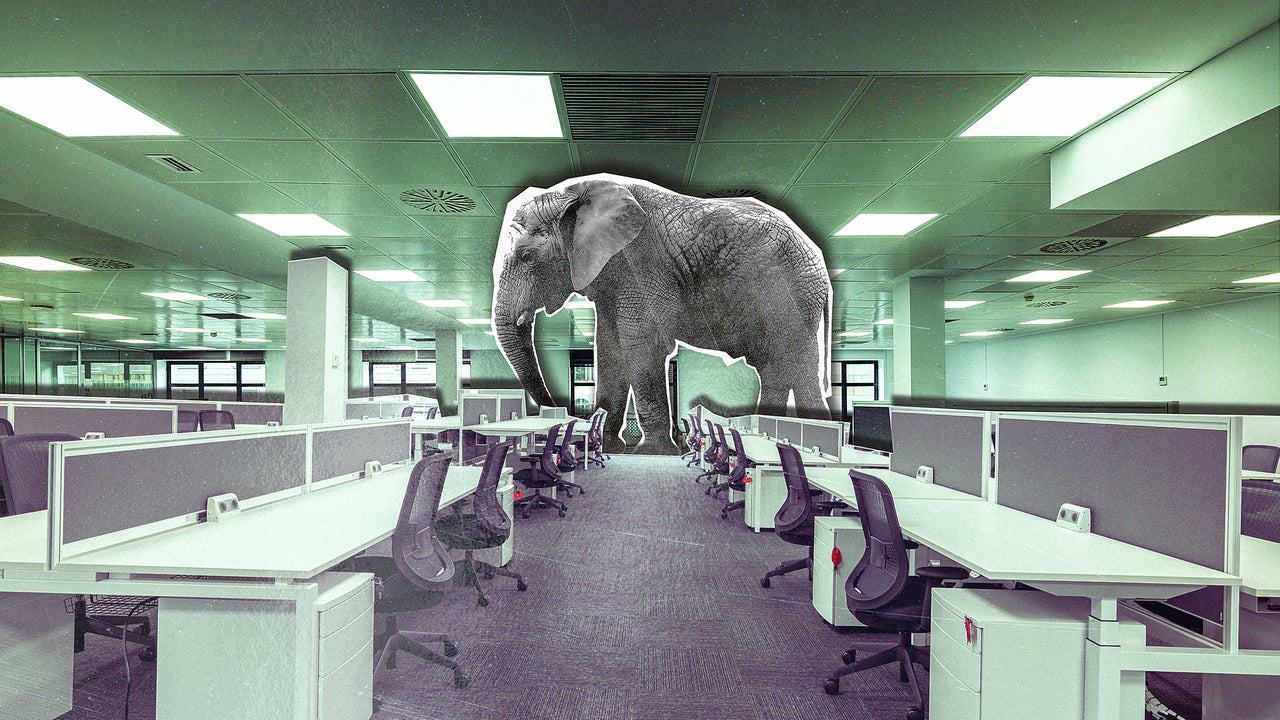
You know the moment. Someone says something in a meeting, or fails to say it, and the room goes quiet. People study their notebooks. Someone reaches for their phone. The conversation moves on, a little faster than it should.
Nothing happened. That is exactly the problem.
Most leaders treat such silences as awkward gaps to be bridged. And they are gaps: something should be there, and isn’t. What should be there is the thing that everyone is avoiding. What we avoid does not leave the room. It settles into how people behave, what they will risk, how much of themselves they bring to work. Over time it drains the energy of everyone present, including the person at the front who chose to let it pass.
In thirty years of working with leaders, and plenty of years getting it wrong myself, I have found that awkward silences tend to be a way of avoiding three conversations.
1. The elephant
This is the conversation everyone knows is needed and nobody will start. The well-liked colleague who is underperforming and costing the company far more than money. The strategy that stopped making sense a year ago and is still being blindly pursued. The elephant is rarely a secret. Everyone can see its grey and wrinkly mass. The cost is the energy spent walking around it, week after week, pretending the room is empty—and what it blocks that might otherwise be possible.
Naming the elephant is simpler than it feels. You do not need a grand confrontation. You need one person willing to say, without blame, what everyone already knows. “I think there’s something we keep not discussing here.” That sentence gives the rest of the room permission to breathe.
2. The hangover
A hangover is a past event that still shapes how people behave. A botched reorganisation. A leader who departed under a cloud. That Covid-era downsizing where valued colleagues left and were never replaced in kind. The event is over, but its impact lives on in the caution, the cynicism, the quiet assumption that this is how things get done around here.
The trap is treating present behaviour as a present problem. People are not being difficult. They are protecting themselves from something that already happened, which still shows up in their thinking and their nervous systems. The move is to name the history, not relive it. “I know the last change wasn’t handled as well as it might have been. Here is what I’ll do differently.” Acknowledgement does most of the work. People rarely need the past fixed. They need it seen.
3. The cupboard under the stairs
The first two are conversations waiting to happen. This one is a conversation that has been ruled out. Somewhere along the way, without anyone ever saying so, the organisation decided that a particular subject was not to be raised. The door was shut, and a tacit agreement formed to keep it that way.
Think of the colleague whose performance everyone has privately written off, but whose name nobody will say out loud, because they have been there twenty years, or they are going through something difficult, or they are senior enough that raising it feels like a career risk. Everybody navigates around them. Nobody names it. The perceived kindness has become the lock on the door.
The contents are usually some form of shame: a serious mistake, a failure whose honest account flatters no-one, conduct that everyone has agreed to work around. And shame with nowhere to go does not stay put. It leaks out sideways: as blame, as defensiveness, as lashing out at the oddest moments.
The only way to clear a cupboard is to open it, in daylight, with someone you trust. More often than not the contents turn out smaller than the dread suggested. The fear of what’s lying in wait was doing more damage than the thing itself.
What avoidance actually costs
Years ago I started a business with someone I admired and liked. From the first meetings I had a quiet sense that something was off—the foundations, the terms, the way we made decisions. But I ignored it, because the venture was exciting and raising any of it felt like a threat to the relationship. So I avoided the conversations that sense was pointing to. One at a time, then all at once.
It cost me the business, the friendship, and a fair amount of self-respect. None of it was a strategy problem. It was a run of conversations I chose not to have, each one small enough to put off, until the bill came due.
I once described the experience as living with an elephant with a hangover and trying to stuff it into a cupboard. It wasn’t my most successful strategy.
That is the part most of us miss. Avoidance feels like the safe, considerate option. But it isn’t. The conversation you are not having is still happening, in everyone’s head, and it is using up the very energy you need for the work. Silence is never free. You pay for it in the slow draining away of trust from people who deserve better.
The skill is not eloquence. It is willingness. To say the true thing, in plain speech, a little before you feel ready. Do that, and the energy you have been spending to keep the room comfortable comes back.